
Access to justice

ACCESS TO JUSTICE
“Real justice requires more than just laws on paper. We want to make sure that systemic barriers are dismantled, so that the right to fair restitution becomes reality for all migrant workers.” – Mizue Sauco, TWC2 Legal Officer
TWC2 tackles barriers in the legal system to ensure that all mistreated workers can seek justice. We closely examine applications of the law, work with allies to set important precedents, hold errant lawyers to account, and shine a light on issues within justice processes.
In Singapore, when workers face employment-related disputes, they have two main avenues for recourse. Disputes such as salary and wrongful dismissal claims are first addressed through the Tripartite Alliance for Dispute Management (TADM) and then, if needed, at the Employment Claims Tribunals (ECT).
Workers are usually required to first attend mediation at TADM, which helps workers and employers negotiate settlements without going to court. If mediation fails, workers may proceed to the ECT, a specialised court that hears employment disputes and issues legally binding decisions.
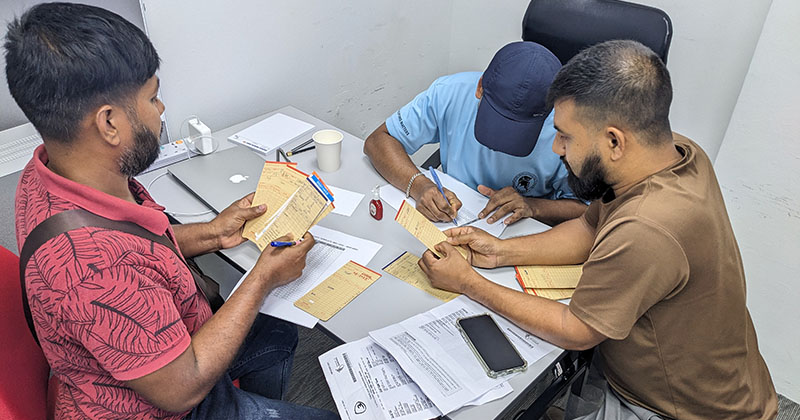
Workers at TWC2 calculating their unpaid overtime hours, prior to filing their claims.
TWC2 closely scrutinises how these systems operate in practice, challenging procedural barriers, mediation practices, and legal interpretations at TADM and the ECT that may prevent workers from fully accessing justice.

Setting legal precedents
TWC2’s legal advocacy goes beyond individual casework. We strategically support cases that can clarify the law and set precedents at the highest levels of the legal system. Through partnerships with pro bono lawyers, we have achieved landmark rulings in the High Court that protect workers from similar injustices in future.
Such cases often require years of perseverance, and we extend special thanks to our volunteers, partners, and all workers whose courage inspires this work.
We also track High Court rulings on other salary cases, and use these rulings to inform our approach to casework.
Enhancing legal scrutiny
TWC2 investigates the finer points of law that can strengthen a worker’s salary claim. These are often points that are sometimes overlooked at the Tripartite Alliance for Dispute Management (TADM), whose officers have mistakenly dismissed cases because of a lack of expertise. Our team systemically identifies potential cases, tracks outcomes, accumulates the needed experience, and crafts methodologies to build successful claims for workers.
Examples of occasions when we have spoken up:
Click on the following tabs to read about the legal points we currently scrutinise:
Legal points we currently scrutinise
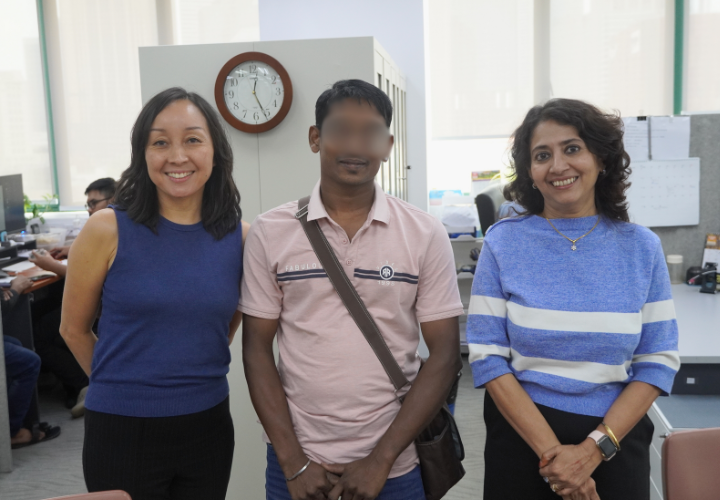
A worker who received a settlement payment on the day of his first court hearing, with TWC2 Legal Officer Mizue Sauco (left) and volunteer interpreter (right).
Improving the ECT process
In 2017, the Employment Claims Tribunal was established to replace Singapore’s Labour Court, and is a low-cost legal avenue for workers to pursue an expanded range of employment claims. TWC2 has since worked to document persistent challenges faced by migrant workers when navigating the ECT process. By highlighting structural barriers within it, we are pushing for shifts that make the system more accessible to low-wage workers.
- 2026: TWC2 report on the barriers of entry at the ECT.
- 2026: TWC2 report on the enforcement gap of ECT orders.
- 2026: TWC2 commentary on the 2026 proposal of new law on civil judgement enforcement.
- 2026: ST forum letter on improving access to justice at the ECT
- 2019: MOM adopts our recommendations on adverse inference
- 2019: TWC2 forum letter on bosses ignoring ECT orders
- 2018: TWC2 highlights non-enforcement of ECT order
- 2018: TWC2 critiques Tribunal outcome
- 2017: Recommended improvements on Tribunal order enforcement
- 2016: TWC2 submission on proposed Employment Claims Tribunal
Challenging unfair practices
The basis for issuing stern warnings is loose and opaque; factually innocent people can be slapped with warnings, and then be administratively penalised. This has a disproportionate impact on migrant workers, who can lose the chance to earn a livelihood in Singapore. TWC2 strongly urges a review of the stern warning system.
Some case studies:
- Bangladeshi shipyard worker who was acquitted with Stern Warning, 2022
- Indian construction worker who was acquitted with Stern Warning, 2021
- Stern Warning for a bike thief who didn’t do it, 2015

TWC2 advises an injured worker (arm in sling) about the injury compensation process, so he knows he doesn’t need a lawyer.
Holding lawyers to account
While we hold our friends and colleagues in the legal profession in the highest regard, there are also errant lawyers and paralegals who take advantage of migrant workers. Over the years, we have highlighted such cases of misconduct to the Law Society, and led to serious professional consequences for such lawyers.
In 2024, Joseph Chen was disbarred after neglecting a worker’s injury case for nine months, resulting in its discontinuation without the worker’s knowledge. Read more on our website and the ST.
In 2023, Saha Ranjit Chandra, a paralegal who had been associated with now-disbarred lawyers Charles Yeo and Joseph Chen, was charged in court for insurance fraud. More here.
In 2022, the High Court found serious ethical lapses by lawyer Subbiah Pillai, who defrauded a worker of his insurance compensation settlement. The worker only received his money 8 years after the initial settlement payout, when his application to the Law Society Compensation Fund was approved, thanks to the help of our probono network. Read more about the case on Legal Wires.