
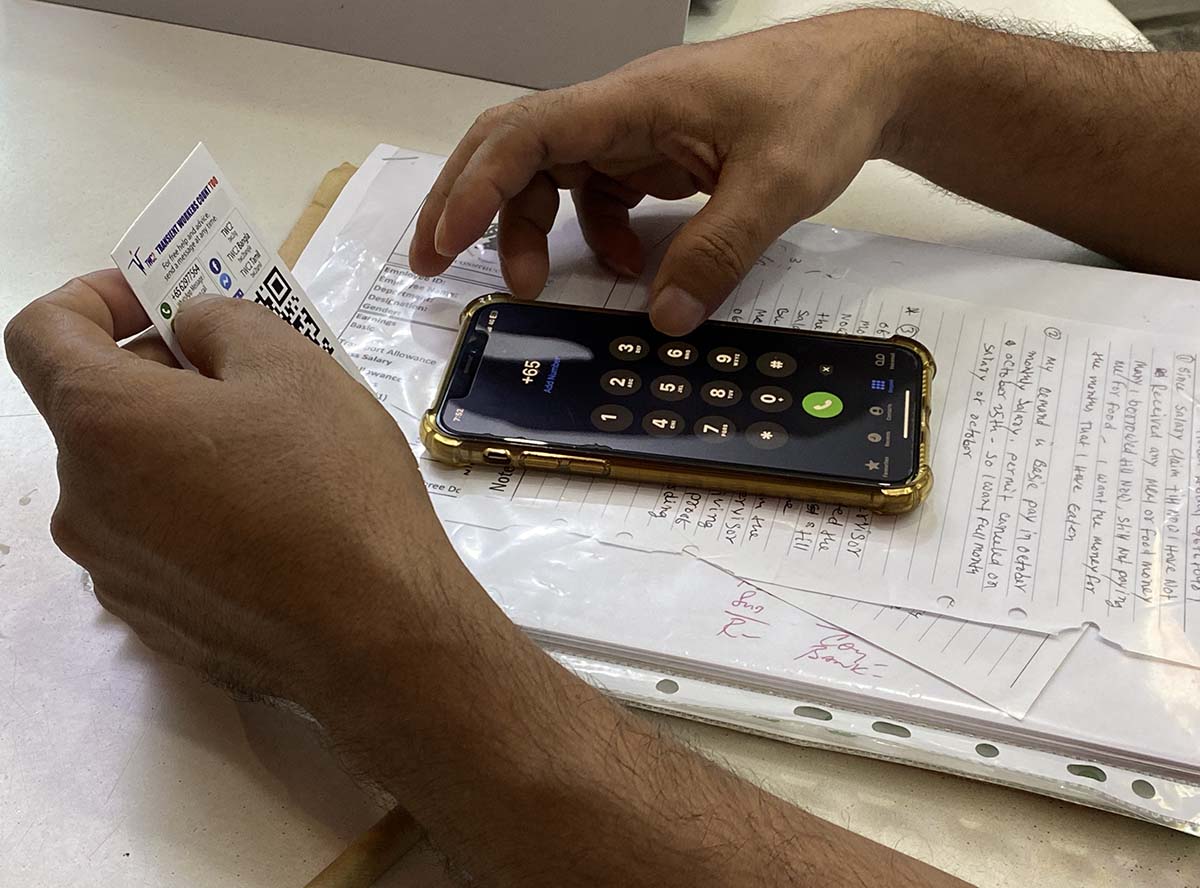
Lutfor storing TWC2’s helpline number into his phone.
I arrive at TWC2’s Cuff Road Project on a weekday evening. A queue of workers has already formed ahead of the 6:30pm start time. Patiently they wait for TWC2 volunteers to set up and then address their work-related issues.
A Bangladeshi by the name of Lutfor (not his real name) sits down with a fellow volunteer responsible for registering particulars and understanding the issues the worker has. Lutfor has a stack of papers, which he lays onto a plastic sheet on the table, but which he guards tightly near to his chest. They must be precious. Carefully, he takes out the contents in order to explain his situation to the volunteer.
On 17 May 2024, MOM responded to this article saying it contains “inaccuracies and misinformation”. In the post-script below, we show how there is nothing inaccurate here, for what MOM says in its response only confirms our story.
Lutfor says he has been shortpaid his salary by his employer, a company we will call SagaCity. He was first in Singapore in 2018, but has been working for SagaCity since October 2022. Unfortunately, his employer did not give him his agreed salary, providing various excuses to delay the payment. Eventually, Lutfor decided to take matters into his own hands and filed a salary claim with MOM in July 2023. Unusually, he continued working for SagaCity till the expiry of his Work Permit in September 2023, unlike most other workers who have filed salary claims and find their work permits promptly cancelled.
Nonetheless, Lutfor has been jobless since September, relying on borrowed money from fellow workers for survival.
The claims process
After a worker files a salary claim with MOM, the Tripartite Alliance for Dispute Management (TADM) sets up mediation sessions between employer and employee to see if an amicable settlement can be reached. TADM is the unit of MOM that handles salary disputes. This stage was from early-November 2023 to December 2023. Lutfor and his employer could not agree on a settlement.
The matter was then escalated to the next stage, the Employment Claims Tribunal (ECT), part of the State Courts. This was done when TADM issued Lutfor a Case Referral Certificate, which is a form documenting all claim amounts for which judgement by the ECT is sought. At this ECT stage, precision in claims computation and evidence are required, in keeping with judicial norms, so the Certificate must be accurate. Since TADM had been assisting Lutfor this far, it was TADM which drew up the numbers on the Certificate, performing calculations for the claim amounts based on details provided by Lutfor, and within the provisions of law.
The ECT process begins with one or more Case Management Conferences, the first of which was held in late-December 2023, and the second in early January 2024. The purpose of Case Management Conferences is to ensure that the evidence, etc are properly organised before the hearings begin.
At the second of these sessions, the ECT Registrar pointed out errors in the calculations of the claim amounts, largely relating to overtime pay. Lutfor was advised to go back to TADM to get them corrected before the next Case Management Conference on 24 January 2024. Lutfor will have to present an amended Case Referral Certificate.
Lutfor’s confidence was shaken. How could TADM get the computations wrong? Weren’t they supposed to be the experts in employment law? What other errors are lurking within his papers?
Lutfor had heard of TWC2 from a friend and decided he would rather trust TWC2. Out of courtesy, he informed TADM that he was going to consult with TWC2, and TADM gave him its blessing.
On the table
Lutfor’s collection of documents that he placed on the table this evening is an impressive collection, including a copy of his In-Principle Approval for a Work Permit (IPA) – which serves as a reference for his rightful salary – screenshots of various Whatsapp messages, and his own calculations of the amounts he was owed each month. I wonder how much trouble he went through to put it together.
But smart though Lutfor may be in making his own “first cut” calculations, they are not suitable for submission to the ECT. This is because the numbers to be put on a Case Referral Certificate must comply with a required format and with the definitions in the Employment Act. No low-wage migrant worker is going to be able to do that.
As amazing as the product of his diligence, is that TADM, which should have been able to do that, came up with claim totals that the ECT Registrar rejected as erroneous.
Who to turn to?
“I didn’t know there is TWC2”, he says with a mix of exasperation and regret. He should have come to us earlier.
Lutfor’s is not the first case where TWC2 has had to correct errors made by TADM, and then try to get TADM to issue revised Case Referral Certificates based on our more careful calculations. This is nothing new to us.
Our volunteer explains to Lutfor how we are going to assist him, starting with how he has to show up at our main office tomorrow morning with all his papers so that we can recalculate everything from scratch.
I see tears welling up in Lutfor’s eyes. I think there is a sense of relief, and deep in me I rejoice too that he has found a bit of light at the end of an anxious day.
The next morning, Lutfor shows up at TWC2’s office, spending several hours with us. We compute his claim quanta from the raw data, based on his time cards, and teach him how each number was derived, so that, later on, he can explain and defend these numbers in court.
In the late afternoon the same day (9 January 2024), he is sent straight to TADM to get an amended Case Referral Certificate.
Later, we will train Lutfor how to argue his case in court clearly and cogently. Most common folks have no idea how to speak in court and the worst thing would be to ramble off-topic. As migrant workers typically have a weak command of English, they may need to rely on translators, but speaking through translators is also a skill, requiring one to shape one’s sentences in an easily translatable way. We have to teach that too.
How many more?
I wonder how many workers know about the process of salary claims in Singapore, and how many workers are like Lutfor, on the lonely path of dealing with the problem themselves. Granted, Singapore has structures in place to protect these workers from unfair employment practices. However, what seems to be evident is that the execution of the structures is far from perfect, as seen from the inaccurate calculations by TADM in this case.
Salary calculations are complex, and workers may not be able to compute their claims correctly, therefore TADM assists them with the calculations. However, calculations can be faulty as workers may not be able to clearly articulate the history of their salaries or explain what the various pieces of paper (potential evidence) mean. Company documents also vary in quality and structure, increasing the difficulty of interpretation.
At TWC2, we typically spend hours with each salary claimant going over his papers and statements, checking and cross-checking the numbers. This is the effort needed to produce a set of numbers in which we can have confidence. We don’t know if the same amount of care is possible at TADM.
For now, TWC2 is a safeguard. However, as one of the best societies in the world, it is a little embarrassing when the courts spot mistakes and reject calculations made by a State unit such as TADM. I am optimistic that we can do better.

23 May 2024
On 17 May 2024, MOM responded to this article and its twin article No popping of champagne after salary claim victory with a statement accusing TWC2 of “inaccuracies and misinformation”.
There was no inaccuracy or misinformation in what we wrote. Even a close look at MOM’s statement reveals no specific difference of fact. Instead, what MOM appears to prefer is for the story to be telescoped such that they would appear prompt in delivering the service that the worker wanted, whereas our story highlighted the delays and obstacles in getting the desired outcome. MOM’s beef seems to be that we are not playing ball by putting out a sanitised version of the story.
There is no dispute about the fact that the original Case Referral Certificate (CRC) that TADM produced for the worker Lutfor did not reflect what he wanted to claim. At the Employment Claims Tribunal, the CRC was thus considered erroneous and sent back for amendment.
With TWC2’s assistance, a new set of calculations was produced reflecting Lutfor’s wishes. Lutfor went back to TADM on or around 4 January 2024 to ask that these new figures be reflected on the amended CRC.
It would have been the simplest thing to incorporate the new numbers into an amended CRC.
Yet, it would take two weeks to get this done. Our story mentioned this delay. MOM’s statement, read between the lines, also hints at a delay. In those two weeks, Lutfor and TWC2 made repeated requests for action including an email we sent dated 18 January. We were concerned about having to meet Tribunal deadlines. The fact that we had to make repeated requests was a good basis to surmise that there was resistance to making the changes, though we stated in our story that we did not know why there was resistance.
It is almost amusing to read MOM’s preferred and telescoped way of telling the story. They wrote “After attending a session at the Employment Claims Tribunals, Luftor asked TADM to amend the Claim Referral Certificate to a different claim amount. TADM did so accordingly” – as if making the change was the smoothest thing in the world, glossing over the difficulties Lutfor faced in getting his wishes recognised.
MOM in its response has revealed something of what was going on – conflicting impulses behind their processes. On the one hand, MOM’s statement said TADM maintains “neutrality in the claims process and register the claims according to what the claimant intends”, and for this reason TADM “issued a Claim Referral Certificate based on his intended claim amount.” Ultimately.
But, the original CRC was rejected by the Tribunal because it did not reflect Lutfor’s claim intentions. Why this was so is hinted at in MOM’s response, when they said, “The TADM mediator had gone through Lutfor’s documents, alongside with employer’s documents to verify the claim amount. However, Lutfor did not accept the TADM mediator’s verified claim amount, and sought to claim for an amount that he had independently derived.”
In other words, TADM decided for Lutfor how much he should claim based on TADM’s reading of the materials, which is rather contrary to the earlier claim of “neutrality”.
Even after Lutfor was sent back to TADM by the Tribunal to get the CRC amended, “TADM had requested for clarity and the reasons behind the Employment Claims Tribunals’ instructions to amend the Claim Referral Certificate”, said MOM in its statement, underscoring once again that TADM’s impulse was to act as gatekeeper to assess and control how much Lutfor could claim.
It looks as if these conflicting notions of TADM’s role played a part in the delay.
As the foregoing discussion shows, for MOM to take issue with our characterisation of the events as “resistance” is belied by their own account of what was happening on their side behind the scenes.
This is the public service rendered by TWC2 when we publish stories in such detail, even if they are not the sanitised versions public servants prefer. We shine a light on what goes on in gritty detail. In the process we raise good questions, such as this one here: Is it any business of TADM to try to decide for the worker what he or she can claim at the Tribunal?