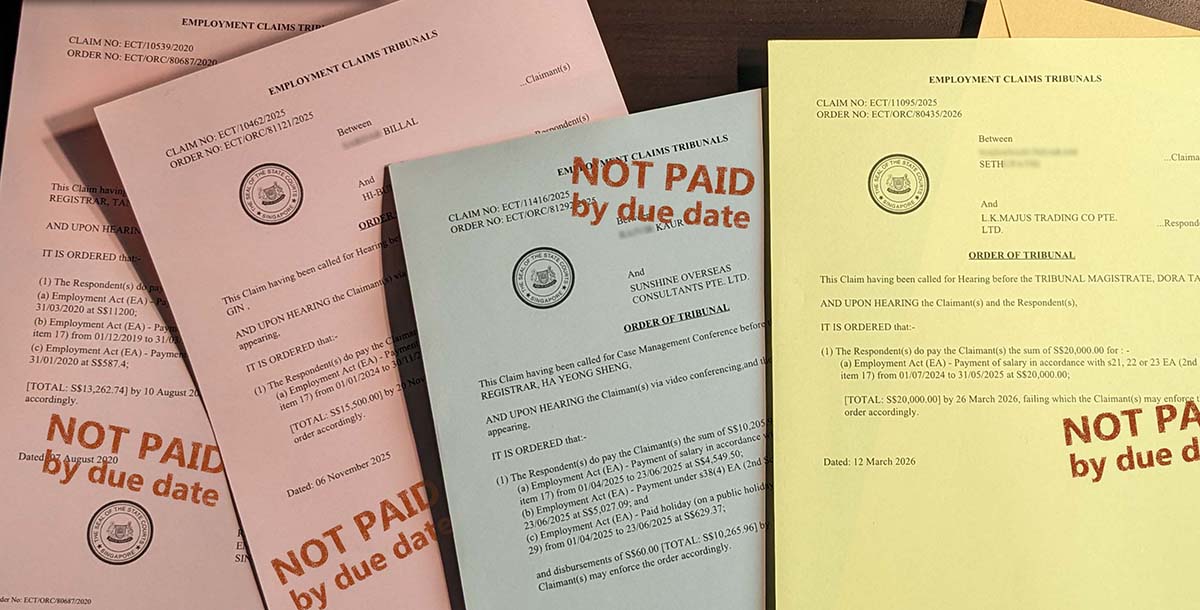
This report examines how fair the salary claims process in Singapore is. It focuses particularly on whether legal victories translate into meaningful financial outcomes for migrant workers who file salary claims. Whilst Singapore’s salary claims framework, administered through the Tripartite Aliance for Dispute Management (TADM) and adjudicated by the Employment Claims Tribunal (ECT), crucially provides a formal avenue for dispute resolution, this study finds that significant gaps remain between legal recognition and material outcomes.
The findings of this report draw from qualitative interviews conducted by the researcher during her internship at Transient Workers Count Too (TWC2). The researcher interviewed three groups of workers whose salary claims reached different conclusions:
- workers who settled during mediation for less than the amount they had initially claimed;
- workers who obtained favourable rulings from the Employment Claims Tribunal (ECT) but received no payment due to employer bankruptcy or abscondment; and
- workers who similarly obtained favourable ECT rulings and whose employers were also uncontactable or bankrupt, but who received partial or full compensation through the security bond insurance mechanism.
By analysing outcomes across these groups, this report highlights how the practical enforcement of legal victories through wage recovery shapes workers’ experience of fairness more than procedural access alone.
The findings show that the near-impossibility of enforcing Tribunal Orders (TOs) is a central weakness of the current system. Many workers interviewed who had “won” their cases were ultimately unable to recover the full wages they were owed, as they lacked the financial means to pursue enforcement and had limited access to institutional support. This enforcement gap not only undermines the practical value of legal rulings but also influences workers’ behaviour earlier in the claims process.
This report also finds that workers face significant hardship whilst their cases are ongoing. During this period, most workers are unable to work and earn an income, and support from former employers is often minimal or entirely absent.
Even in the rare cases where workers eventually recovered the full amounts they were owed, these sums were often insufficient to make up for months of lost income and the debt they accumulated during the claims process.
The report (14 pages, PDF) can be downloaded by clicking the icon at right.