
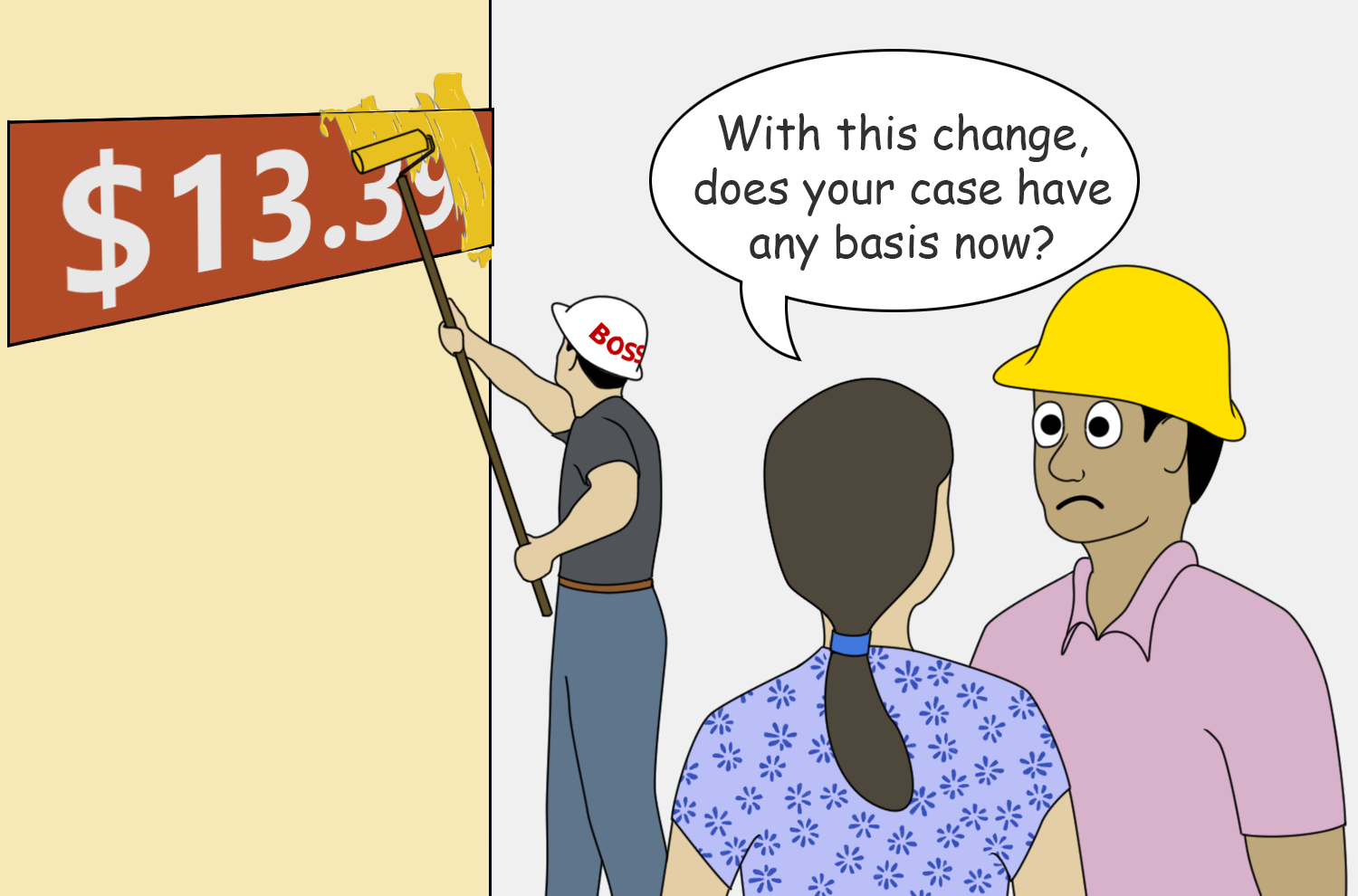
Midway through the TADM mediation session, the boss spoke with the TADM officer in Chinese, a language Kamal (name changed) did not understand. TADM is the Tripartite Alliance for Dispute Management, a unit related to the Ministry of Manpower (MOM) that handles employment-related claims. Its role is to try to get parties to arrive at an amicable settlement but, as in good mediation practice, the mediator also has to guide parties as to the law. They should not be endorsing any settlement that is in contravention of law or that is reached through violation of lawful process.
Kamal had submitted a claim that mostly arose from short-payment for the overtime hours he had put in. To understand the basis for his claim and why we found the outcome at TADM troubling, it is necessary to recall the history of his recruitment and a few specific salary numbers involved, which we will detail a bit further down.
Our concerns were raised when Kamal told us that after the boss had spoken to the TADM mediator, the mediator told him (Kamal) that the overtime rate in the In-principle Approval letter (IPA) had been “corrected” by the boss about three months into Kamal’s employment. Consequently, Kamal’s claim for short-paid overtime could not stand since it was entirely based on the original (and now suppressed) overtime rate stated in the IPA.
The mediator advised Kamal to withdraw the bulk of his claim (relating to overtime) leaving only a tiny portion of it relating to working on a public holiday (Deepavali, 20 October 2025). The latter bit was settled with the boss paying him seven dollars. Kamal withdrew his overtime claim.
In our opinion, based on this account from Kamal, the mediator was wrong to accept a late “correction” of the overtime rate. The advice to Kamal to withdraw his claim was therefore incorrect.
At recruitment
In June 2025, Kamal was negotiating with the boss of a construction company for a new job. Kamal was then in Singapore, not in Bangladesh; he was exiting from an earlier job here. No agent was involved and Kamal was speaking or messaging directly with the boss over the terms of employment, so there wasn’t a third party responsible for any miscommunication that might follow. Kamal asked for a basic salary of $36 per day, which the boss verbally agreed to. This would be roughly equivalent to $936 a month.
However, when the boss sent him a copy of the IPA after MOM issued it, Kamal noticed that the basic salary there was only $570. He asked the boss why. We don’t know if the boss addressed Kamal’s query directly, but the boss pointed to the unusually high rate for overtime hourly pay ($13.39) as his way of “honouring” the agreement.
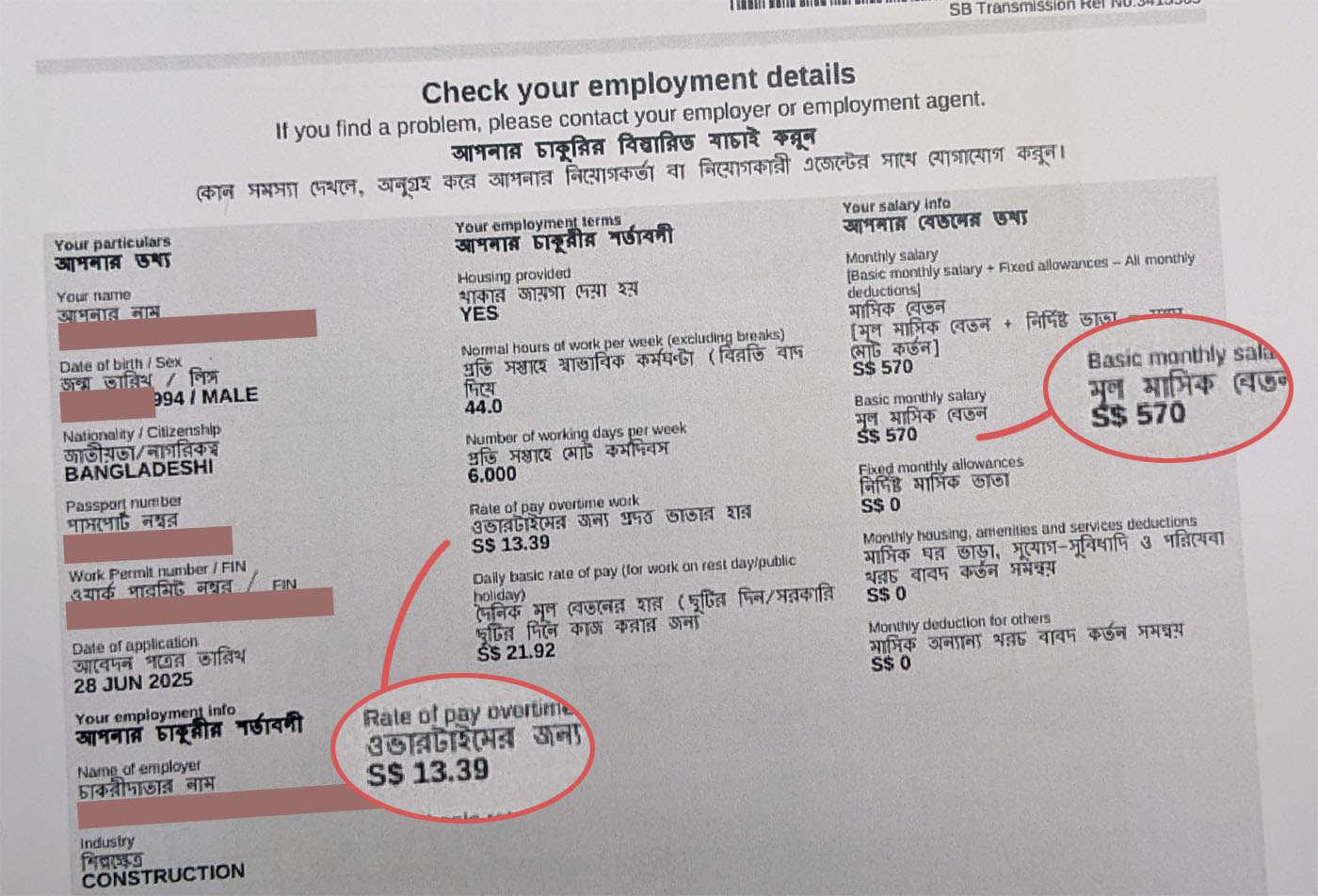
The In-principle Approval was generated by MOM, with details submitted by the employer
In Singapore, it is almost universally the practice for companies to apply an overtime rate of pay that is 1.5 times the basic hourly rate of pay. In this case, since the $570 monthly basic is equivalent to an hourly rate of $2.99 (based on the formula set out by the Employment Act), then 1.5 times that would mean an overtime rate of $4.48 per hour. However, a higher multiple (such as the $13.39 in Kamal’s IPA) is possible and the law allows for it, as we will show below. So, when the employer entered $13.39 as Kamal’s overtime rate in the IPA application, MOM’s system accepted it as a valid entry. Once the boss signed off on his IPA application, it would be considered fixed, even if it had been a typographical mistake.
Except that, hearing Kamal’s account, it was not likely to have been an inadvertent error. The fact that boss used the figure in the IPA ($13.39) to deflect Kamal’s query about a lower-than-agreed salary meant that the boss was fully aware that $13.39 was the figure he had submitted to MOM, unusually high though it was.
Transcript:
TWC2: When were you negotiating for this job? Was it last year?
Kamal: Ya. Last year, middle of the mo…
TWC2: Middle of the?
Kamal: Year.
TWC2: Middle of … year. And, er, were you in Bangladesh at that time?
Kamal: No. I’m in Singapore. I’m talking with the boss directly.
TWC2: You were talking directly with the boss.
Kamal: Yes.
TWC2: And was it the agent or the boss who sent you the IPA?
Kamal: My boss sent to me the IPA.
TWC2: By WhatsApp?
Kamal: Ya. By WhatsApp.
TWC2: Now, what was the salary – the basic salary – that you agreed with the boss?
Kamal: Basic salary is the thirty six.
TWC2: Per day?
Kamal: Ya. Per day.
TWC2: So, per month it is nine three six, right?
Kamal: Nine three six.
TWC2: Yes, nine three six. But… however, I see that salary in the IPA – the basic salary – is five seven zero. Did you notice that? Did you ask your boss about that?
Kamal: Yes, I’m asking about boss about this salary, then he said your overtime is higher, though. You calculate it and you see that this is more than your basic. Then I say it’s okay. And I no asking anything.
TWC2: And all this was before you started the job.
Kamal: Ya.
TWC2: Not after you started the job?
Kamal: No. Before.
The law says 1.5 times is the minimum overtime rate
The Employment Act 1968 allows for an overtime rate higher than 1.5 times. This can be seen in Section 38(3) of the legislation where it says that “the employee must be paid for the extra work at the rate of not less than one and a half times the employee’s hourly basic rate of pay…”
Over the six months of employment, Kamal received his salary through his bank account. However, he was not issued any payslip even though MOM rules require employers to issue detailed itemised payslips with every salary payment. These rules are based on Section 96 of the Employment Act. In the absence of payslips, Kamal could not see what overtime rate the employer was applying when computing his monthly salary. He had a sense, however, that the computation was incorrect, and not according to the IPA.
However, Kamal had detailed time cards, and he could total from there the number of overtime hours he worked. When we calculated what he should have been paid against what he was actually paid, we could see a discrepancy of about $2,700. This was the basis for Kamal’s overtime claim.
Despite a signal that the basic salary was falsely declared, it was taken no further by TADM
On or around 11 March 2026, the mediation session was held at TADM. Kamal attended, as did the boss and the boss’ wife (the “madam boss”). Fairly early in the meeting, the madam boss said something about “thirty-six dollars” with reference to the basic salary, which was consistent with what Kamal told us earlier. However, according to Kamal, the TADM mediator advised her that the meeting should proceed on the basis of the salary figures stated on the IPA, where the basic salary was stated to be $570 per month.
This position might be technically right, but in the larger interest of fairness, it would be too narrow a position. Once a $36 daily rate was mentioned, a right-minded person would have reason to wonder if the basic salary in the IPA ($570 per month) truthfully reflected what had been agreed between parties prior to employment. From there, the possibility of false declaration would surface. Ideally, the mediator should have seized on the madam boss’ admission and allowed Kamal to include a basic salary component in his claim rather than dismiss the matter as irrelevant.
Moving on, the next big issue was the overtime rate. Based on what Kamal reported of the session, there were two huge errors. The first was over the applicable rate, and second was over the timing and execution of the change.
The rate
After the boss spoke to the TADM mediator in Chinese, the mediator explained to Kamal that the overtime rate of $13.39 per hour stated in the IPA was no longer in effect because about three months into employment, the boss had gone into MOM’s data system and “corrected” the overtime rate. (Kamal’s used the word corrected when reporting to TWC2 – did he hear this word from the mediator?)
Kamal’s recollection was that the amended rate would be $4.11 per overtime hour.
Unless his memory was faulty, even this figure would raise questions, it being contrary to law. Going by the basic monthly salary ($570) in the IPA, if an overtime rate was to be 1.5 times the hourly basic rate of pay, then it should be $4.48. Why didn’t the mediator catch this?
In the mustard box alongside, we explain why $4.11 would have been an incorrect rate even if a multiple of 1.5 times was applied. It is a serious matter if a mediation session proceeds in a way that diverges from legislation.
This however does not change the fact that $13.39 was the overtime rate stated in the IPA and officialised by MOM at the very start.
Even the “corrected” overtime rate of $4.11 would have been illegal.
How did they arrive at $4.11? Our educated guess is that between the boss and the mediator, they simply used the basic rate of pay for rest day calculations ($21.92 as can be seen from the IPA imaged above) and divided it by eight hours to arrive at an hourly rate of $2.74. Then they multiplied this by 1.5 times to get $4.11.
However, the Employment Act lays down a different formula, as can be seen from its Fourth Schedule. It says to multiply the monthly basic salary by twelve, and then divide it by 52 weeks and again by 44 hours per week. That gives the basic hourly rate. Then multiply by whatever multiple was agreed between parties as to the overtime rate – so long as it is at least 1.5 times. If we used this correct formula, the basic hourly rate would be $2.99, and the 1.5 rate for overtime would give a figure of $4.48.
Execution of the change
It is clearly written in the Regulations that any downwards revision in a Work Permit holder’s salary terms cannot be unilaterally made by an employer. The law also says that the worker’s prior written consent must first be obtained, and even then, MOM must be notified before any adverse change in terms can take effect.
Employment of Foreign Manpower (Work Passes) Regulations 2012 > Fourth Schedule Part IV > Section 6A:
6A.—(1) The employer shall not —
(a) reduce the foreign employee’s basic monthly salary, fixed monthly allowances, rate for overtime payment or daily basic rate of pay to an amount less than that declared as such in the work pass application submitted to the Controller in relation to the foreign employee; or
(b) increase the amount of fixed monthly deductions to more than that declared as such in the work pass application submitted to the Controller in relation to the foreign employee,
except with the foreign employee’s prior written agreement.
(2) Before implementing such reduction or increase, as the case may be, the employer shall inform the Controller in writing of the proposed reduction or increase, as the case may be.
We asked Kamal whether, at any time in the course of his employment, he had signed anything that represented his agreement to change his overtime rate. He categorically said no. He didn’t even know that the overtime rate had been altered. The first time he heard of this was when the TADM officer mentioned it to him.
From the information we have, the TADM officer should have asked the same questions we asked and rejected any amended overtime rate as improperly executed and therefore illegitimate.
Moreover, even if the change was properly executed (we argue it wasn’t), it should not have been backdated to the beginning of employment. Kamal heard from the mediator that the “correction” was made about three months into his employment. Why was he not advised to claim for overtime pay at the $13.39 rate for the first three months?
Asymmetry
The asymmetry in the mediator’s position was striking. When doubt was cast on the basic salary potentially to the worker’s advantage, it was dismissed as irrelevant; the figure on the IPA must stand. However, when it came to the overtime rate, the employer’s explanation was accepted and the figure on the IPA was discarded. And backdated.
The TADM officer should have asked the same questions we asked (e.g. whether Kamal had signed any agreement to lower his overtime rate from the IPA) and rejected any amended overtime rate as improperly executed and therefore illegitimate.
It occurred to us: Might it be possible that the TADM mediator didn’t know the law? Did she think that overtime pay could only be 1.5 times basic rate? Was she also unaware of the formula in the Employment Act for calculating the overtime rate?
Workers can’t see overtime rate from MOM’s app
Nearly all workers have on their mobile phones an app from MOM which permits them to see the status and expiry dates of their work passes. Behind the protection of SingPasses, they can also see their salary details as stored in MOM’s data system. These begin life as numbers similar to the IPA, but over time, employers are able to update the salary information, e.g. when the workers have been given increments.
While investigating Kamal’s case, we realised that whilst separate fields for overtime rate and rest day rate are available on the IPA, these are not present in the app format. Kamal could see $13.39 as his overtime rate on his IPA, but could not see the same figure in the app.
So, when the employer surreptitiously and improperly changed the overtime rate, Kamal was left completely unaware. Even when he was discussing this problem with us at TWC2, there was no way to see the rate – though it didn’t occur to us then that the employer had surreptitiously changed it.
The app, by its very design, creates a bind spot for workers which employers can exploit. The design needs to be improved.
The pity was that Kamal made the decision on the spot to take the mediator’s advice and withdraw his claim. If he had stood his ground and consulted us, we would have told him he had a stronger case than he was led to believe. On the upside, Kamal soon found a new job within a month or so after the mediation session. He seemed happy with his new position.
8893