

Several key sectors of Singapore’s economy, such as construction and hospitality, are heavily dependent on migrant workers
Many articles on TWC2’s website describe the pain workers bear when they find themselves unable to resist unreasonable demands by employers or delayed salaries because they cannot afford to lose their jobs. That disempowerment is almost always traceable to the debt they took on to fund their recruitment fee. Pain becomes visible distress when the employer cancels their Work Permit prematurely, leaving them with no job, yet still exposed to moneylenders’ or banks’ demands for repayment of the loan.
Press commentaries and reports by other organisations likewise mention time and again the scourge of recruitment fees.
However, too often the “solution” called for takes the form of “more regulation” or “stiffer punishments”, without being specific enough to be practical.
It is, admittedly, a complex problem, made more so by the cross-border nature of migrant worker recruitment. Add to that the fact that many recruiters and intermediaries operate informally, outside any licensing framework, and neat words like “regulation” begin to wilt in the harsh light of reality.
Moreover, calls for stiffer penalties imply the use of the criminal justice system, but this has a major drawback. To trigger the processes of the criminal justice system we must first have a victim. Straight away, we can sense something inherently inadequate about relying solely on a solution that not only demands that someone must first be victimised but also that he or she must have the strength to speak up and face possible retaliation. It is also sobering to remember that while the State may obtain a conviction through the criminal justice system, the victim may still be left without reparations.
Good laws and an efficient and effective criminal justice system are indisputedly important and must continue to have a role to play but we need to look beyond these traditional tools for supplementary solutions to the recruitment fee problem.

Two construction workers from Bangladesh (back to camera) discuss their case with a case handler from TWC2. They each paid about $16,000 for jobs with basic salary of only $452 a month. It would take them 35 months (about three years) to earn enough from their basic salaries to recover this sunk cost – provided they didn’t spend a cent and saved every dollar earned.
A systemic issue, not just isolated bad actors
The recruitment fee problem can also be seen as an ecology, a systemic issue, not merely as an issue involving isolated bad actors. Framed thus, we can begin to ponder how we can modify that ecology. Done well, it is preventive, not retroactive like the criminal justice system. It prevents people from becoming victims, rather then try to solve the problem after they have gotten into a recruitment fee trap.
One of the most interesting features of the present ecology is that employers almost never openly advertise their job vacancies for low-wage migrant labour jobs. They merely let a few select people know about them and then these people monetise their insider knowledge, acting as recruiters. We have heard many reports of employers expecting a cut of the fees charged by these favoured recruiters.
Objective 1: transparency
Therefore, the first big change to the ecology we need to make is to break that practice of tightly guarding information about available jobs. They should be openly advertised to prevent ‘insider trading’. That said, employers might still say, for public consumption, we welcome job applications from all and sundry, but in practice, they would favour certain recruiters because those recruiters are prepared to share their spoils with the employer – which means demands for big sums of money from prospective workers continue.
Objective 2: cut out illegitimate middlemen
The second big change to the system must spring from the fact that the central actors in the ecology are the middlemen (also known as recruiters or agents). It strikes us that redesigning the system to exclude them will go a long way to dealing with the problem. But can we still have recruitment without recruitment middlemen? In this day and age when digital connectivity is nearly universal, we think we can. What we need is a way for employers to recruit directly, even across borders, using the internet. However, given the dirty history of migrant recruitment (where employers have been known to take a cut of recruiters’ fees) we have to ensure that even direct recruitment operates within tightly controlled spaces.
As detailed below, TWC2 believes that Singapore needs a digitally-based platform for the hiring of migrant workers for Work Permit and S-Pass jobs. This platform (we also refer to it as a centralised jobs portal) is the means to achieve objectives 1 and 2, and should be the only permissible marketplace for recruitment.
But is it feasible to think in terms of cross-border direct recruitment using the internet?

The smart phone penetration rate in our source countries is now very high. For example, according to the Bangladesh Bureau of Statistics, smartphone use increased from 63.3% of households in 2023 to 72.8% in 2025 in that country. According to a 2018 report by Telenor, smartphone penetration in Myanmar was 80% (unclear whether 80% of individuals or households). In any case, if there are still people in source countries who have yet to get into the digital age, Singapore really has no need for them since one cannot function in Singapore anyway without at least some familiarity with the technology. With smart phones, any prospective worker in a source country should be able to apply for jobs directly without a need for intermediaries.
If Singapore-licensed recruitment agencies are involved, there will inescapably be a fee involved. Who should pay? The gold standard is that the employer should pay, but our Employment Agencies Act allows agents to charge workers the equivalent of one month’s salary for each year of contract subject to a maximum of two months’ salary. That, at least, should be the baseline and no worker should be made to pay more than that.
Perhaps our use of the term ‘direct recruitment’ overstates the case a bit. Legitimate, ethical employment agents should have an opportunity to provide their services within such a marketplace; some employers may prefer to recruit through them rather than directly. That is fine, provided that the agents’ actions stay within the law and are as carefully policed as that of employers’ while acting through the digital marketplace.
Should be mandatory to recruit only through a centralised jobs portal
TWC2 proposes a centralised jobs portal for all Work Permit and S-Pass jobs in Singapore. It should be mandatory for all employers with job vacancies within these work pass categories to advertise their vacancies transparently on the portal’s site, and the portal should enable the entire hiring process to be conducted through it. It shouldn’t just be an advertising platform.
Use of the portal for recruitment should be mandatory. No employer should be able to bypass it to avoid its safeguards. We don’t even need heavy-handed laws to enforce exclusivity. All it takes is a simple administrative practice that no Work Permit or S-Pass will be issued unless the hiring had been conducted through the portal.
Exclusion of illegitimate middlemen is easily achieved by only issuing login credentials to employers with work pass quotas, Singapore-licensed agents, and valid jobseekers. Anyone claiming to be a jobseeker can only apply for a job on his or her own behalf. That way, no one can enter the system to apply for a job for someone else (i.e. act as a middleman).
As for who counts as a valid jobseeker, it is not as difficult a question as it may first appear. We can include:
- Any foreigner who is currently working in Singapore, or has just left a local job;
- Any foreigner who worked in Singapore previously, but is now back in his or her home country;
- Any foreigner who, despite not having worked in Singapore previously, pre-registers as a prospective worker e.g by submitting passport information, biodata and training certificates.
Valid jobseekers get log-in credentials valid for a limited time (renewable). See also the explanation in the salmon-coloured box about digital identity in Singapore, which enables remote verification of a person’s identity.
Digital identity (SingPass)
Perhaps some background about digitisation in Singapore may help fill in the context for the discussion in this part of the article.
Singapore’s digital identity system, known as SingPass, includes all migrant workers here. It allows them to use their smarthones to interact remotely with the government and offical agencies . With SingPass, including face-scans and electronic fingerprints, it means that it is possible for the government to know for certain that the worker calling in is really who he is, regardless of the worker’s location.
It also makes it possible for someone to apply for a job remotely, yet with the assurance that it is the worker himself who is applying, and not some recruiter impersonating a worker.
Where things get tricky is when the migrant worker has never come to Singapore before and therefore does not yet have a digital identity. But it should not be difficult from a technology point of view to issue temporary digital identities to those applying for work, and have their digital identities confirmed after arrival.
With a portal, many security features can be built in. Communication between employers and job applicants should only be done through the messaging feature of the portal. No external contact numbers or email address should be exchanged (thus minimising the risk of parallel discussions being conducted off-portal, which discussions may lead to demands for money or misleading descriptions of the terms of employment). AI surveillance can help prevent exchange of external contact numbers and requests for parallel conversations outside the confines of the portal.
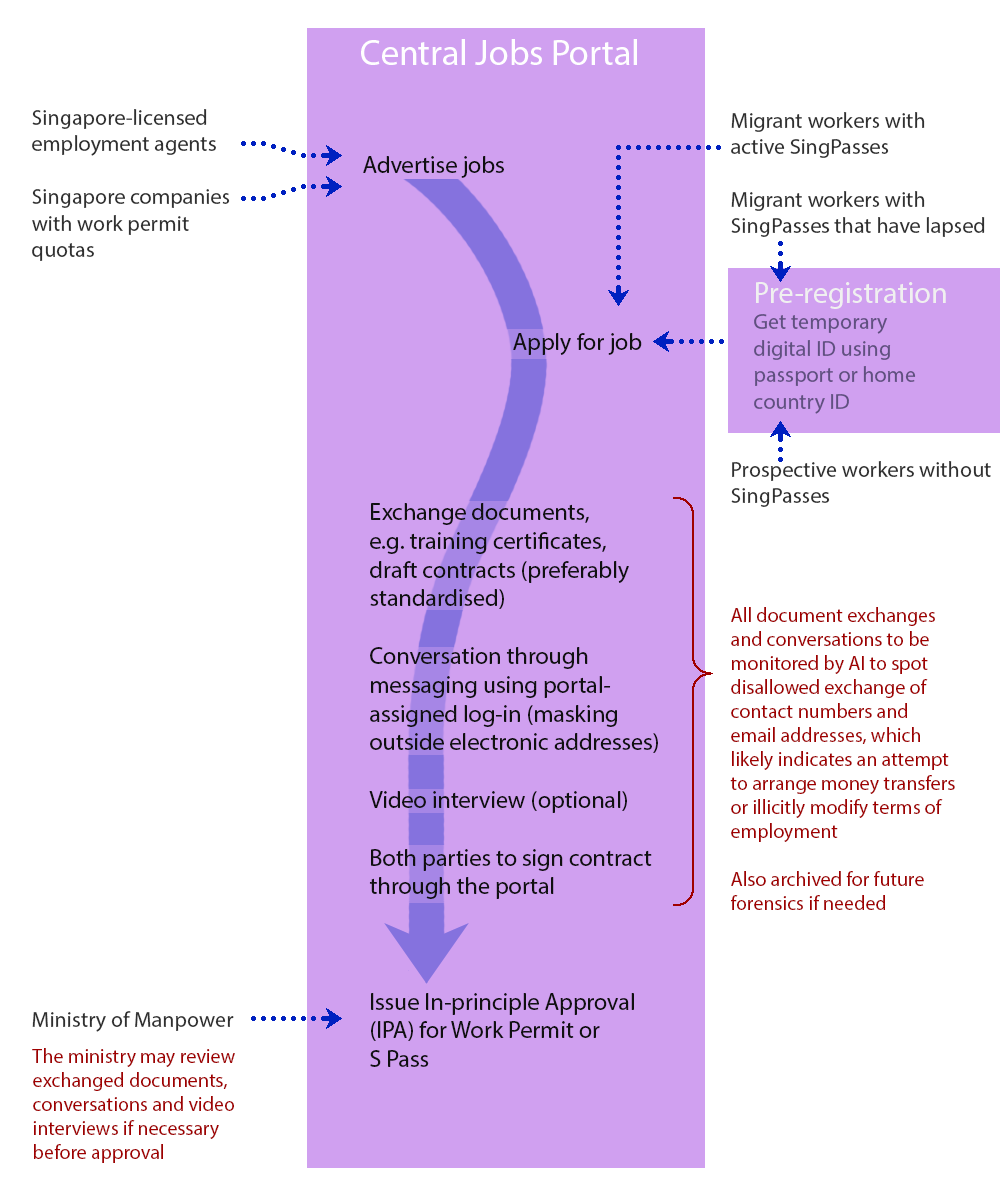
Most importantly, the entire portal and all communication and transactions through it should be under Singapore jurisdiction, thus minimising complications from jurisdictional questions. Should there be any dispute in future about the terms of employment, the archived conversations and exchanged documents can also be retrieved as evidence.
The technology is mature. It is political will that we are waiting for.