

This is an AI-generated image
In March 2026, Channel NewsAsia (CNA) ran a story, both text and video, about the unusual plight of Burmese workers in Singapore, in light of the fact that there is ongoing conflict in the country and a government resented by many.
CNA’s text story is titled ‘I’m scared to go back’: How some Myanmar workers end up exploited in Singapore. Their video story was also posted onto Youtube:
TWC2 contributed substantially to the story which included interviews with our Executive Director, Ethan Guo (starting from 6 minutes 24 seconds), and two of our worker-clients (from 5 minutes 10 seconds) with faces masked to protect them from retaliation.
We sit down with Ethan again to ask him to fill us in a bit more about the issue.
TWC2: What challenges faced by Myanmar nationals are unique compared with those faced by other migrant communities here?
Where the more stereotypical foreign worker, from India or Bangladesh, tend to be in the construction sector, you will find many workers from Myanmar in the service sector, in the F&B line. That’s because there’s a shortage of workers in these areas, and hours are long, work is hard.
In this respect, actually that’s a common theme among migrant workers, who are essentially cheap labour for Singapore.
A key difference with Myanmar nationals, and a source of much distress, is that they cannot afford to go home. So firstly, they will do everything within their means to avoid losing their jobs and being sent back. That means putting up with short payment of salary, wrongful deductions, poor working conditions. Close your eyes and pick any Myanmar worker in F&B, you’ll probably find that his employer is making him do 12 or 13-hour shifts at basic salary with no overtime pay and no days off.
Also, when they are sick or injured, they will choose not to report it or to get treatment because they don’t wish to anger their employers and end up losing their jobs.
TWC2: The CNA story also featured two guys who were given documents stating ‘performing artiste’ jobs when they worked in F&B. Surely, that’s a scam – in addition to all the challenges of long hours, etc.
And it’s not just that kind of scam, with ‘performing artiste’ documents. Others, for example, were scammed to enter Singapore under Training Employment Pass. It’s a little-known fact but unlike a work permit, employees under a Training Employment Pass are left with no safety net even when they file a rightful claim. For example, their employers are not obliged to provide them with food or shelter. When something does go wrong, they have no protection, no safety net.
Another difference in the anxieties faced by Myanmar nationals stems from the ongoing conflict in their home country and the threat of conscription. Many do not want to go back to Myanmar when their employment officially ends. They would prefer to go to a third country – and since Myanmar is a member of ASEAN, they can go to one of the other ASEAN countries where they can stay for a short while before deciding what to do next.
Under the law, there’s supposed to be the ability for workers and employers to come to an agreement on being repatriated somewhere else other than their home country. But in reality, many employers deny this, sometimes out of spite because the employment didn’t end well and there’s a broken relationship between both parties. So imagine a situation, it’s not even within their control whether they are sent back and hauled up by a government they loathe; but it’s a decision made by the employer!
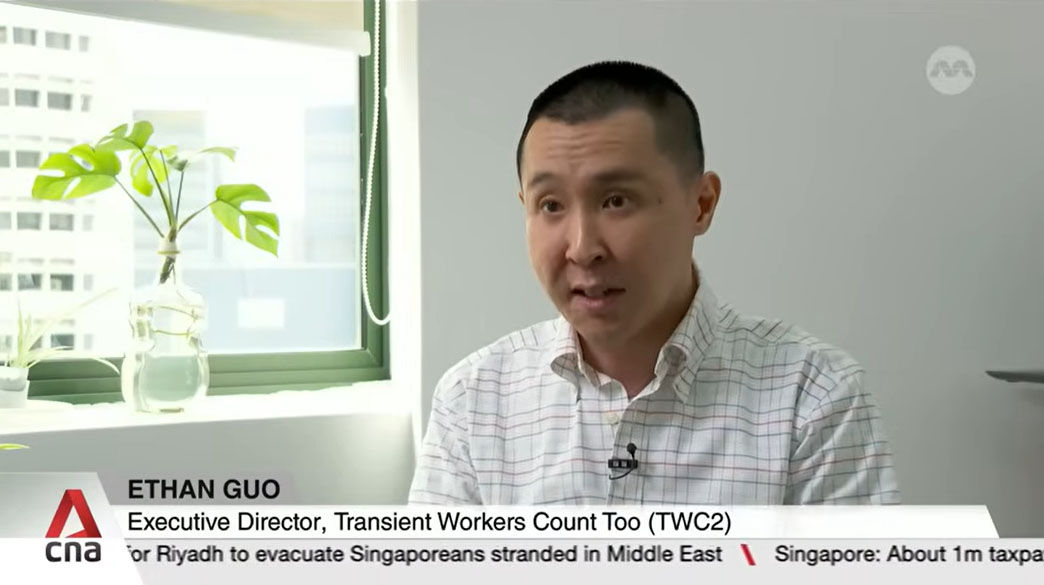
Ethan Guo in a screengrab from CNA’s video story
TWC2: What existing laws and regulations hinder favourable outcomes for Myanmar nationals?
The lack of job mobility is a big one – it’s a term to mean the ability to change jobs. Migrant workers don’t have an automatic right to move into new jobs. They can resign if they’re treated badly, but by default, they have to be repatriated unless the old boss or MOM (Ministry of Manpower) gives them permission to transfer. The fear of losing their present job without the right to get into another job is what causes the power imbalance between employer and worker. Knowing this, employers can be tempted to be unreasonable, for example, demanding long hours.
Singapore should give migrant workers the right to switch employers without needing their employer’s permission, with the requisite notice period. Let workers have at least 30 days after ending employment to find a new job. And have a central jobs portal so that those who need to find a new job won’t have to end up paying thousands of dollars to unscrupulous agents – that they don’t have.
TWC2: How do you hope these regulations can be reviewed so that special circumstances, such as those faced by the Myanmar community, can be taken into consideration?
During the New Year, Coordinating Minister for National Security and Minister for Home Affairs K. Shanmugam was quoted as saying that Singapore should do what we can to help those who are suffering in war-torn countries. He mentioned countries like Gaza and Ukraine.
But what about nearer to home in Myanmar? The help that we give shouldn’t just be limited to relief supplies. Humanitarian aid can also be in the form of protections for the Myanmar community in Singapore. These are not people looking for a handout. We’re talking about workers who’re here to do decent work that Singaporeans don’t want to do. They contribute to Singapore.
If Singapore is afraid of being seen as providing special treatment to workers from one country, then by all means, make these changes for all migrant workers in Singapore! The revisions to regulations that would help Myanmar workers are regulations that would benefit all migrant workers.
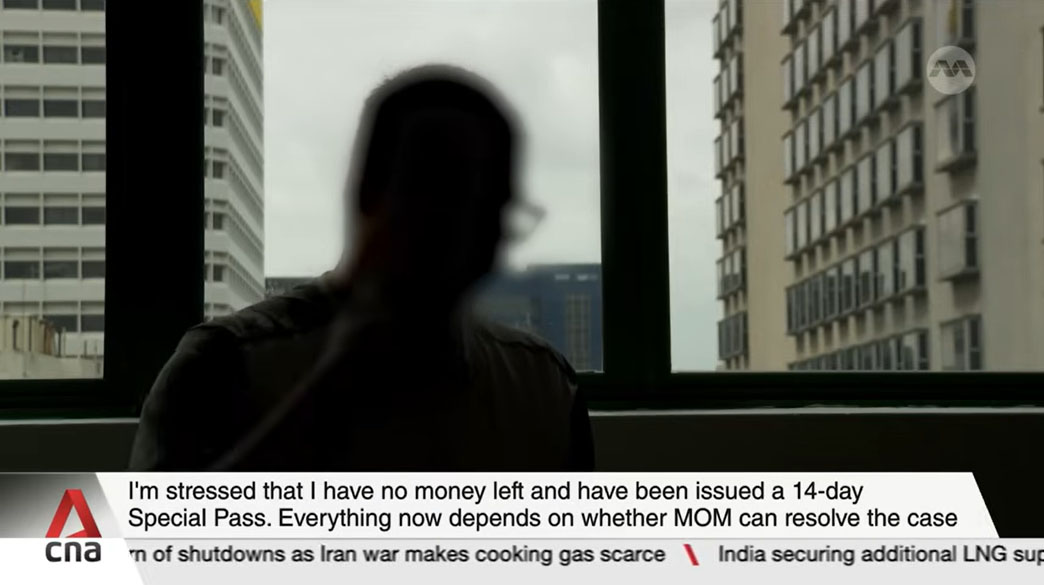
Kyaw, in this screegrab from CNA’s video story, was assisted by TWC2
TWC2: What’s your frank assessment of whether news stories like this have much of an impact on Singaporeans’ thinking?
I know the news coverage has at the very least made some people sit up and have some awareness of the situation. But I’m not sure if people actually feel empowered to do something about it. Or some may not care because it doesn’t involve Singaporeans’ lives.
It has made me think about a recent statement by the President of the Korea Workers’ Compensation and Welfare Service (K-COMWEL), Park Jong-kil. Mr Park said South Korea should treat migrant workers well, because Korea itself was once a source country for foreign labour – dispatching nurses and miners to West Germany. So in that respect, Korea understood the hardships of working overseas.a manner which we would like to be treated ourselves.
We have been blessed, such that when Singaporeans work overseas, they largely do so as higher level expatriates, or simply to broaden their horizons.
Our former prime minister Lee Kuan Yew once warned Singaporeans that “our women will become maids in other people’s countries” if the government became incompetent, which essentially means we know the life of a migrant worker is a hard one and we do all we can to avoid such a “fate” befalling us. So should it not also be our moral imperative to help make the lives of migrant workers in Singapore that much easier? Especially those whose lives are in disarray because of civil war back home?
We talk about the principles of adhering to international laws, such as the right of passage through the Straits of Malacca and Singapore. Why should we not equally uphold human rights? We can start by treating these Burmese workers facing a terrible situation in a manner which we would like to be treated ourselves.
TWC2: Are you glad that at least CNA has done such a story?
I am reminded of the conversation Vanity Fair photographer Christopher Anderson had with White House Deputy Chief of Staff for Policy, Stephen Miller. Stephen Miller told the photographer that he had a lot of power in the discretion he used to be kind to people. Christopher Anderson told Mr Miller he had the same power too.
The truth is that we all have, in our individual capacities, the power to be kind in some way. And I am very glad the CNA reporter chose to exercise his discretion to be kind by trying to shine the spotlight on this problem.