
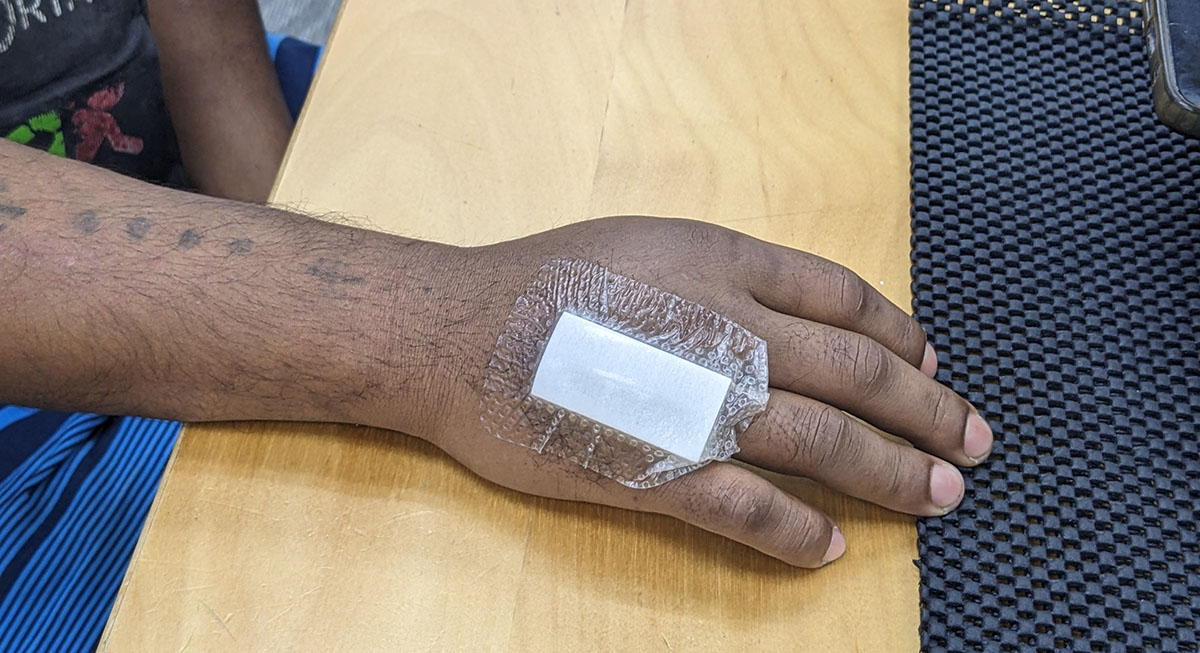
A Burmese worker suffered fractures in his hand after a fall; nearly four months on, incident still not reported to MOM. TWC2 intervened.
A review of the data we have in our case management system revealed a rather sorry picture: in a significant proportion of injury cases, employers dragged their feet over making a report to the authorities. We were able to confirm that at least 31 percent of cases on our books were reported later than the ten-day deadline set by the Work Injury Compensation Act (WICA). This does not mean that the remainder were all reported within the period; for reasons of imprecise data, we cannot be sure when they were reported to the Ministry of Manpower (MOM). Some of them would have been promptly reported, but almost surely some were late. It wouldn’t surprise us if in actual fact 50 percent or more were reported late.
The rules require employers to file an incident report within ten days. As for what counts as an incident, the rules define it as an incident in which the injured employee received medical leave or light duty orders from a registered doctor. The simplicity of this definition leaves little doubt as to when a report ought to be made.
The data
In 2025, we at Transient Workers Count Too registered 466 migrant workers with injuries into our case management system. On average, we were seeing two new cases every working day. The previous year, we saw 381 cases.
Of these 847 cases over two years, there were 686 cases for which we had data as to their accident dates and a good indication of when the case was reported to the Ministry of Manpower. The accident dates we had were precise, but we could only infer from the reference number of the filing which month it was when the incident was reported. We do not have precise reporting dates. As a result we cannot always be sure if the report was made within ten days.
However, in some cases, it would be obvious that more than ten days had elapsed. Say, for example, if a worker was injured on 5 June. If the WICA reference number indicates that the report was only made in July, then evidently the report was more than ten days after the incident. However, if the accident happened on 25 June and the report was made sometime in July, we wouldn’t be able to say if the report was made within ten days or not.
As a result, the graph below shows through the use of colour how many cases were definitely late (214 cases red and tea-coloured), but cannot show clearly how many were not late.
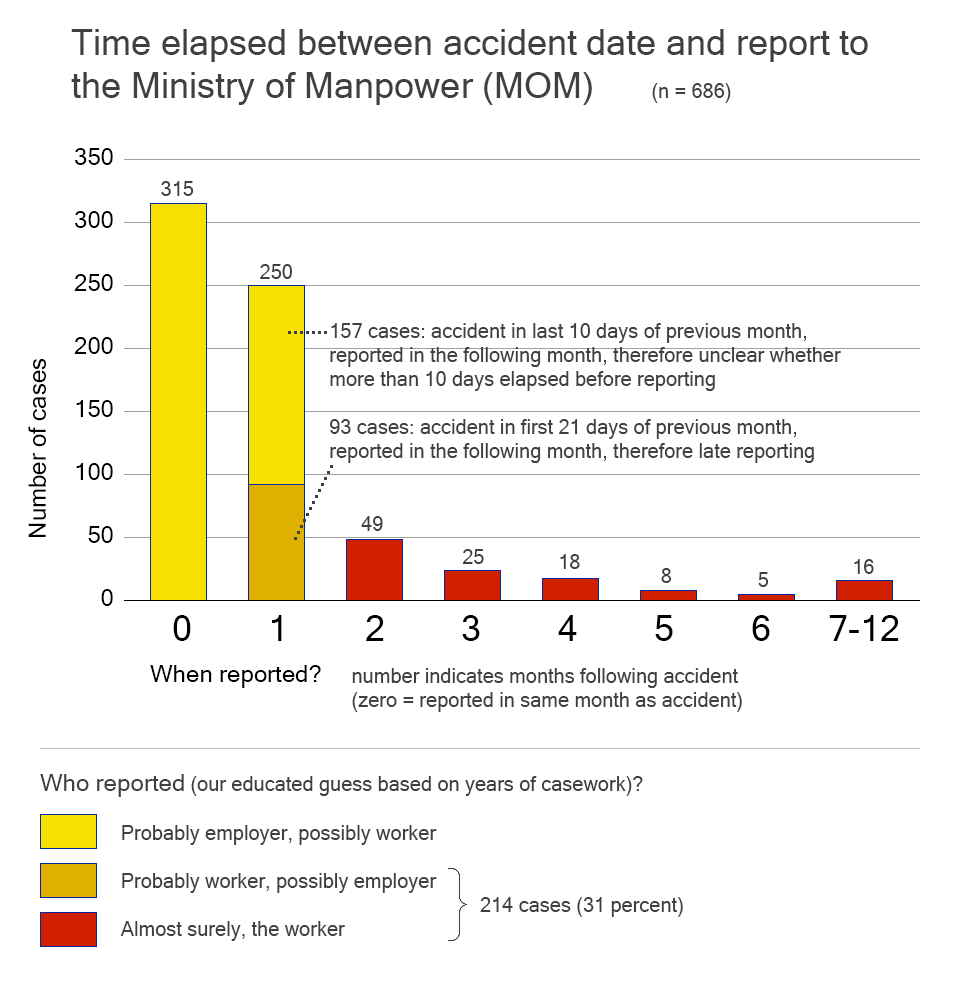
As the above graph shows, some of the late ones were very late indeed. 72 cases (10.5 percent) were reported only in the third month (or later) after the accident. Our observation is that in these instances, it is almost always the worker who made the report after noticing that his employer had failed to do so. In some of these instances, TWC2 helped the worker make the report. The ten-day rule applies to employers, not workers. Workers have up to a year to file a claim.
That 10.5 percent of employers failed to make a report within the first two months after an accident is a another way of saying that these employers were obviously not of a mind to report the accident. Possibly another 30 percent (or more) were hesitant, going by how the ten-day rule was ignored even though MOM was notified within two months.
On this website, we have written about how commonplace it has become for employers and agents to misdeclare key salary information when they apply for work passes. Few seem to be afraid of their criminal liability, probably because there are very few known examples of penalties. The same thing may be happening with injury reporting, going by our figures. Likewise, we rarely hear of employers being penalised for failing to abide by the ten-day rule. Even if MOM does investigate and take employers to task, doing so behind a veil, with no publicity as to the offender and punishment meted out does nothing to put other employers on notice.
Link to denial of treatment
This is not just an administrative issue. Making an incident report is the first step to triggering the insurance policy that all employers have to purchase for medical costs, medical leave wages and disability compensation. Without this first step, the insurer will likely refuse to activate the cover, and then the employer will find themselves having to bear these costs.
It may seem illogical for employers to not activate the insurance policy, but apparently their fear of worksite safety investigations and demerit points that may follow an incident report outweighs their fear of financial liabilities. Quite likely, some employers at least think that they can mitigate these costs through other means, e.g. by deceiving or bullying their employees into accepting repatriation (“Better to go home and recover with your family taking care of you”) perhaps with a small lumpsum or an insincere promise of re-employment some months down the road. Over the years, many workers have told us of such attempts by employers to get them out of Singapore as quickly as possible, and without the needed treatment.
This case involving a Burmese construction worker gives some real-life insight into how it affects them. The subcontractor whom he was working for concocted a story about him slipping on a silicone bottle when in truth he fell off a ladder and broke bones in his hand. The worker was instructed to lie about how the incident happened and not to contradict the employer’s preferred account. Medical attention was not offered either; he was merely given ice for the fast-swelling hand and told to rest in the site office.
Fortunately, the main contractor found out by the following day and took the worker to a doctor who saw that it was serious and operated on the hand immediately. Despite this, no incident report was made by the subcontractor employer. Eventually it was the worker hmself, helped by TWC2, who made the report to MOM in the fourth month after the injury.
Unlike this story’s focus on reporting dates, that other story about the worker who was told to lie will focus on the clinic’s handling of medical leave, which is yet another, albeit somewhat separate, issue that bedevils many injury cases. However, as we mentioned above, any incident in which a worker gets medical leave would be a reportable incident, so the failure to issue medical leave certificates likely springs from the same motive to avoid reporting the incident.
Coming back to the matter of late reporting, our data published here and the stories of hurt and suffering experienced by the vulnerable clearly show the need for some timely cracking of the whip by MOM. It’s no use having good laws unless they are enforced.

See also the subsequent article 30 “under-reported” cases of work injury a year, says MOM.