
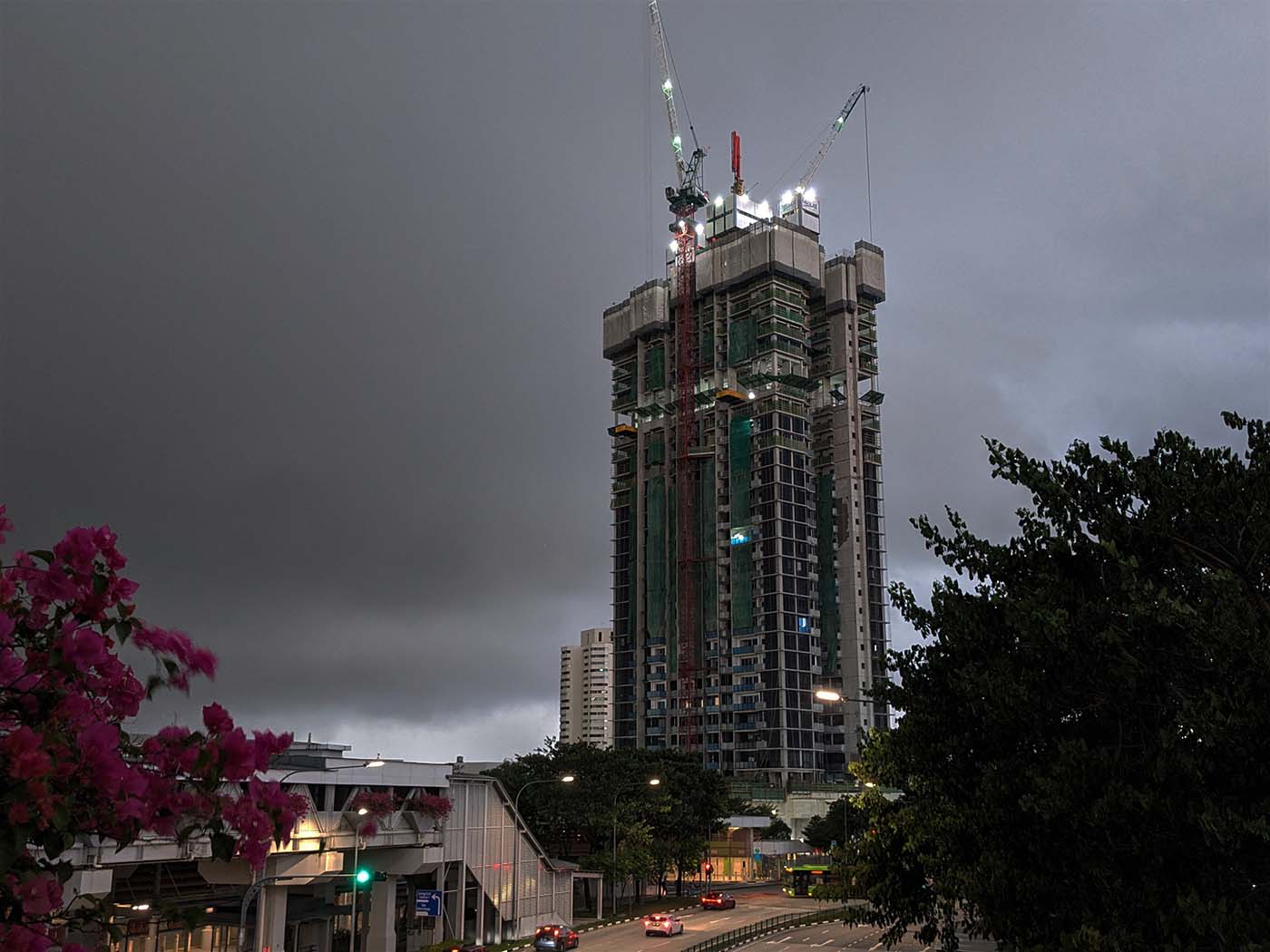
The accident occured at this project location
Around 15:30h one unlucky day in late December 2025, Hningan (name changed) fell off a ladder hurting his knee and, more severely, his right hand. A safety officer, whom we will call Prakash in this story, took him down from the eighth floor to the site office on the ground floor and gave him some ice to press over the fast-swelling injury. No doctor was called.
Hningan was nominally employed by a company we will refer to as Company T. He was supplied as float labour to Company C which was a subcontractor at a worksite near Jurong East MRT station. There was a main contractor in charge of the entire project – a well-known construction company in Singapore. Three persons will also be mentioned a fair bit in this story: Prakash (name changed), whom we mentioned above, was a safety officer of Company C; we will later mention two more persons (Shingoh and Nohon), both employees of the main contractor.
Hningan was new at this job, having joined Company T only a few weeks earlier in December 2025 and which supplied him to Company C. This was his first job in Singapore, after having paid about $2,700 to complete a basic construction skills course in Yangon and then another $1,500 to friends to secure this job with Company T. Those friends are with the same company, he says.
Coming back to the events of that afternoon, Hningan remained with Prakash in and around the site office for the rest of the day and into the evening, when other managers and supervisors of Company C gathered for a close-of-day meeting around 20:30h. At some point during or after that meeting, Hningan was told that should anyone ask about how he hurt himself, he should say that he slipped on a silicone bottle, causing him to fall, and not mention the ladder or fall from height. Hningan had the sense that company managers were all agreed that he should be using that (fabricated) story.
That night, he was merely told to stay in the dorm to recover. Still no medical attention. The pain gradually became unbearable.
Where’s his official employer in all this?
We find it interesting while hearing this account from Hningan that he makes no mention of Company T, his official employer. He does not say whether they were even informed about the accident or what responsibility they were taking for it. In recounting to us the rest of his story, which will be about his later interactions with the doctor and surgery, he still doesn’t mention Company T.
To a doctor the next day
At some point, the main contractor came to know of the incident, and the next day, Shingoh took Hningan to an orthopaedic clinic. Shingoh handled all the communication with the medical staff. Due to his limited command of English, Hningan could not follow what was said.
Hningan underwent an Open Reduction Internal Fixation (ORIF) procedure to stabilise the fractures in his right hand. The issue with the knee wasn’t so serious by this point. After the ORIF surgery, Hningan was given follow-up dates; he was also instructed by Shingoh to rest for one month. Whether those instructions originated from the doctor is unclear.
We ask Hningan whether he was issued any formal documentation about medical leave. He says no, he did not get any medical leave certificates (MCs).
Here’s the timeline for the three months between the accident and surgery and his showing up at TWC2 for help:
- 2 January 2026: Follow-up appointment at the clinic, accompanied by Nohon, an employee of the main contractor. No MC issued by the doctor.
- 8 January 2026: Follow-up appointment at the clinic accompanied by Nohon. No MC issued.
- 26 January 2026: Instructed by Shingoh, Hningan had to return to work. Despite experiencing persistent pain in his right hand, he was assigned regular manual labour which included carrying bags of cement. The nature of the assigned tasks was physically strenuous.
- 5 February 2026: Follow-up appointment at the clinic accompanied by Nohon. No MC issued.
- 4 March 2026: Follow-up appointment at the clinic accompanied by Nohon. No MC issued.
In all, Hningan had been to the clinic five times (including the first visit with the operation). At none of these visits did he get an MC.
No accident report made
On 10 April 2026, Hningan made his way to TWC2 for help. He reported having been made to return to work despite not being fully recovered. He also had concerns about a second surgery scheduled for 13 April 2026 – the fact that a second surgery was needed only supported the point that the recovery was incomplete.
A quick review of where things stood made us focus on two important aspects: Firstly, we found that no accident report had been made to the authorities and secondly, the absence of MCs was quite irregular.
The rule in Singapore is that any employer which has an employee involved in a work-related accident and who is issued medical leave or light duty by a doctor has to make an incident report to the Ministry of Manpower within ten days. An incident report sets in motion a work injury compensation process and may also trigger an investigation into safety standards at the worksite. In TWC2’s experience, employers often want to evade both.
The two features in Hningan’s case – no report made, and no MC issued – therefore appeared to be linked to such a possible motive.
While it is the employer’s duty to file an incident report, an employee can do so too. TWC2 helped Hningan file one directly. Subsequently, we learn that MOM has launched an investigation.
Elusive medical leave certificates
At the same time, we tried to get to the bottom of the curious matter of the absent MCs. We wrote to the clinic for copies of all MCs issued to Hningan. The clinic replied that no MCs were issued because the patient had allegedly signed “waiver” forms. We then requested copies of these signed waiver forms. The clinic then responded that they had to consult with Hningan’s employer, as the employer was responsible for covering the costs of his medical treatment. Why that consultation was necessary was not at all clear to us, since we were making the enquiry with the full authority of the patient, Hningan. The general principle, and it’s a matter of the most basic ethics, is that the patient should always have full rights to any medical information pertaining to him.
We checked with Hningan again. He reiterated in no uncertain terms that he had neither seen MCs nor signed any waiver forms.
A few days later (13 April 2026), he went back to the clinic for his second surgery. Following the procedure, the nurse asked him to sign a new MC, dated 13 April 2026. He signed. Then she presented him with five more pieces of paper which looked similar to the first (but with different, earlier dates) and Hningan, thinking that these too were MCs, signed them as well. The nurse did not explain what those pieces of paper were. We would later discover that the other five pieces of paper were MCs backdated to align with his earlier appointments. However, each of these backdated MCs had an extra clause near where the patient’s signature would be, saying he agreed to waive the medical leave that was being offered to him!
Stranger still, Hningan noticed that immediately after he signed those six pieces of paper, the nurse photocopied them and then put the originals into a shredding machine. Why she did that, he did not know. Even he thought it was a remarkable move.
On 15 April 2026, Hningan was back at the clinic for a follow-up appointment. This time too, an MC (without a waiver clause) was presented to him to sign. He signed it. Wiser now, he asked for a copy of it. The nurse refused to give him one. Nohon, who accompanied Hningan to the clinic was also refused a copy. Fair enough, as a representative of the main contractor, Nohon had no right to it, but Hningan was the patient. How could they refuse to give him his documents?
On 22 April 2026, Hningan visited the Emergency Department of Ng Teng Fong General Hospital accompanied by a TWC2 volunteer and a Burmese translator. We later heard from the volunteer that the doctor who saw Hningan’s hand noted that it was still swollen – this was about four months and two operations after the accident – and that he was unable to clench his fist. The doctor also noticed that Hningan had no sensation on one side of his finger.
Whilst TWC2 is not medically qualified to make any judgement we cannot help but wonder if the injury was aggravated by the absence of MCs and the instruction to Hningan to return to heavy work after just one month.
This is a developing story, but by this point it was obvious to us that serious questions could be asked as to whether the clinic was acting professionally with respect to MCs.
Not uncommon behaviour
Absence of medical leave certificates even when warranted by the medical status of the patient is hardly uncommon although it is clearly a breach of professional ethics. The Singapore Medical Council, in its webpage Ethical Issues around Medical Certificates (Part 1), says:
The SMC Ethical Code and Ethical Guidelines (ECEG) 2016 cautions doctors to consider medical factors when they issue an MC, and to guard against allowing the interests of other stakeholders to affect their actions. In particular, doctors may be under pressure to alter the duration of an MC for non-medical reasons, such as requests from employers, financial incentives or workplace benefits for the patient.
And even if MCs are issued, quite often no copy is given to the worker. Instead, clinics are asked by employers to deliver all documents to them, which is also a violation of medical ethics. The same webpage also says:
…the MC should be given directly to the patient unless he/she (and not his/ her employer) requests otherwise.
In the light of the above, TWC2 has helped Hningan file a complaint with the Singapore Medical Council.
17766