

When we ask workers about the numbers stated in their recruitment documents, perhaps half the time we get answers indicating a divergence between what was actually agreed and what was declared to the Ministry of Manpower (MOM). It is remarkable how often false information is fed to the authorities, apparently going undetected. Here, we dive into the details of one such case, showing what happens on the ground.
A key recruitment document would be the In-principle Approval letter (IPA). This document comes out of an application made by the employer, or a Singapore-licensed employment agency authorised by an employer to act on his behalf, to MOM for a work pass. Employers (or their agents) are required to be truthful in providing details to MOM, and these details would later be inscribed into the IPA.
It is shockingly common to hear from workers that the numbers and other details declared to MOM and incorporated into their IPAs bear no relation to the actual promises made during their recruitment. Mostly, it is the salary details that are different from what had been promised, but sometimes even the job description is different too. False declaration is a criminal offence but going by how common it is, one can’t help but wonder why the authorities are not exercised over it. Underdeclaration of agency fees charged also raises the possibility of tax mischief.
The example here
In the earlier story After emergency surgery for appendicitis, worker got the sack we wrote about how Burmese restaurant worker Ye Mint (name changed) found work in Singapore. The first of his two jobs was fixed up while he was still in Yangon attending a language course. The language teacher introduced him to a contact in Singapore, whom he knows as Paula, who found him a job with a company called Joyrui (the first job). Ye Mint then had to pay $5,000 to the teacher as recruitment fee.
Although the $5,000 was paid to the teacher in Myanmar, almost surely a big part of that would have flowed to the Singapore contact Paula or the employment agency here (Ye Mint can’t tell us whether she was even formally employed by a licenced agency, or whether she was freelancing as an unlicenced agent working informally with an agency). In the earlier article, we explained how we came to the view that the Singapore agency took about $3,300 as their fee – which does not include the $500 they charged for arranging a job interview. Our reasoning was that when Ye Mint lost the job that they placed him in, the agency refunded $1,650. It is the rule that agencies should refund half of what they had charged if the worker is terminated after less than six months on the job.
The licenced agency on Ye Mint’s In-principle Approval (IPA), issued by the Ministry of Manpower (MOM) was “57 Employment”. Also declared on the document was that they took just $300 as their fee. This figure would not have come from MOM, but from the agency that applied online for an IPA.
But our point is this: Isn’t it funny how the refund was far bigger than $300? Does this not suggest that the figure of $300 was falsely declared?
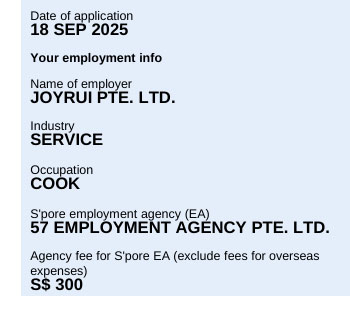
Relevant portion of Ye Mint’s In-principle Approval for his first job, showing the amount declared to MOM as agency fee
Another job, another irreconciliable figure
After he lost the Joyrui job, the agent found another job for him, also with a food and beverage company, this one called Wei Dao Fu. Interestingly, the documentation come through another agency, Wonderful Manpower.
For this second job with Wei Dao Fu, Ye Mint had to pay $3,450, as can be seen in this WhatsApp message. $1,650 would come from the refund while a further $1,800 had to be paid up. That the refund could so easily be set off against the new recruitment fee suggests that there was a relationship between the first agency (57 Employment) and the second (Wonderful Manpower).

WhatsApp message telling Ye Mint how much his second job would cost him
Yet, the In-principle Approval for the Wei Dao Fu job shows that Wonderful Manpower only declared $800 as agency fee.

Relevant portion of Ye Mint’s In-principle Approval for his second job, showing the amount declared to MOM as agency fee
It is possible that, officially, the employment agencies only took the declared amounts as their fee, with the balance going into the private pockets of the agent(s) themselves. If so, it raises the question of whether the agents declared these “commissions” in their annual income tax filings. Additionally, especially if these persons are not registered with MOM as employment agents, but working as mere staff or freelancers associated with the licensed agencies, then taking any money is also an offence. It is the law that unlicensed parties cannot accept fees for providing employment agency services.
Salary figures also misaligned
When we interviewed Ye Mint (for the earlier article) about the recruitment experience for each job, we could see that the salary details that the agency or employer declared to the Ministry of Manpower were also different from what had been agreed with Ye Mint for the respective jobs, as can be seen from a close look at the images below.
Ye Mint agreed on a salary of $1,600 per month for the first job; however, the IPA shows that a total fixed salary of $2,000 was submitted to the ministry. Similarly for the second job, Ye Mint also agreed on $1,600 per month (basic $1,300 + $300 housing allowance); once again $2,000 was submitted.
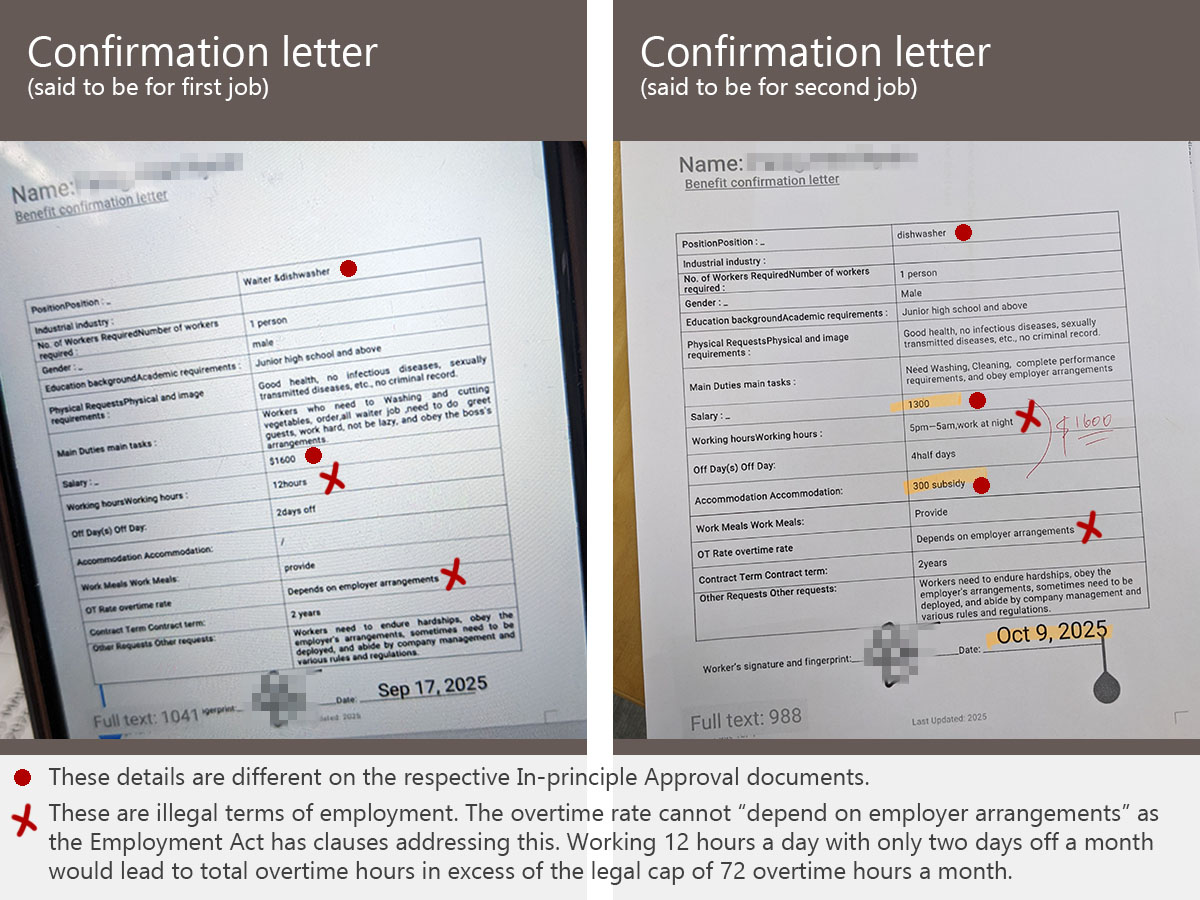
Benefit Confirmation Letters that Ye Mint signed prior to taking up his jobs
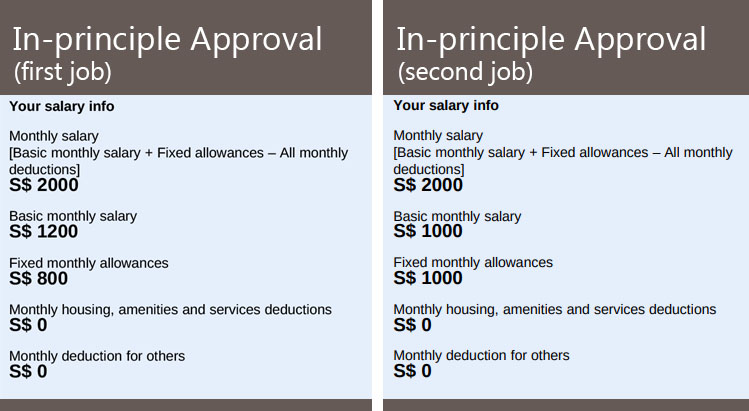
In-principle Approvals issued by MOM. The application process requires the employer or authorised agent to submit salary information, among other details. The worker has no part to play in making IPA applications.
In neither case is it possible to definitively link the details in the confirmation letters with the respective IPAs because the confirmation letters do not contain employer names. However, the dates are consistent with Ye Mint’s account of events, and Ye Mint has no other confirmation letters.
Ye Mint does not cook
A relatively minor detail is the occupation stated in the two IPAs. In both, Ye Mint’s job was to be a cook. Yet, the man doesn’t know how to cook, and he did not apply to be a cook. Even the confirmation letters say “dishwasher”, indicating that the agent clearly knew what kind of work he was applying for. Why the agency or employers declared “cook” to MOM is unknown.
But was he made to be a cook after starting work? No, he said. He was never even required to attend a food safety course. It is mandatory for any person who handles and prepares food and beverages within food establishments to complete at least a Level 1 course. Dishwashers and kitchen cleaners apparently do not need to go for the course.
False declaration is a criminal offence, yet this and many other examples that TWC2 sees almost on a daily basis, shows it is almost a habit.
17679