

This is an AI-generated image
In our recent survey which exposed the harsh salary landscape faced by migrant workers in Singapore, one subgroup of survey respondents stood out. These were Work Permit holders in the “marine” industry. They had perhaps the lowest salaries of all.
The label “marine sector” (term used by the Ministry of Manpower) is somewhat misleading. It does not mean seafarers. The term actually refers to workers in shipyards, engaged in engineering and steel construction jobs, building ships and offshore structures. The term also encompasses workers in fabrication workshops off-site, making parts that are later assembled in the shipyards. At TWC2, we tend to call all these workers “marine engineering workers” or “marine shipyard workers”.
Our survey indicated that Work Permit holders in this sector earn the lowest guaranteed pay while enduring the highest salary deductions. A follow-up investigation by our team confirmed these troubling observations.
The online survey
Conducted online in early 2026, our salary survey examined the pay structures and recruitment fees of Work Permit holders, the lowest-paid tier of Singapore’s migrant workforce. The data submitted by 126 survey respondents from the marine engineering sector (“marine respondents”) stood out sharply, falling behind all other industries across several key metrics:
Lowest overall earnings: Marine respondents recorded the lowest average monthly salary (see definition in box at right) at $567, compared to an average of $868 among construction sector workers and an overall cross-sector average of $967.
Poor Salary Awareness: Workers in this sector showed the weakest grasp of their contractual pay. Only 16 out of 126 marine respondents could provide mathematically coherent salary details based on their In-Principle Approval (IPA) letters. In the online survey, we simply asked them for details of their salary components; we did not ask them to submit documents for our examination. The great majority of marine respondents submitted details that were internally incoherent, suggesting a weak grasp of their entitlements.
Negative salary adjustments: Marine respondents were the only subgroup in the survey whose monthly deductions, in general, exceeded allowances, thus driving workers’ guaranteed monthly salary below their basic monthly salary (see definitions in box at right).
Salary components
The four main salary components discussed here are:
- Basic monthly salary
- Monthly allowances
- Monthly deductions
- Fixed monthly salary*
(*also known simply as ‘Monthly salary’)
The relationships among these four are as follows:
Basic salary + Monthly allowances – Monthly deductions = Fixed monthly salary
There are other salary components such as overtime pay, night shift allowances (as and when the worker performs a night shift), and occasional, non-monthly deductions (e.g. no-pay leave), but these are not part of this article’s discussion.
Follow-up investigation
Because only 16 of the 126 survey responses yielded mathematically coherent salary data, we decided to find another way to verify our observations. We extracted from our case management database for closer analysis examples of In-principle Approval (IPA) letters that clients had submitted to us in recent years. We found 37 such IPAs. It is extremely unlikely that any of these 37 IPAs to map over the 126 survey responses. First however, here is the relevant part of a worker’s IPA, showing how we read the information off the document for the purposes of this analysis:
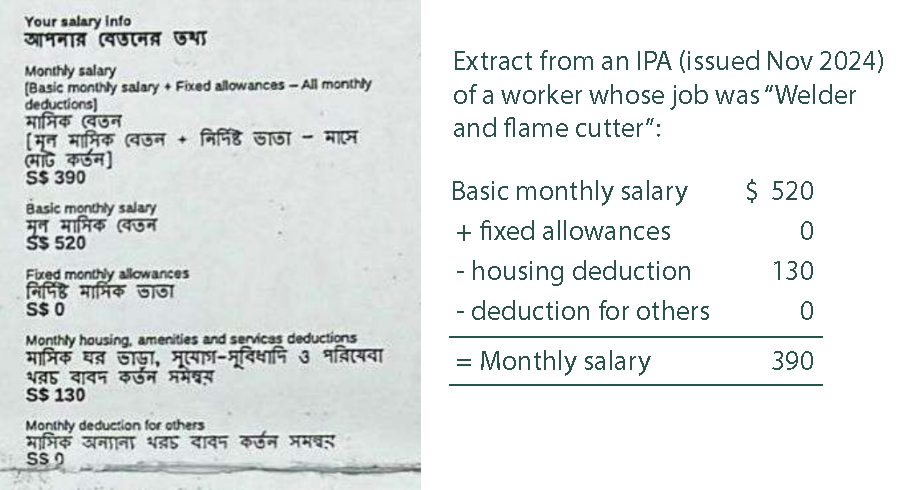
An example of the salary stated in a marine engineering worker’s IPA
Analysis of these 37 IPAs confirmed that the survey results were not an anomaly; if anything, the reality is worse:
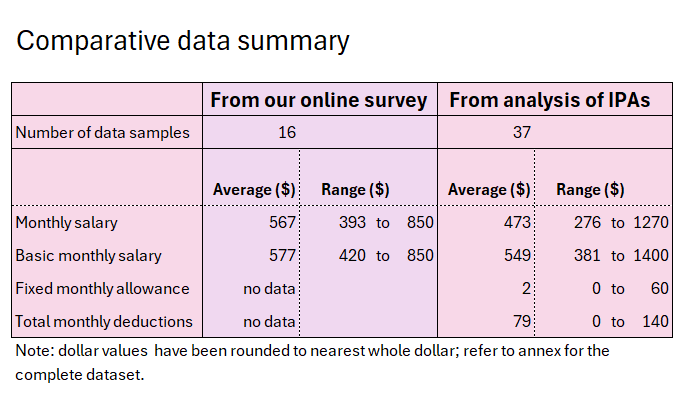
Even lower earnings: The average monthly salary of the 37 workers was $473, and the average basic salary was $549, both lower than our survey findings.
Heavy deductions vs. negligible allowances: While fixed monthly allowances averaged a meagre $2, monthly deductions averaged $79. Consequently, fixed monthly salary was, on average, $76 lower than basic monthly salary.
Heavy deductions: Over 70% of the IPAs listed monthly deductions of $50 or more. A majority (20 of 37) showed deductions exceeding $100, with 15 workers seeing $120 to $140 carved out of their already-low pay each month.
In the table below, we compare the findings from the 16 survey respondents who provided coherent details against the findings from an examination of 37 IPAs in our database.
Uncovering the systemic reality
Migrant workers holding Work Permits, regardless of sector, generally earn less than Singaporeans in the lowest-paid jobs. What we have shown is that among migrant workers, those in the marine engineering sector typically earn even less than their Work Permit peers in other sectors. These marine engineering workers must therefore constitute the bottom of the wage ladder in Singapore.
There are no published statistics about their numbers; the Singapore government’s statistics combine construction, marine and process Work Permit holders for reporting purposes. However, we know that the largest shipyard operator in Singapore has somewhere between 25,000 to 30,000 workers at its site, virtually all of them migrant workers. There are perhaps a few thousand more more in other shipyards and fabrication workshops.
Establishing these salary figures is only the first step. Moving forward, government bodies and industry stakeholders must examine why the situation is the way it is. Why have heavy monthly deductions have become standard practice in this specific sector, for example?
TWC2’s own observations suggest that underlying everything is a degree of market failure, specifically, in three main respects:
Market dominance by Singapore’s largest shipyard operator, Seatrium: Here, we are referring to the employment market. Whilst it is true that contractors of Seatrium hire their own workers, subcontractors’ applications for Work Permits require endorsement by Seatrium, and TWC2 has learned that Seatrium has rules that make it difficult for a marine engineering worker to switch from one contractor to another. Effectively, a worker working for one contractor has little realistic prospect of switching to another contractor, and his employer (the contractor) knows this. No one should be surprised then that job immobility can lead to depressed salaries.
Regulatory strait-jacket: The Singapore government compounds this problem of immobility by disallowing in-country job switches to other industry sectors. A marine engineering worker cannot transfer to a construction job, for example, even if the skills requirement in many cases may be similar. The worker has to go back to his home country, and from there look for non-marine job. Almost certainly, this will involve a massive recruitment fee. The impossibility of an in-country transfer and the high cost of looking for a non-marine job further constrain the options for a migrant worker in this sector.
Equity (fairness) issues: The flawed market structure thus generates a highly skewed distribution of income to the disadvantage of workers. No doubt, any question of equity necessarily involves a value judgement, but what is stark is that
(a) similar migrant workers in the construction sector earn demonstrably more, and
(b) the actual salaries of marine engineering workers pale in comparison to the salary recommendations set by the government in their Progressive Wage Model – which is only applicable to citizens and permanent residents. As can be seen from the link, the salary levels are generally in the ballpark of $2,000 per month, or higher in certain trades.
Addressing these underlying forces is critical to ending wage erosion and establishing fair pay standards in the this sector.
These structural constraints, especially as they result in demonstrated inequities, raise the question of forced labour (sometimes referred to as modern slavery). For an industry sector that essentially exports all their products (barges, ships, rigs, etc), foreign scrutiny of labour practices and State policies will likely prove extremely embarrassing. Moreover, as developed countries increasing impose penalties and import bans on products made with forced labour, embarrassment may the least of the headache. Such scrutiny can also result in trade friction. It is not in Singapore’s longer-term interest to turn a blind eye to this situation.