
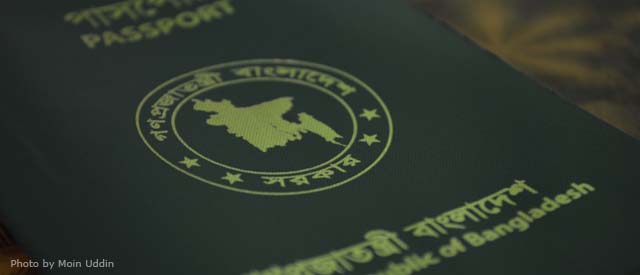
Raju (name changed) first came to work in Singapore more than a decade ago. He came again to start on a new job in February 2026. One month later, his employer was informed by the Ministry of Manpower (MOM), that Raju’s current passport had a date of birth that was different from his previous passport(s). The current passport said he was born in 1984 when the earlier passport(s) said he was born in 1974.
TWC2 does not know how and why a date of birth can be so vastly different from one Bangladeshi passport to the next. But this is not the first time we have seen a case like this. There have also been cases where the names were different in subsequent passports. While we in Singapore expect identity documents to be precise and inerrant, other countries may be more lax, and this can create problems for their citizens when they go abroad.
Having caught the discrepancy in Raju’s date of birth, MOM told the employer that whilst he would be allowed to continue on his current Work Permit till its natural expiry, Raju would not be eligible for any renewal or new Work Permit thereafter.
TWC2 understands why such a policy is necessary. Any country has a sovereign right to refuse entry or work opportunities to a foreigner whose identity documentation cannot be relied on. Security risks may arise if we’re not strict about it.
With Work Permits especially, there is the issue of maximum allowable age. It is currently set at 63. If 1974 was Raju’s date of birth, he will reach that maximum by 2037. If he was born in 1984, he can have ten more years of working in Singapore. If we’re lax about accepting changeable dates of birth then it would open to door to foreigners trying to game the system.
So, when Raju came to us for helping in reversing MOM’s decision to bar him from future employment, we said there was nothing we could do. Not only do we agree with the policy, we could see no reason why any exception should be made in his case. We thought that would be the end of the matter.
Salary shortfall
A month later, Raju contacted TWC2 again. This time his problem was that he had been terminated from the job. We do not know whether the passport issue had anything to do with it.
A few days later, he came to TWC2 to discuss his options. During the conversation, we uncovered the fact that he had been shortpaid by about $1,600, mostly for overtime hours and working on his rest days. We told him that he had grounds for a salary claim.
When we completed the calculations, we got ready to help him file the claim through TADM’s online portal on Thursday 30 April 2026. TADM is the unit in MOM that handles salary claims. Unfortunately the portal had technical problems and we could not lodge in the claim. Raju would have to go to MOM personally to file it offline, but the following would be 1 May 2026, a public holiday, so the earliest possible date for him to go to MOM would be Monday 4 May.
However, there was a difficulty with that too. After the cancellation of his Work Permit, Raju had been issued a Exit Pass, in which his last day of stay was fixed as 2 May 2026. That would be the Saturday in the middle of the long weekend. Foreseeing complications, we wrote to MOM to say that he wanted to file a salary claim but was unable to do so because of a technical glitch in TADM’s filing portal. We asked MOM to defer his last day of stay to allow him to personally file a claim the next working day (Monday 4 May).
MOM is normally very reasonable over such requests.
Things unravelled on Sunday, though we didn’t know of it till Monday when we heard from the Immigration and Checkpoints Authority (ICA) that Raju had been arrested for overstaying the previous day (Sunday). We explained to the officer that Raju had been wanting to go to MOM to file his salary claim today and the officer said he’d see what he could do.
Tuesday: MOM emailed us asking whether Raju had managed to file a salary claim. It was good to see MOM following up on our Friday evening message. We explained in our reply that Raju had been arrested for overstaying and was not able to go to MOM. We requested MOM to intervene since Raju had a reason to not leave Singapore until his claim was resolved.
A few hours later, Raju contacted us – from Bangladesh. He had already been deported.
Salary claim
Fortunately, since salary claims can be filed online and (at least officially) it does not matter if the worker is abroad, we still filed Raju’s salary claim for him. This may require tweaks to TADM’s usual process for handling salary claims since, typically, they arrange face-to-face meetings with employers and employees to mediate a settlement. This may now have to be done through virtual conferencing.
Like most salary claims, this one will take time. We may have a follow-up story if there’s anything unusual about the process or outcome.
17644