

The montage is AI-generated. Any resemblance to any real person is unintended.
Here is a case where a worker could show us how money flowed from her Myanmar recruiter to the Singapore agency that placed her in a food service job. She had screenshots of all transactions. Actually, no money flowed to the agency, even though thousands of dollars moved through the bank accounts of multiple people. The way money was channelled raises many questions, and provides good evidence of the point TWC2 has long made: the recruitment ecology is a snake pit of multiple individuals all breaking the law in some way.
It may be commonly assumed that recruitment proceeds like A and B below:
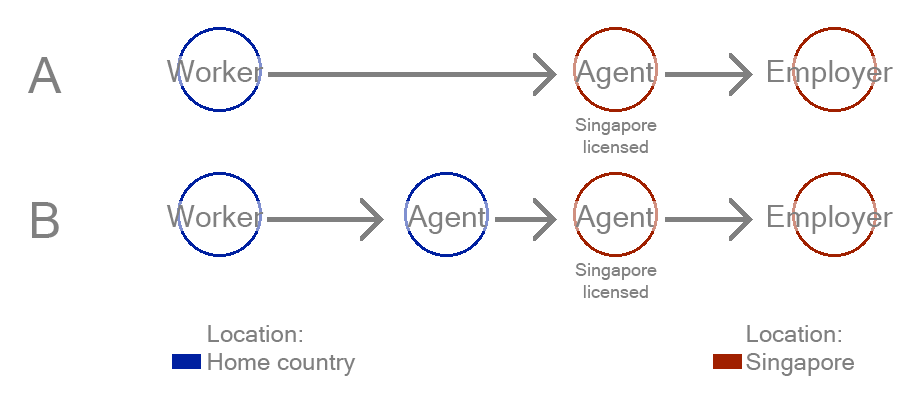
In truth, low-wage migrant workers hardly ever describe recruitment journeys as neat as A or B, characterised by clearly defined and licensed employment agencies with physical offices. It is far more common for them to describe journeys that involve shadowy characters whose real names they do not know, and who only operate via phone calls and text messages. In the graphic below, these shadowy figures are shown as fuzzy blobs.
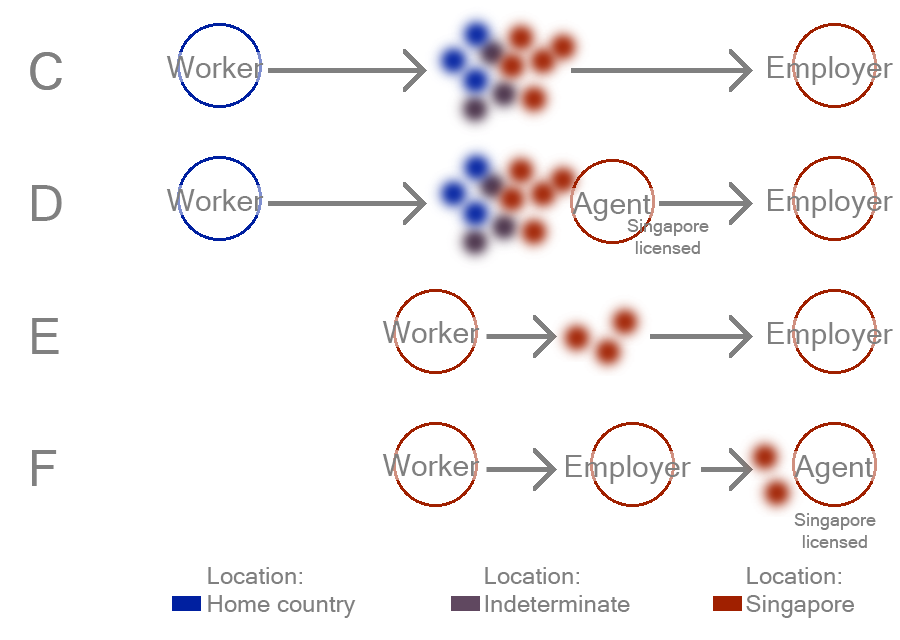
As shown in E and F, even when the worker is already in Singapore and looking for a transfer job, he often finds himself having to work through shadowy intermediaries in some way, and pay them too.
Heinoi’s journey
The recruitment journey of the worker in this story, whom we will call Heinoi, resembles path D. She first dealt with a recruiter in Myanmar who liaised with an employment agency in Singapore for the placement. However, when it came to money flows, several additional parties were involved. We will detail the money flows in this story. They raise many questions.
The job was to be in a coffeeshop, and a total payment of $6,100 was agreed as the recruitment fee. Since Heinoi didn’t have that much money, a close friend who was already working in Singapore helped pay for her first. This close friend did it as a personal favour with no commercial interest. Below are the payments made by the close friend, to recipients nominated by either the Myanmar recruiter or Singapore agent.
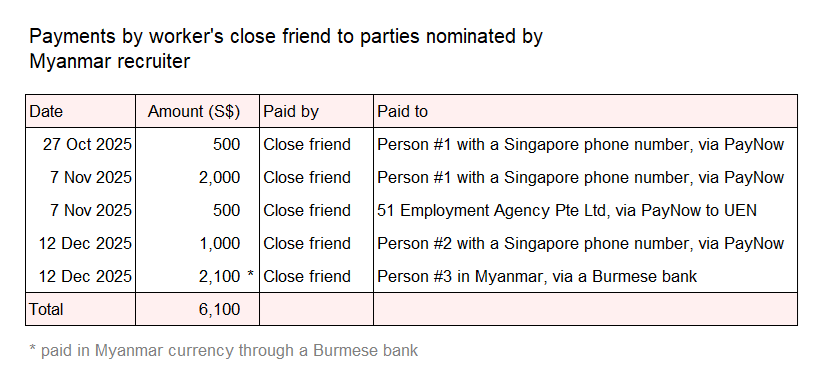
$4,000 of the asked-for $6,100 was paid to Singapore-based recipients, of which only $500 went to the account of a registered employment agency. The rest went to individuals.
Yet even the $500 that went to a registered employment agency was curious. It was paid to 51 Employment Agency Pte Ltd (UEN 201826442W), but as documents would later show, this agency was not involved in the job placement.
Money flow from Myanmar recruiter to Singapore agent
Some time later, Heinoi asked her Myanmar recruiter for evidence to show that money had been forwarded to the Singapore agency arranging the job. She received screenshots of various PayNow transactions. The first one was in early December even before Heinoi received an In-principle Approval letter confirming the job. This payment can be considered a kind of deposit.

What does the above show? It shows that the Myanmar recruiter asked someone working in Singapore (Payroll account number ending 07-7) to pay a Tong Shuailin $500 via money-transfer app PayNow. The name ‘Tong Shuailin’ is linked to a Singapore phone number but this name – we do not know if it’s a real name or a nickname – is not on the Ministry of Manpower’s published list of licensed agents (as at 22 May 2026). Without a licence, it is a criminal offence for someone to be conducting employment and recruitment business – and receiving money for such would strongly indicate conducting such business.
About two weeks later, more transfers soon followed:
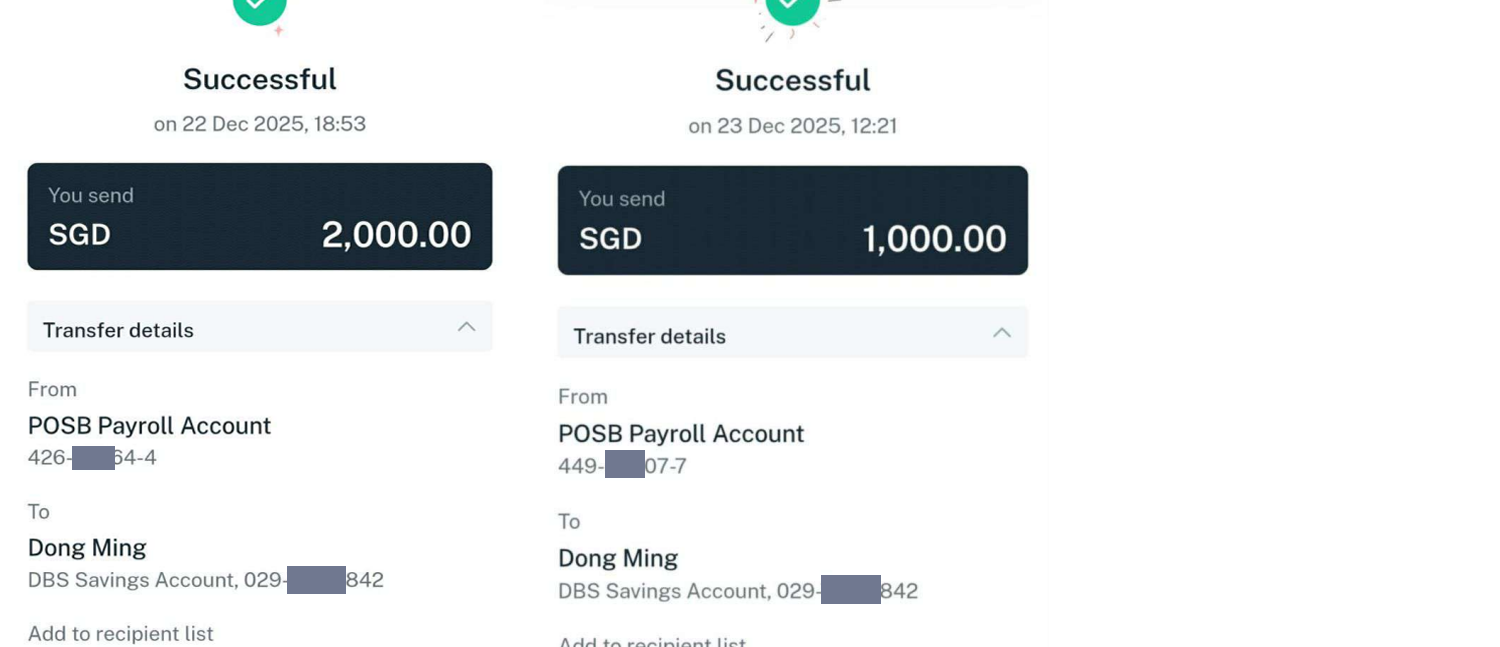
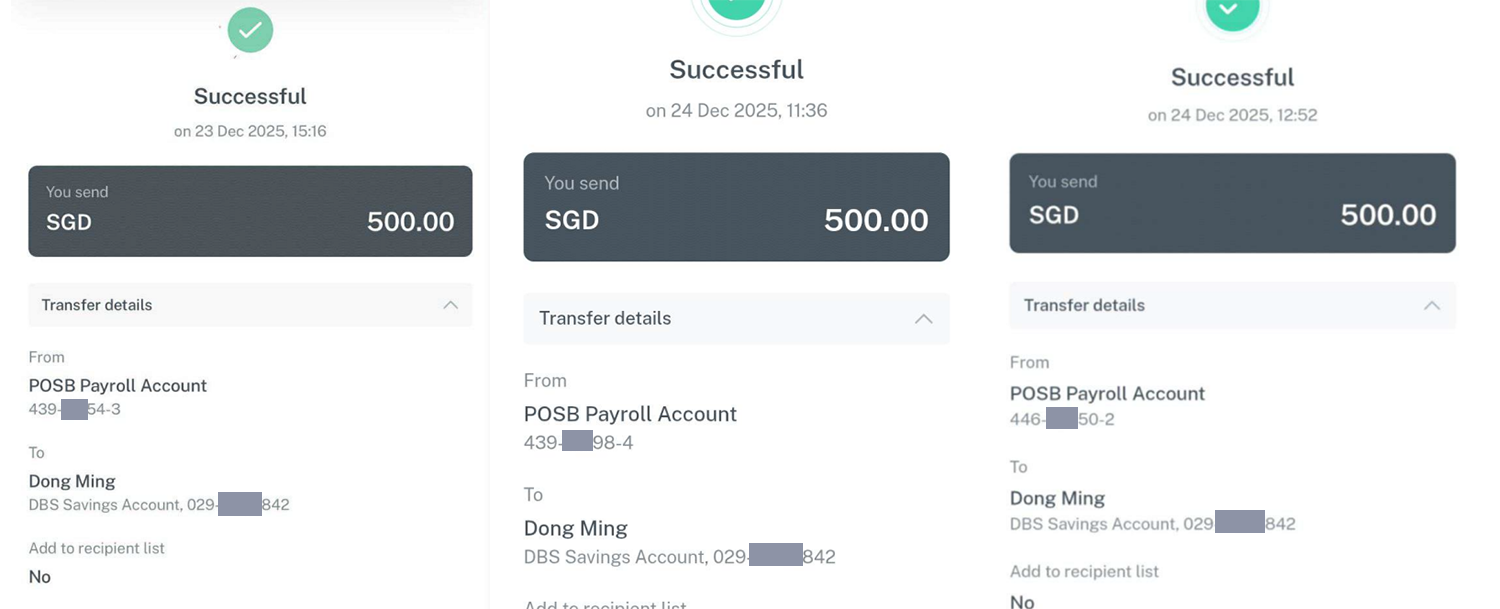
It is noteworthy that all five transactions were made from POSB Bank payroll accounts – five different ones. The significance of using payroll acounts will be explained in the section below. We can also see that all the transfers were made to the personal savings account of a certain Dong Ming, who is listed as a 50% shareholder of SG Jobs Pte Ltd. This person is a Singapore citizen with a Singapore address. However he or she is not listed as a licensed agent with the Ministry of Manpower either (checked 22 May 2026).
Here’s a summary of the above payments:
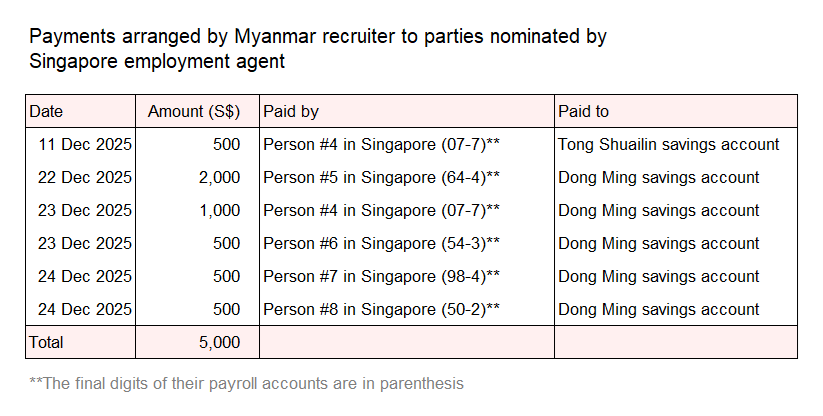
A total of $5,000 was sent across to the Singapore agency, said the Myanmar recruiter. Indeed, that is the total shown on the second table.
Significance of payroll accounts
A POSB Bank payroll account is a special type of account designed for Work Permit holders. It has to be opened with employer action, and is meant as an account into which salaries are paid. Its unique feature is that it is a zero minimum balance account, to cater to low-wage employees. However, a Work Permit holder is not supposed to engage in other kinds of work or commercial activity, and therefore there is no legitimate reason for a payroll account to be used in employment agency-related matters.
Yet, the Myanmar recruiter said these transactions were related to the recruitment of Heinoi. Might these transactions have been done as personal favours? Possibly, but unlikely. Why involve so many different payroll accounts? We can imagine small commissions being paid to the account holders for the “service” but this would open the Work Permit holders to criminal investigation.
SG Jobs Pte Ltd did not receive any money?
Curious too is that fact that none of the transactions sent money to SG Jobs Pte Ltd, the licensed employment agency shown at bottom left of Heinoi’s In-principle approval (image below). Instead, money was sent into personal savings accounts.
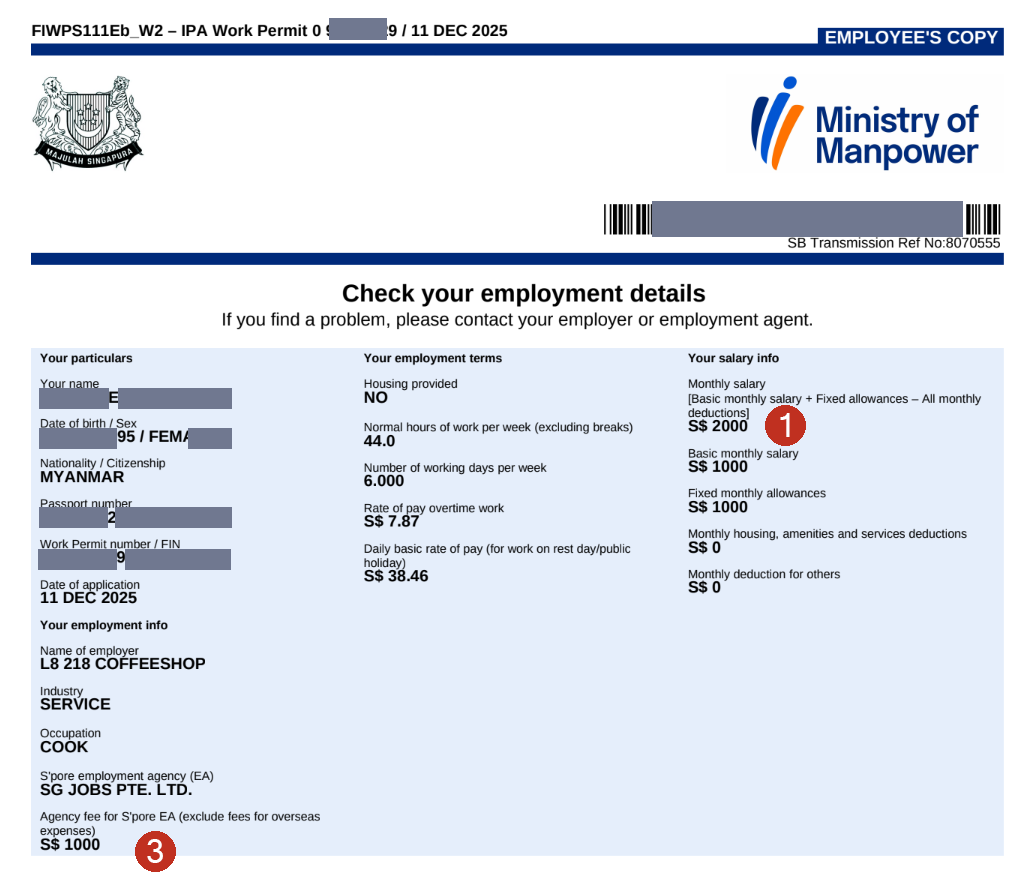
Why might these people do things this way? The most obvious possibility relates to tax avoidance, though we can do no more than speculate. Sg Jobs Pte Ltd ought to be liable for Goods and Services Tax (GST) as well as corporate income tax.
False declarations
We round off this story with a quick mention of other transgressions that we could see in Heinoi’s documentation. It shows how much of the recruitment business defies the law – in addition to all those illicit money flows detailed above.
This was the job confirmation signed in Myanmar by Heinoi. It shows that the agreed salary was to be $1,100 a month (marked as red disc 1) where the simple term “salary” in such documents usually implies the sum of basic monthly salary and fixed monthly allowance. However in the In-principle Approval imaged above, the corresponding figure, marked against red disc 1, is $2,000. Whoever submitted an application for a Work Permit for Heinoi falsely declared the agreed salary.
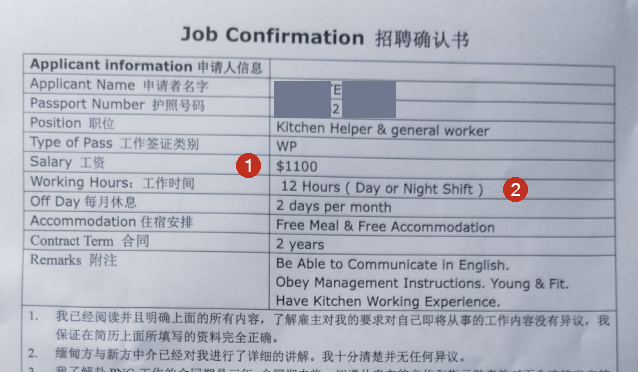
We cannot definitively explain why an agent or employer would want to falsely inflate the declared salary in this case, but one possibility that comes to mind is to justify a higher recruitment fee. Singapore law allows a Singapore-licensed agency to charge the equivalent of one month’s salary for each year of contract, subject to a maximum of two months’ salary. In Heinoi’s case, it is stated in the Job Confirmation that it would be a two-year contract. By declaring the IPA fixed monthly salary to be $2,000 a month, they would be able to charge an agency fee of up to $4,000.
And still it boggles the mind, for
(a) the Myanmar recruiter told Heinoi that $5,000 was sent to the Singapore agency, and
(b) on the In-principle Approval letter, the agency fee was declared as $1,000 (see red disc 3).
It’s like nobody cares about truthfulness and honesty.
Finally, there is the question of excessive working hours. Red disc 2 on the Job Confirmation letter marks where it is said Heinoi should work twelve hours a day. She would only get two days off a month. Twelve hours a day would easily mean a grand total of 130 to 140 overtime hours a month, far in excess of the legally permitted maximum of 72 overtime hours a month. Here too, it seems as if nobody cares about the law.
17369