

This is an AI-generated image. Any resemblance to real persons is unintended.
Two years ago, we wrote an article ‘If unemployed, yet required by authorities to remain in Singapore, where do they stay?‘ highlighting the problem of migrant workers caught up in police investigations, losing their jobs and being left with neither work or accommodation. yet, it cannot be in Singapore’s interest to have a pool of unemployed people floating about in desperate circumstances.
Just about all of these persons – some accused of an offence but either not charged or not yet tried in court so we cannot assume they are guilty, others merely required to remain in Singapore as potential prosecution witnesses through no fault of their own – are able-bodied and capable of holding a job. Meanwhile Singapore is perennially short of labour. Yet they are left to languish.
We argued in that article that their right to work, a fundamental human right enshrined in Article 23 of the Universal Declaration of Human Rights which Singapore is bound by, should be supported by better policies, designed to ensure that no one is left aside. We suggested that as a last resort, our large government-linked companies should be roped in to provide temporary jobs.
About two months after we published our article, the Ministry of Manpower responded. We appreciate that response; it makes for a conversation in the public interest.
On 27 Apr 2024, Transient Workers Count Too (TWC2) published an article, “If unemployed, yet required by authorities to remain in Singapore, where do they stay?” in which they took issue with the Government reserving the right to decide if migrant workers on Special Passes assisting with Police investigations were allowed to work.
Special Pass holders (SPHs) who are required to remain in Singapore to assist in investigations or as prosecution witnesses are generally allowed to work under the Temporary Job Scheme (TJS) during the investigation period so that they have the means to sustain themselves and provide for their family back home while the case is ongoing.
However, each SPH’s eligibility for TJS is assessed thoroughly by the law enforcement agencies conducting the investigations and/or the Ministry of Manpower (MOM), taking into consideration possible concerns over public safety and potential interference with investigations. It is important that the Government reserves this right to act in the best interest of the broader public.
While MOM does not overrule the decisions of law enforcement agencies, each work pass application is stringently assessed based on the prevailing criteria, and TJS applications are no different. Potential employers will also be informed of the worker’s legal circumstances so that they can make an informed hiring decision.
Eligible SPHs who need help to secure a job will be referred by MOM to employment agencies to facilitate their job search. These SPHs can also find jobs through their own preferred means such as by directly contacting employers or engaging their own preferred employment agency.
TWC2 should inform MOM when they encounter any migrant worker on Special Pass who requires assistance with finding a job or has issues with accommodation.
A close analysis of this reply reveals that it really is a re-assertion of the present system. It does not indicate any tweak in policy in response to the arguments we had put forth, which means the gaps in the present policy remain. The best way to illustrate the gaps is graphically.
MOM’s letter in effect describes a cascade of three “if” statements. At each level, what happens at “if yes” is described, but it remains silent what happens “if not”.
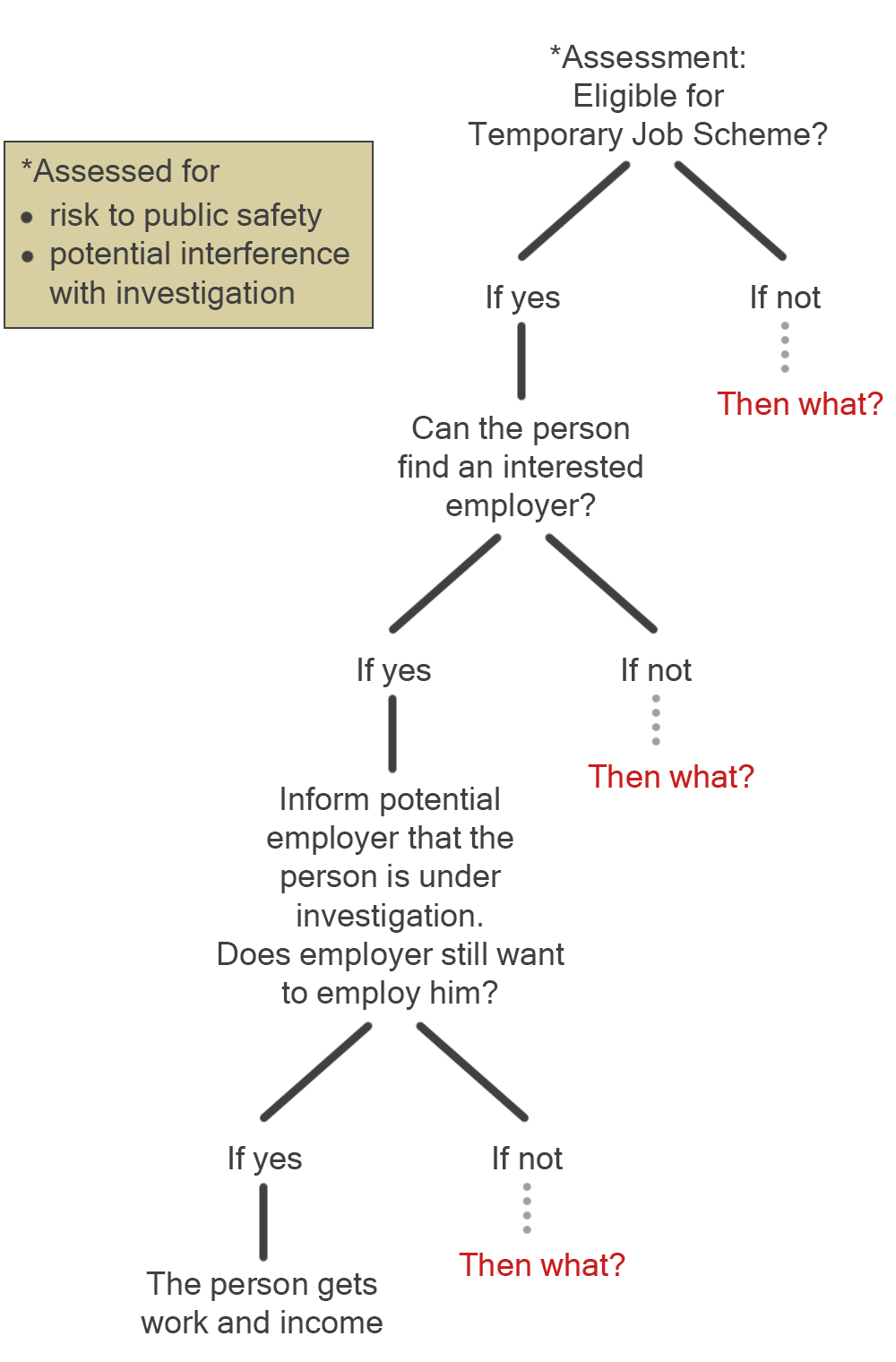
Our April 2024 article pointed out that when individuals fall through the “if not” cracks, the government (whether police or MOM) has no comprehensive plan to assist, even when it is the government that insists that the person remain in Singapore, sometimes merely as a witness. As seen from our diagram of the logic in MOM”s reply, there is indeed no plan. At best, for the individual concerned, there may be a piecemeal response, depending very much on how sympathetic the Investigation Officer is – which is not something one can rely on.
All we can hope for is that after we have highlighted the matter, the authorities would be more sympathetic and, while still abiding by their logical cascade, minimise the number of people falling through the “if not” cracks.
Public safety and potential interference with investigations
One part of MOM’s response cries out for additional comment. It’s this part:
… eligibility for TJS is assessed … taking into consideration possible concerns over public safety and potential interference with investigations.
It actually doesn’t make sense. Suppose a person is assessed to pose a public safety risk, e.g. the individual is prone to violence, or may possibly interfere with witnesses, wouldn’t it be better to keep this person employed and supervised for at least several hours a day, rather than let this person loose?
An intelligent response should be to find him a job that minimises contact with the public, for example. In turn, this means that the authorities will need to be more involved in getting him a job that comes with safeguards, whereas at present, the attitude is a hands-off one, basically saying “you’re not allowed to work”, which only gives that person more time and more incentive for mischief. There will be strong incentive to work in the shadow economy, possibly participate in criminal activities, just to survive.
Another way to look at this position expressed by MOM is this: if you’re a risk to public safety or may interfere with witnesses, we will not let you work and you go homeless and starve. Such a position smacks of pre-emptive, non-judicial punishment based on an internal administrative assessment. What if later a court finds the person innocent? Who is going to undo the months or years of unemployment?