

This is an AI-generated image
The crux of this story is about deductions made to a worker’s salary. More specifically, just because a figure for deductions is written into the In-Principle Approval, does that make it legit? The law says every deduction made to an employee’s salary has to be justified by the employer, clearly indicating that the burden is on the employer to do so.
Many workers with salary grievances first make their way to the Ministry of Manpower (MOM), and only later come to TWC2 – usually when they realise that navigating the claims process on their own is daunting. When they first show up at MOM, they are sent to the Tripartite Alliance for Dispute Management (TADM) which is the unit in MOM that handles employment disputes such as salary claims.
As with any claim, the claimant has to decide how much to claim based on whatever evidence he or she thinks there is. Even so, most migrant workers are not able to calculate the claim amount in detail. The mathematics is only part of it; there needs to be a clear idea of governing law and the applicable formulae for calculating salaries. Most workers rely on TADM officers to calculate their claim amounts for them.
Quite often, when the worker later comes to TWC2 and shows us his documents, including the claim calculations made by TADM, we find ourselves having to recalculate everything for the worker. It is unavoidable if we spot serious errors in the TADM papers. Naturally, we explain to the worker why our calculations differ, and if the worker prefers to use our numbers (they almost always do), he or she has to find the fortitude to insist that TADM use TWC2’s calculations. The latter part is not easy.
In this story about a construction worker whom we shall call Humayun, we will detail exactly why we told the worker that TADM’s numbers were insupportable, and why our calculations differed considerably.
We would also mention a recent article, Employer lowers overtime rate without worker’s consent, new rate accepted by TADM, where we opined that the mediator (we use the terms TADM officer and TADM mediator interchangeably) handling that salary case at TADM seemed unaware of provisions in the law and thereby acted in a way that prejudiced a worker’s claim. There are echoes of that in Humayun’s case too.
Background to Humayun’s case
Humayun had been receiving salary but not proper payslips, without which he had no way of knowing whether the amount sent monthly into his bank account was the correct amount. He had a sense, though, that it was less than accurate. So he went to TADM and filed a salary claim.
At first, he left it to the TADM officer to help him calculate his claim amount, but soon after, he came to TWC2 for help. The TWC2 case officer noticed that TADM’s calculations were incorrect, and completely recalculated the claim for Humayun in a manner that followed the law.
We will now explain the differences, but since they spring from how the In-principle Approval (IPA) should be read in relation to the Employment Act, we have to start by describing Humayun’s IPA.
The IPA
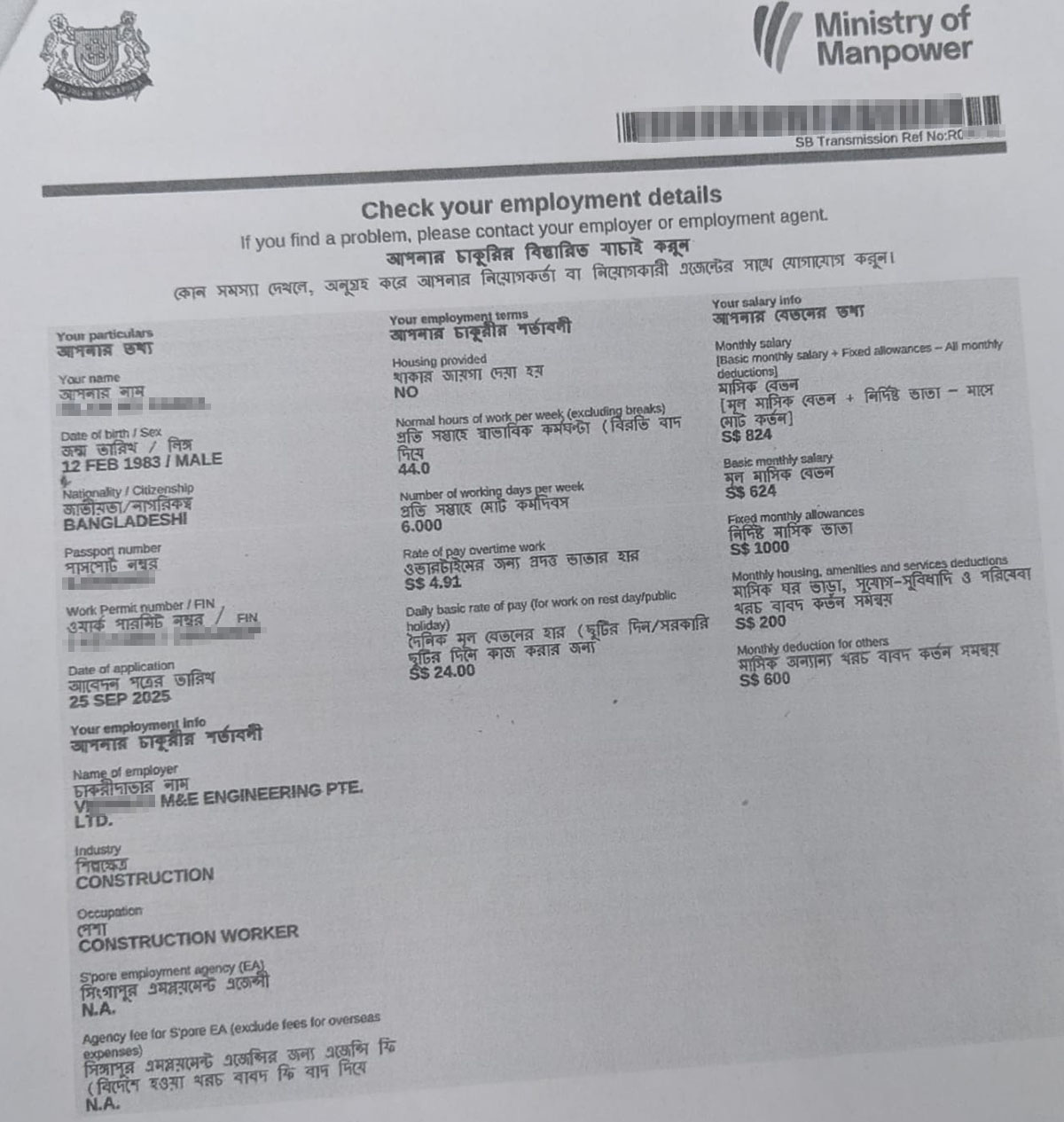
The In-principle Approval is a document generated by MOM when the ministry approves the employer’s application for a work pass for a foreigner. It carries the details that were submitted by the employer with respect to the job and its remuneration. This is Humayun’s IPA:
For easier reading, we summarise Humayun’s salary structure thus:
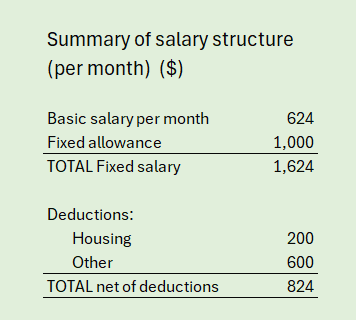
TADM used $824 as the starting point in its calculations; this figure can be seen as “Monthly salary” in the IPA and “Total net of deductions” in the peppermint plate. TADM came up with a claim amount of over $2,000. At TWC2 however, we use the Fixed salary (Basic salary + Fixed allowances = $1,624) as the starting point. Our practice is to leave aside the deductions stated in the IPA. Doing so, Humayun’s claim amount became $5,900; a huge difference.
Saving on the levy and overtime pay
As an aside, our experienced eyes tell us a lot about this structure. Firstly, the total fixed salary of $1,624 was designed to put Humayun in the category of an R1 skilled worker, which would give the employer the benefit of a lower rate in the monthly foreign worker levy. Yet, the total fixed salary of $1,624 was primarily made up of an allowance of $1,000, overshadowing the basic salary of $624. This had consequences for Humayun’s overtime pay.
If Humayun’s basic salary had been $1,624 per month, then his overtime rate would be at least $12.78 per hour, based on the formula set out in the Employment Act. By declaring his basic salary to be only $624, his OT rate would be only $4.91 per hour. What motives were there behind this salary structure? one might ask.
Yet, through the months of Humayun’s employment, the employer didn’t even apply the $4.91 rate. They paid Humayun $4.50 per overtime hour.
The deductions
The different starting points had to do with the deductions. By using $824 as the starting point, a figure that was net of deductions, TADM baked in the deductions. But once the worker adopts TADM’s method of calculation, he will have waived any contest to the deductions and the employer will not need to justify his deductions in the mediation and adjudication process to follow. It’s giving the employer a free pass.
Yet, the Employment Act is written in such a way that the burden lies on the employer to justify any deduction he chooses to make to an employee’s salary.
Our working method, therefore, is to base the claim on the fixed salary, and then let the employer justify each deduction in accordance with the Employment Act. It is not for the employee to automatically reduce his claim quantum by the deductions. It is for the employer to justify that these deductions are valid in law, and ultimately for the Employment Claims Tribunal to decide whether the employer’s justifications have merit.
After we explained to Humayun why we calculated his claim the way we did, he submitted the new calculations to TADM.
The TADM officer then asked Humayun whether he had another IPA that showed no deductions (he does not). This suggests that the TADM officer disagreed with our calculations, instead holding the view that only when no deductions are shown on an IPA can a claim calculation be built without deductions. The corollary would be that once a deduction is shown on the IPA, it must be absorbed by the worker. We see that position as wrong, and in conflict with law.
The officer was polite. She asked Humayun whether he had another IPA in hand that showed no deductions and whether TWC2 was working off the same IPA (with deductions) that Humayun had prevuiously shown her. This is the WhatsApp exchange:
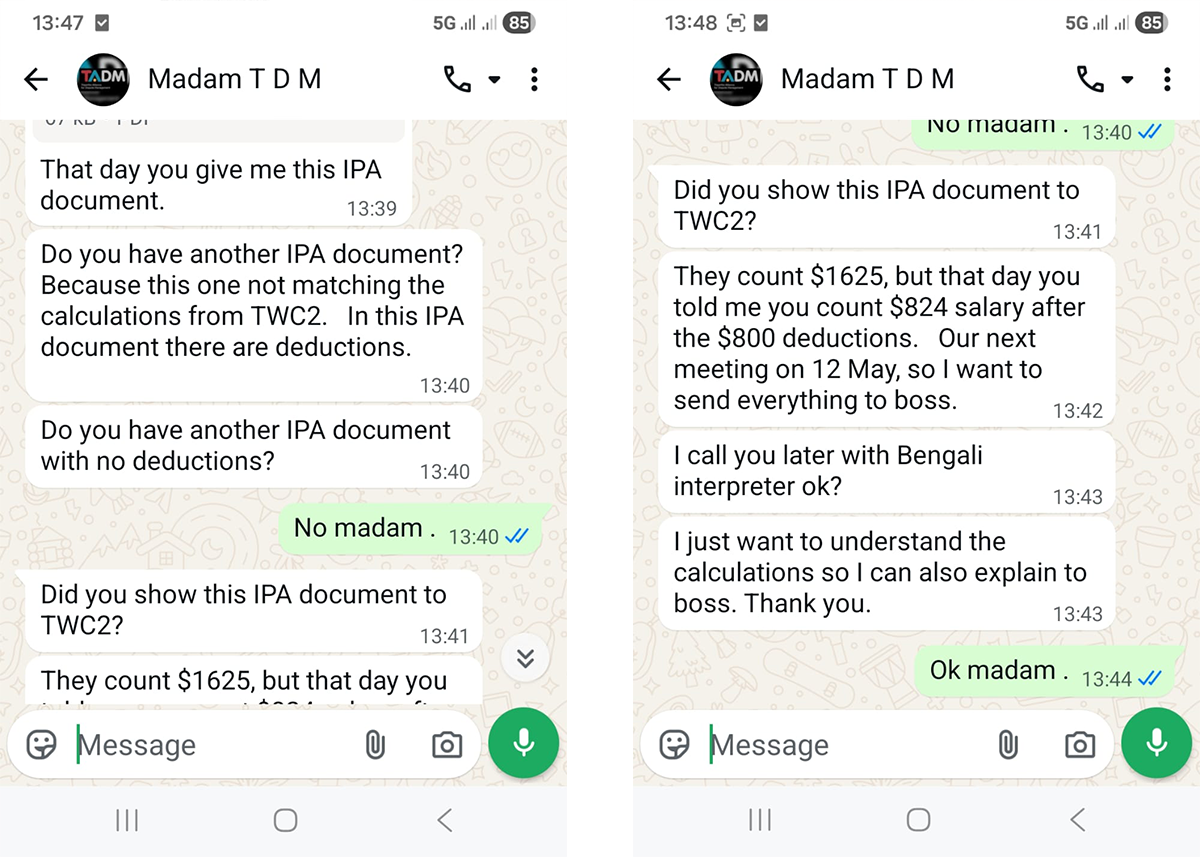
The query from the TADM officer after Humayun sent her TWC2’s calculations.
If we read between the lines here, the mediator can be seen saying that the choice of using $824 as the starting point for TADM’s calculations was Humayun’s when he first showed up at MOM and TADM. This might well be so. But we would argue that any officer doing this conscientiously would not merely ask the worker “What is your basic salary?” and take whatever answer at face value. It is common knowledge that many migrant workers don’t really know how to read the IPA.
At TWC2, we don’t ask workers “What is your basic salary?”. We scrutinise his documents including the IPA and we tell him what his legal documents say his basic salary is – quite often, the worker is surprised to hear a different figure from us – and then we proceed with our calculations from there.
Coming back to the WhatsApp messages, faced with this question from TADM about deductions, Humayun comes back to us for help to formulate a reply. He understood our explanation the first time, but finds it hard to articulate it himself when confronted with a challenge. We have to explain the law once more to him.
The law
Unlike fixed basic salary and fixed allowances, “fixed” deductions are not truly fixed. This is because the Employment Act has a lot to say about what is allowable as a deduction (and how much) and what is impermissible. Just because an employer submitted some figures during their work permit application process, and those figures wound up on the IPA document, it does not make them permissible. Any deduction is still subject to the conditions imposed by legislation. In using the term “fixed”, the IPA is poorly worded as a result.
Section 27(1) of the Employment Act lists deductions that may be made from the salary of an employee. What’s relevant here are sub-items (d) and (e). The exact words are:
(d) deductions made with the employee’s written consent for house accommodation supplied by the employer;
(e) deductions made with the employee’s written consent for such amenities and services supplied by the employer as the Commissioner may authorise;
These two sub-items are further qualified by Section 30(2), which says:
(2) Any deduction under section 27(1)(d) or (e) must not exceed an amount equivalent to the value of the house accommodation, amenity or service supplied, and the total amount of all deductions under section 27(1)(d) and (e) made from an employee’s salary by his or her employer in any one salary period must not in any case exceed one‑quarter (or such other proportion prescribed in substitution by the Minister) of the salary payable to the employee in respect of that period.
Humayun’s deduction for house accommodation would likely be justifiable since he was directed by the boss to stay in a hostel on Owen Road, but even here, there are two possible complications, the first of which is that in the IPA, the employer had declared that housing would not be provided. Given this inconsistency, it should be for the employer to justify why a $200 monthly deduction for housing was valid under the law. It was not for Humayun to explain.
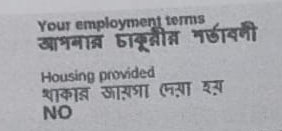
Fragment of the IPA relating to housing
Even if the Employment Claims Tribunal ultimately rules that despite the strange “No” in the IPA, the employer can still make a housing deduction in Humayun’s salary, is $200 a fair amount? That’s the second complication.
We ask Humayun: how many men were housed in the same room in the hostel? (he has since moved out).
Ten men, he says.
If it’s ten men and the employer charges each man $200 per month for housing, does the employer pay $2,000 a month to the hostel for just one room?
If the employer rents the room for less than $2,000 per month, how is $200 “equivalent to the value” of the amenity provided to Humayun (to use the precise words in the legislation)?
As for the $600 monthly deduction on the IPA for “Others”, Humayun says he did not receive any other amenity or service. Here again, if the employer wants to impose such a deduction, the employer has to justify it and also justify the value of the service or amenity so supplied. Moreover, it should not be done in hindsight. The worker should have been informed each time an amenity or service was supplied that its cost would be charged to him. That’s a basic principle of fair dealing.
The one quarter rule
The final part of Section 30(2) is particularly germane.
total amount of all deductions under section 27(1)(d) and (e) … must not in any case exceed one‑quarter of the salary payable to the employee in respect of that [salary] period.
If we treat the housing and “Others” deductions as fixed and inescapable – and these two add up to $800 a month – then Humayun has to earn at least $3,200 in a month to make this rule. According to the IPA, his basic salary and fixed allowance added up to only $1,624 per month. If Humayun did not work any overtime or extra hours (increasing his total salary for the month), it would not have been legal for the employer to put in a deduction of $800. That’s why we said above that “fixed” deductions are not truly fixed.
We can see it another way too. How much overtime would Humayun need to do to earn $3,200 in any month?
Sequence in the calculations
It is worth noting the implication within Section 30(2) as to the sequence to be used in salary calculations when it comes to deductions. In order to test whether deductions constitute more than one quarter of the total salary, one must necessarily first calculate the total salary before applying any deduction (if valid). This again confirms that TWC2’s method is correct.
At the correct overtime rate of $4.91 per hour – which the employer ignored, using a figure of $4.50 instead – Humayun would need to work 321 hours to earn $1,576 from overtime which, added to his fixed salary of $1,624, would make for a total of $3,200.
321 hours!
This would be plainly illegal. Section 38(5) of the Employment Act says:
(5) An employee must not be permitted to work overtime for more than 72 hours a month.
In short, there is no legal way for deductions totalling $800 to be applied. If the TADM mediator had done some back-of-the-envelope calculations like we did, the mediator would have realised this too. Yet, despite this clause in the law and the conditionality of deductions set out in Section 30(2), the mediator was putting the burden on Humayun to explain why he didn’t include the deductions in his claim calculations.
Although from gleaning the WhatsApp messages (imaged above) we thought the mediator was open-minded, Humayun says he could sense that she was miffed when he insisted on using TWC2’s calculations. “She pressure me to include the deductions,” he tells us.
We don’t have to ask him about his response to that. He volunteers: “I say I want to use TWC2 calculations.”
17800