

Salman and Kemal (orange dots on backs) speak with TWC2’s officer David
Sixteen men were recruited by a shipyard contractor in May 2025. The two of them who came to TWC2 told us that they each paid about $2,400 in recruitment fees. We believe the others also paid the same amount.
These two, whom we shall refer to as Salman and Kemal, had In-principle Approvals (IPA) from the Ministry of Manpower (MOM) showing a basic salary of $385 a month which frankly is an absurdly low salary. The IPA showed no allowances and no deductions, so $385 was also their fixed monthly salary. They could still hope to earn more through overtime, but at such a low base, they would need to work a horrendous number of overtime hours to make much of a difference to their total take-home pay. According to them, the other 14 workers had similar salary levels.
About a month after they started with the company – their workplace was Sembawang Shipyard – they were made to sign new contracts which now included a housing deduction of $100 a month, plus some other tweaks. Their fixed monthly salary was thus reduced to $281 a month.
Why MOM permits such a situation is inexplicable. This is laissez-faire gone mad.
Contract substitution
There is a name for such employer behaviour: contract substitution.
Not all contract substitution is bad. If both parties willingly agree, they can replace one contract that they had earlier signed with a new one. But if the substitution was carried out with a degree of coercion, with one party actually unwilling, then it should be very troubling indeed.
In the sphere of labour contracts, especially in relation to migrant workers, contract substitution tends to happen around the time when the employees are most vulnerable and unable to resist demands to sign new contracts and accept inferior terms. Psychological coercion through threats of immediate cancellation of work permits is almost always involved; sometimes more heavy-handed pressure is applied as well.
When this happens, the International Labour Organisation (ILO) sees it as an indicator of forced labour/human trafficking.
Salman and Kemal were at their most vulnerable in June 2025, a month after arriving in Singapore. They had invested money in recruitment fees to get their jobs; they had invested time and trouble and passed up opportunities to secure other jobs. To be faced with demands by their employer to sign new contracts or be sent back home jobless was most unfair. Despite this, it was a Hobson’s choice. They couldn’t but sign. Losing the job and going back home, writing off the sunk cost of a few thousand dollars, was not an option.
Nor were they alone. All 16 men who had come to Singapore on the same flight were called to the company office to sign substituted contracts. All on the same day. The employer didn’t even think it necessary to be stealthy. It was all brazen. He knew his actions would be blessed by law; we’ll come to that below.
This is Salman’s In-principle Approval, clearly showing a simple salary structure of $350 per month:
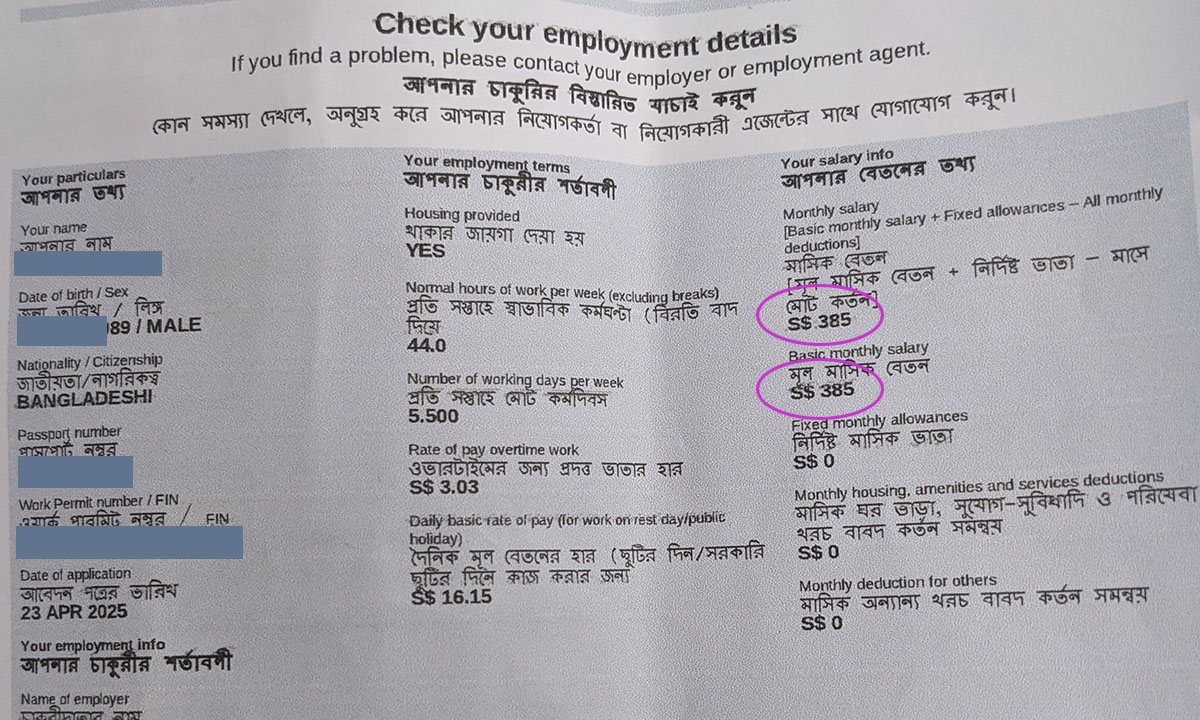
On 23 June 2025, he has made to sign a new contract accepting a $100 per month housing deduction, effectively reducing his salary by 26%. Here’s the relevant portion of the contract (officially known as confirmation of employment). Notice too how the clause is worded such that the amount to be deducted can be varied at will by the employer.
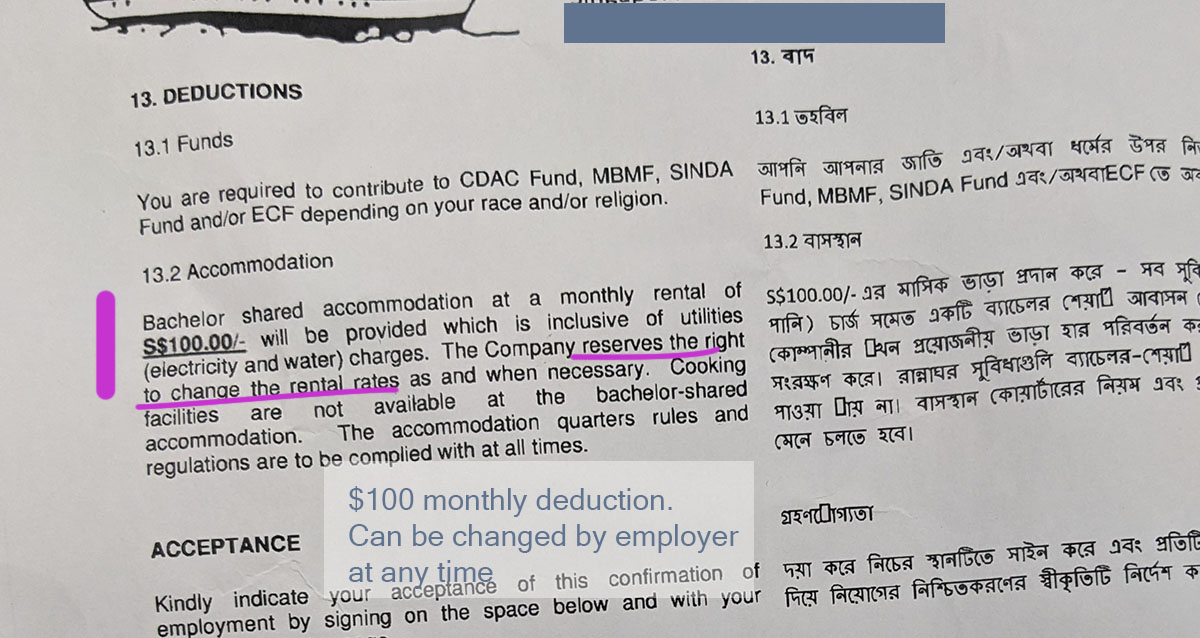
It is hard to believe that all this was not pre-planned by the employer, which is to say that at the point of recruitment, the employer’s offer of a $385 salary (shockingly low as it was) was almost surely insincere.
To put it another way, this can also be described as misrepresentation at the point of recruitment. The employer had probably not intended to honour his promised salary of $385. Misrepresentation too is an ILO indicator of forced labour/human trafficking.
Not uncommon
Contract substitution is something we see at TWC2 fairly often. We have even written about some cases in the past, for example in the article Contract substitution still happening in 2023.
There doesn’t seem to be any interest in MOM to stamp this out. On the contrary, our regulations enable a veneer of respectability to what goes on, effectively legitimising it. Under the Employment of Foreign Manpower Act, there are conditions for when an employer may debase a foreign worker’s salary.
Employment of Foreign Manpower (Work Passes) Regulations (2012) > Fourth Schedule > Part IV > Section 6A:
6A.—(1) The employer shall not —
(a) reduce the foreign employee’s basic monthly salary, fixed monthly allowances, rate for overtime payment or daily basic rate of pay to an amount less than that declared as such in the work pass application submitted to the Controller in relation to the foreign employee; or
(b) increase the amount of fixed monthly deductions to more than that declared as such in the work pass application submitted to the Controller in relation to the foreign employee,
except with the foreign employee’s prior written agreement.
As one can see, the law requires employers to obtain workers’ prior written agreement, but then the reality is that such consent is easily coerced. And the salary reduction… well, it’s all proper now, and enforceable by our courts as well.
17968, 17969