
Laws and
labour protection

LAWS AND LABOUR PROTECTION
“[The company] told me to follow the company agreement, not MOM’s law. They said that everyone does that.” – Migrant worker (name redacted)
No matter how many individual workers we assist, more workers will find themselves in need of help, unless their systemic vulnerabilities are addressed. TWC2 thus advocates for improvements in migrant labour legislation and its enforcement.
We gather evidence about workers’ lived realities, call out errant employers and practices, identify key gaps and solutions, and drive public and parliamentary conversations about migrant worker policies.

Migrant workers are essential to Singapore’s economy.

Background on relevant laws
There are several pieces of legislation impacting migrant workers. One – EFMA – is specific to foreign nationals working in Singapore, while the others cover both local and foreign employees.
Singapore’s Employment Act (EA), which came into effect in 1968, lays out key employment rights for all employees except for domestic workers and seafarers. The Act affords critical protections around maximum hours of work, the right to weekly rest days, and salary payments.
The Employment of Foreign Manpower Act (EFMA), established in 1990, governs the employment conditions of migrant workers and regulates areas not covered by the Employment Act. These include employer responsibilities, Work Permit rules, and repatriation.
The Employment Claims Act sets out processes for dispute handling. The process is a two-stage one involving mandatory mediation, followed by adjudication by the Employment Claims Tribunal if mediation is unsuccessful. It applies to both local and foreign employees.
There is also the Work Injury Compensation Act, which ensures that employees receive due compensation after any work-related injury.
Other laws that have a bearing on migrant workers include:

TWC2’s recommendations are shaped by our conversations with migrant workers, and the cases we handle.
Recommendations over the years
Too often, we see workers fall through gaps. Upon gathering evidence from the ground-up, we communicate our observations and recommended solutions to policy makers. Click on the following tabs for our key findings and recommendations, as well as progress made over the years:

Helping a worker assemble documents for his salary claim as he fights it at the Employment Claims Tribunal.
The need for better enforcement
Despite better protections offered by EA and EFMA over the years, many migrant workers continue to face exploitation and abuse. The most common infractions that TWC2 sees are:
- Illegal and excessive work hours
- Non-issuance of salary documents (timecards and payslips)
- Salary payments by cash instead of bank transfer
- Salary under/nonpayment
At a talk we gave in July 2026, when we described the above kinds of issues that commonly surface, an audience member commented that it was strange to see how all these were only dealt with as civil infringements when underlying every case was a criminal infraction. So why aren’t these treated as such? he asked.
Indeed, that is a good point. TWC2 thus calls for existing laws to be enforced more strongly. By documenting the cases that we see on the ground, we blow the whistle on errant employers, and spread public awareness on the realities that migrant workers face.
Read our latest articles to find out more about these issues, and click on the following tabs for the key changes that we urge MOM to adopt:
Read more
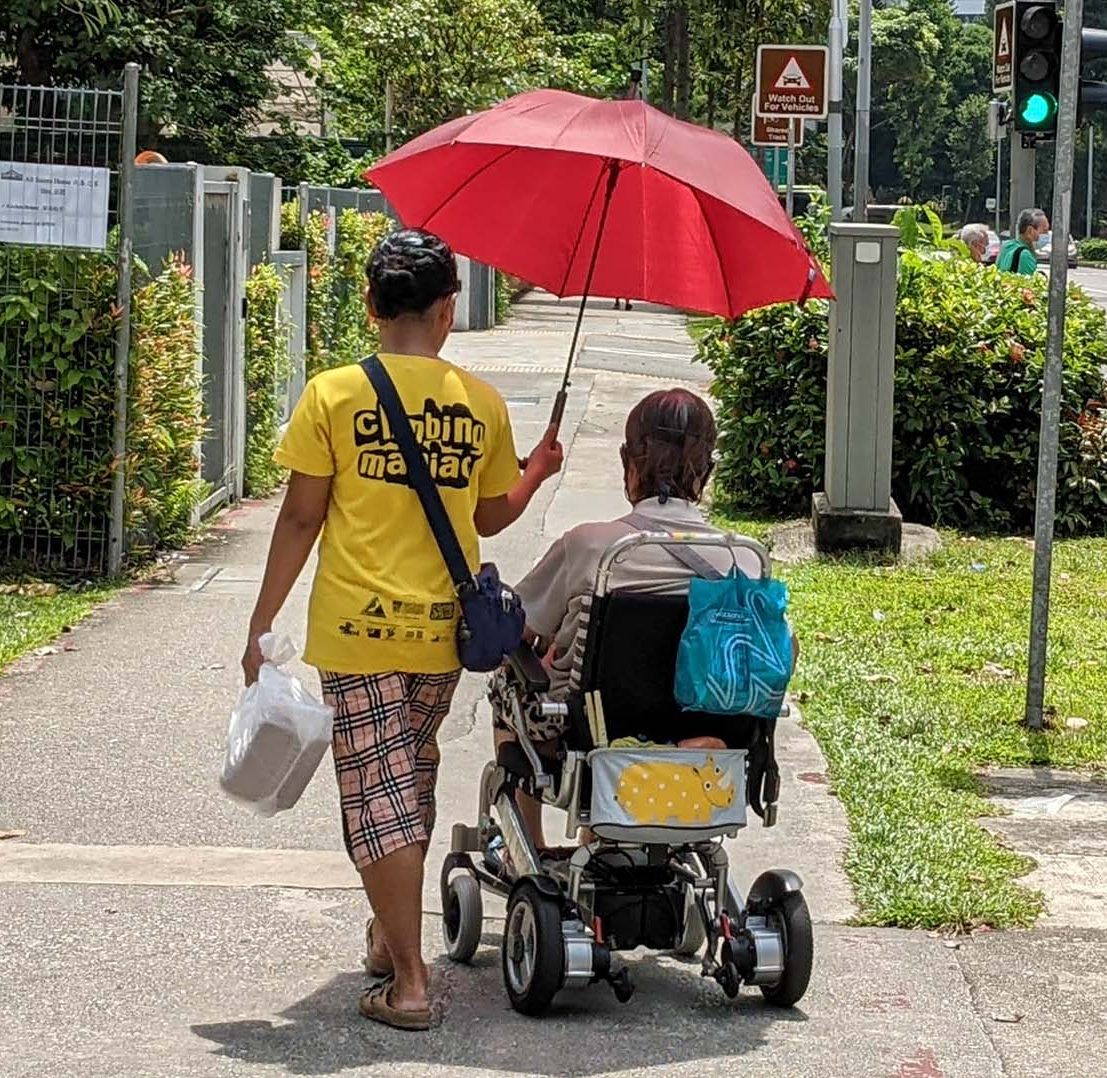
There are over 300,000 domestic workers in Singapore, and they are not protected by the Employment Act.
Domestic workers
TWC2’s work began with improving the conditions of migrant domestic workers in Singapore. Together with other NGOs, we advocated for rest days for domestic workers. In 2012, MOM announced weekly rest days for workers from 2013. Further progress was made in 2023, when MOM mandated that at least 1 rest day a month cannot be compensated away.
While most of our clients are now non-domestic workers, we continue to provide employment advice to domestic workers, and assist with cases when they arise.
- 2025: Piang’s case
- 2024: Mariah’s case
- 2023: Nony’s case
- 2023: TWC2 report on MDW food situation
- 2022: TWC2 critique of MOM’s rest day guide
- 2021: MOM mandates 1 compulsory day off a month for MDWs
- 2021: TWC2 restates recommendations after death of abused MDW
- 2021: TWC2 commentary on weekly days off
- 2020: TWC2 press letter on MDW risk of abuse during lockdown
- 2020: TWC2 press letter on maid agencies abusing power
- 2019: TWC2 press letter on MDW KPIs
- 2017: TWC2 contributes to 2 CEDAW shadow reports
- 2016: TWC2 report on MDW living conditions
- 2016: TWC2 report on MDW recruitment costs
- 2015: Joint statement on surveillance of FDWs
- 2015: Wahyuni’s case
- 2015: TWC2 report on weekly day off
- 2013: TWC2 press commentary on progress on MDW rest day
- 2011: TWC2 forum letter on public attitudes towards MDWs
- 2011: TWC2 on Settling-In Programme
- 2010: TWC2 highlights food issues faced by MDWs
- 2009: TWC2 report on MDW wage payments
- 2009: TWC2 report on experiences of Indonesian MDWs
Other needed protections
Workers being ferried on the backs of lorries repeatedly comes up in the public discourse. So does the question of dormitories. Indeed the daily discomfort, safety risks and indignities that stem from lorry transport and crowded dormitories are issues that weak legislation permits, and they need to be addressed.
Yet, TWC2 is always conscious of the need to be responsive to migrant workers’ priorities rather than impose our ideas of what is important onto them. In this respect, it is humbling to note that when we meet workers, they hardly ever bring up these issues unprompted. Instead, the most pressing issues for them relate to unpaid salaries, contract violations, premature termination and difficulty in getting treatment for injuries.
There is reason for this. The men and women are here to work, earn and provide for their families. Anything that stands in the way of a decent job and promised income is critical for them. They will endure great hardship – the indignity of lorries, the lack of privacy in dorms – to work and earn, but hardship is not critical the way having a job and regular salary payments are.
This is not to say that these questions of transport and accommodation can be left aside. Our common humanity does not allow such callousness.
There is one more issue that irks migrant workers on a daily basis: catered food. The quality is poor, and delivery schedules often mean food is left waiting for too long before they can be consumed. This, strangely, does not garner public concern as much as lorries and dorms, but it probably frustrates workers more than these two issues.
For more information about how we have spoken up on these, click the tabs below:
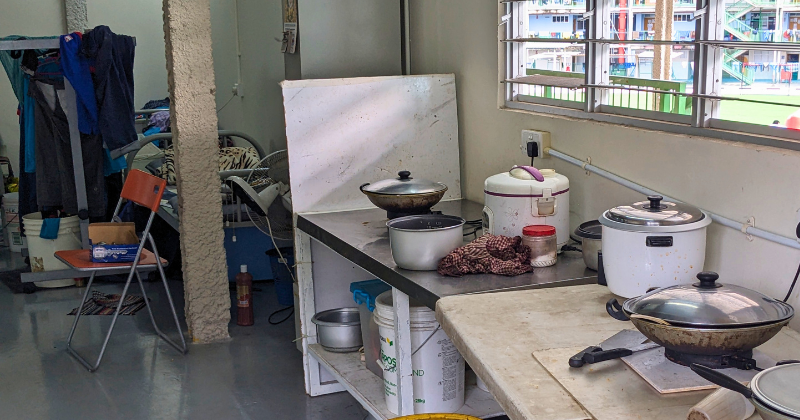
Prime Lodge, 2023. It is not compulsory for dormitories to include cooking facilities, leaving many workers reliant on catered food with poor nutrition.