
Salary problems made up 55% of the 1,600 cases handled by case officers and volunteers in 2025. It is the most common problem that migrant workers face. Nearly all salary problems involve a dispute over overtime pay (among other components of salary). Some workers have also been made to work on their rest days and public holidays and complain they have not been properly paid for those extra days.
One of the most common ways employers use to stymie any future claims over improperly paid extra hours is to prevent employees from having any record of those extra hours. This way, employees will be at a serious disadvantage when they wish to file claims because the Employment Claims Tribunal puts the burden of proof on workers.
The traditional way extra hours are recorded is through a handwritten card which workers refer to as a time card. Typically, workgang supervisors write onto the card the starting and ending times of a worker’s workday and sign against the line entries, or they simply write in the number of basic-pay hours and overtime-pay hours. At the end of each month, workers must submit the physical cards to the company’s payroll department so that the due amounts for overtime and other extra hours can be computed.

A worker shows us a photo of his time card on his phone. He came to TWC2 for help over unpaid salary.
A variant of the handwritten time card would be the punch-card system. Here is an example:

Not only did this cafe employee work illegally long hours, she was not paid for any of her overtime at all. At least she had proof of her hours.
It is hardly unusual to see cases of migrant workers being made to work 12-hour days like the cafe worker above or 14-hour days like the construction worker in the first picture. The law permits 12-hour days, but it cannot be every day. It limits the total number of overtime hours to 72 per month.
See also our research report Overworked and Underprotected.
Whether handwritten or punched, workers who are savvy will often take a photograph of their cards before handing them to the payroll department. These photos will be immensely helpful when we have to calculate exactly how many extra hours were worked and how much the extra wage component should be.
Unfortunately, we also see a lot of workers who trusted their bosses and failed to take photos before passing their time cards or punch cards to their human resource departments, only to suspect a few months later that in fact their monthly salaries had not been correctly calculated. By then, however, they have no proof in hand.
The importance of having photographs of their time cards is underscored by how seriously bosses take them. In the story Boss locks up his workers, seizes phones and deletes all their data we describe an incident in which, as his employees start to express unhappiness over non-payments, the boss resorts to seizing all their phones and deleting data and photos from the devices.
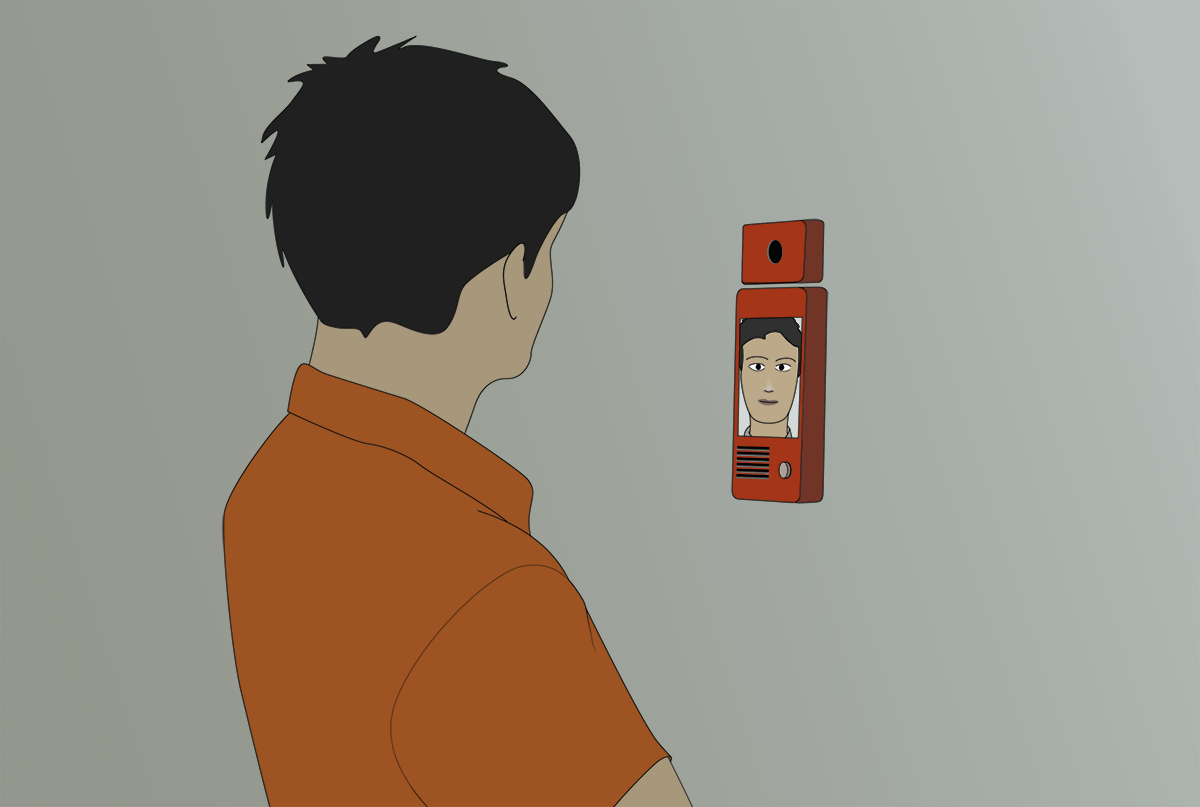
It gets worse. The current trend is to move to face-recognition systems. This is a seriously regressive step from workers’ point of view, since all data is captured and stored digitally and no copy is available to workers. There is nothing to photograph even if they want to.
Payslips
The law does not require employers to provide copies of time records to employees. Instead, Section 96 of the Employment Act requires detailed itemised payslips. MOM has on its website a template of how a payslip should be, though we think that the template itself has shortcomings. It could be better.
Enforcement, however, is patchy at best. Judging from the cases we have handled, our sense is that many employers, particularly those with intent to underpay their workers, will simply not issue payslips, confident that the authorities will not hold such lapses against them. Even when a salary case is lodged and the worker tells an MOM officer that he had not been getting detailed itemised payslips, we have yet to hear of any instance when the employer was penalised for failing to do so. The Employment Act may speak of payslips being mandatory, but in practice, too many employers see them as optional.
Moreover, even when employers dutifully provide payslips, the information on them may not be sufficiently detailed to allow an employee to know for certain whether it is accurate. For example, the payslip may say the overtime component is $455.36, but does not say how that number was derived. How many overtime hours does that represent, and at what hourly rate?
Digital payslips
Increasingly, employers no longer issue paper payslips. It is fine to use digital copies, sent to the employees via WhatsApp, for example.
However, we have also seen instances where the employer uses a proprietory app which requires workers to log in to see payslip details in there. Typically, after a worker has filed a salary claim because he or she has been incorrectly paid despite nicely-formatted payslips, the employer cancels the employee’s Work Permit, and removes his or her log-in privileges to the app. All of a sudden, just when the employee needs to show previous payslips to prove short-payment, they are no longer accessible,
Centralised Payslips Portal
While enforcement has a role to play, creating a universal platform for payslips (and time sheets) can make a big difference in effectiveness. It standardises format, and it makes it easier for a court to apply the presumption – simply from the absence of uploads onto the portal – that an employer contravened the law by not providing payslips.
A web-based portal that does not disable logins after Work Permit cancellation also overcomes the disadvantages of proprietory apps.
TWC2 would suggest that the required format be as follows:
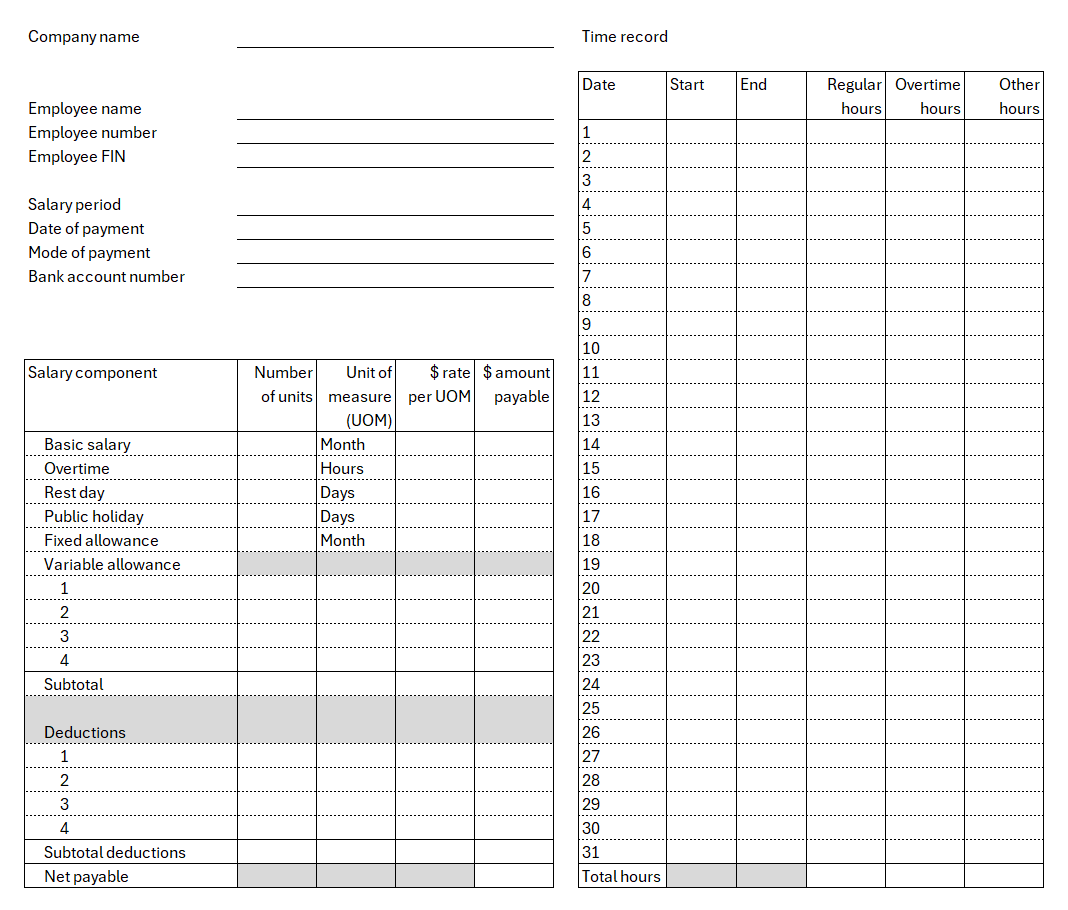
Example of a good payslip.
The point is not only to show how much is being paid, but how the numbers were derived. That is why it is important to detail the hours day by day even though Section 96 of the Employment Act does not say so.
Good employment relationships and fair dealing begin with honest exchange of information between parties. This builds trust, and a centralised payslips portal is the way to go.