

Schubert (name changed) has two different problems. One is completely familiar to us, the other less so. The familiar one is that he has been paid much less than what the law says his salary should be. The less common one is that he is upset that his boss is making him work on his rest day.
Most low-wage migrant workers want to work as many hours as possible. This springs from the extremely low basic salaries in the construction, shipyard and service sectors where most of their jobs are. Working overtime is their way of boosting their income, despite the risk of workplace accidents when they get too tired.
Occasionally, we see a worker who tells TWC2 that he or she really does not want to work these many hours anymore, but Schubert is the first in a long time to say he does not want to work Sundays. He stresses Sundays. He wants to go to church and the employer won’t accommodate him.
He tells us that things are coming to a head. He has spoken to his boss about Sundays, but the boss remains unyielding. Then in the week before coming to TWC2, the boss made him sign a letter without him being given any chance to read it. Of course, the boss didn’t give him a copy either.
We ask him to recall as much as he can about what was said concerning the demand to sign that piece of paper and, piecing together the fragments of dialogue he can remember, Schubert comes to the view that it was possibly a warning letter. The employer may be laying the groundwork for firing him. Schubert thinks the letter might have said something about his poor attitude, so that it can be used to justify termination.
The bullying way in which an employee is made to sign something without giving him a chance to read it, and without giving him a copy actually tells us more about the attitude of the boss than the worker.
The problem of Sundays
The law is clear that employers can only request employees to work on their rest days. They cannot compel through rostering and then penalise an employee for demurring.
Section 37(1) of the Employment Act says:
37.—(1) Subject to section 38(2) or 40(2A), an employee must not be compelled to work on a rest day unless he or she is engaged in work which by reason of its nature requires to be carried on continuously by a succession of shifts.
Those other mentioned sections – 38(2) and 40(2A) – are meant for situations of extreme necessity, such as dealing with accidents, urgent work to be done to machinery or plant, or work essential for defence or security. These exceptions do not apply here. Nor is the construction work that the company engages in, according to Schubert, done continuously in shifts.
We advise Schubert that if the employer fires him over the question of his rest day, we can help him file a wrongful dismissal claim. He is happy to hear that he has rights.
Salary short-payment
The salary problem that Schubert describes is frustratingly common. It is one where a worker is promised a certain salary – evidenced by formal documentation through the Ministry of Manpower (MOM) – and yet he is paid at an arbitrarily lower rate. Over the twelve months that Schubert has worked, he believes that he’s been shortpaid by over ten thousand dollars. It has reached such a point that whether or not the employer resolves the Sunday question, he really doesn’t want to continue with the company much longer.
We tell him he should not procrastinate. Under the Employment Claims Act, he can only file claims for owed salary for the previous twelve months. It is already late May 2026, and Schubert started with the company in May 2025. Any delay and he will be forfeiting his right to claim owed salary for the earliest months.
This seems to be helping him crystalise his decision.
Now, let’s look at the details.
Back in 2025, when the employer applied to the MOM for a Work Permit for Schubert, they would have had to submit salary details, and declare that these details represented the terms of employment agreed between them and Schubert. The details are stated in the In-principle Approval (IPA) letter that Schubert received prior to his coming to Singapore, and can be accessed by Schubert through an MOM app.
Employers have been known to surreptitiously go into MOM’s online system and change the salary details midway through employment, doing so with the false claim that the worker has given prior written consent to the modification. However when Schubert uses the app to check again, he confirms that the salary details there remain the same as those on his original In-Principle Approval (IPA).

Screenshot that Schubert took when he accessed his salary details through the MOM app
With the above information, we are able to derive what should be the hourly rate for overtime work and the daily rate for working on rest days. The Employment Act lays down the necessary formulae.
Now that we have established what Schubert’s rightful salary should be, we ask him how much he was actually paid. He describes wildly different rates of pay and shows us his April 2026 payslip to illustrate his point. The stated hours (start-work and stop-work times) are correct, he says, but the basic salary – the company uses a basic rate of $2.50 per hour when it should be $800 a month according to the IPA – was plucked from thin air. We can see several other issues with the company’s computation too, most starkly the total absence of the promised $550 monthly allowance.
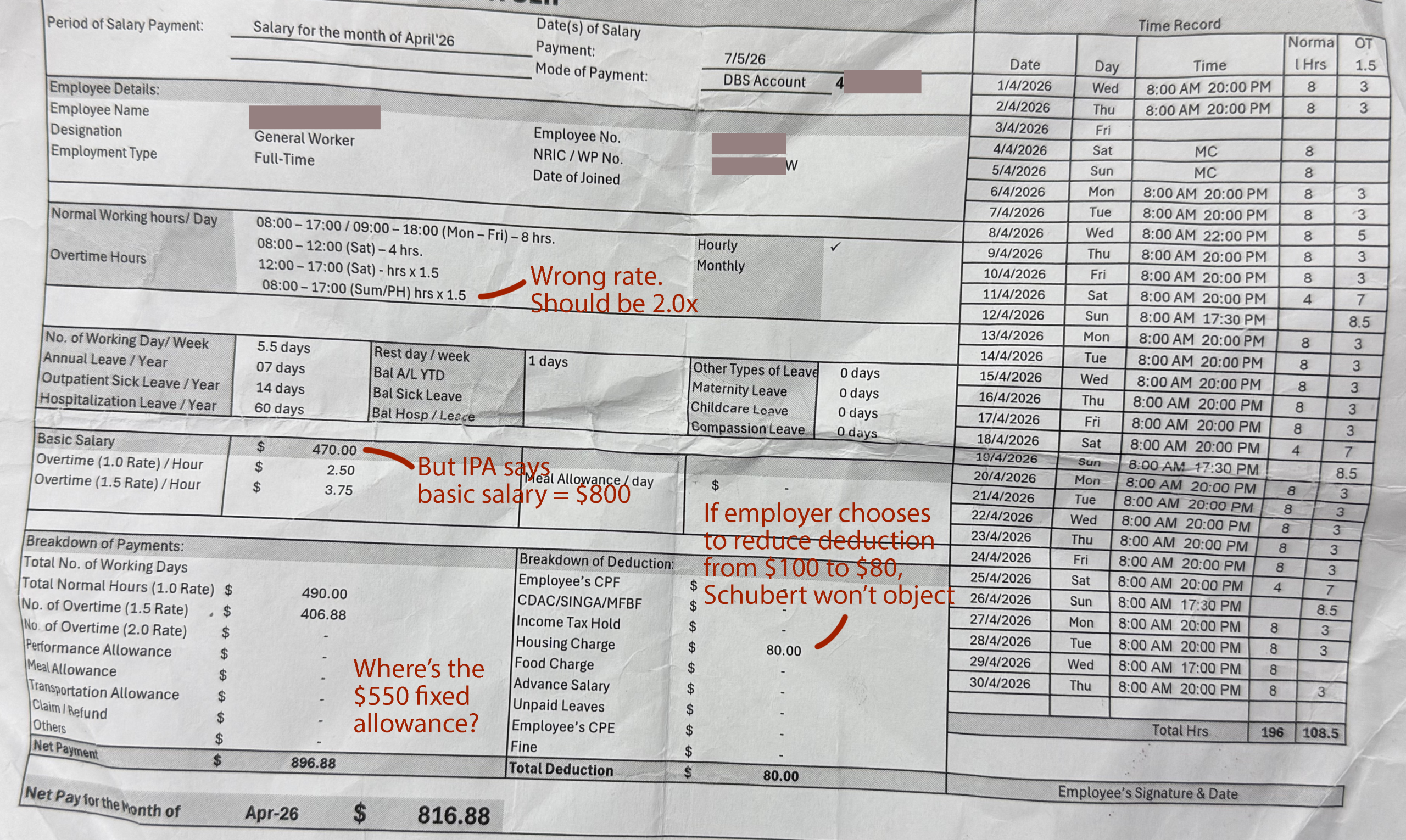
Payslip for April 2026 with TWC2 comments in red.
For our readers’ convenience, we put the company’s calculation and our own calculations (done according to the IPA) side by side:
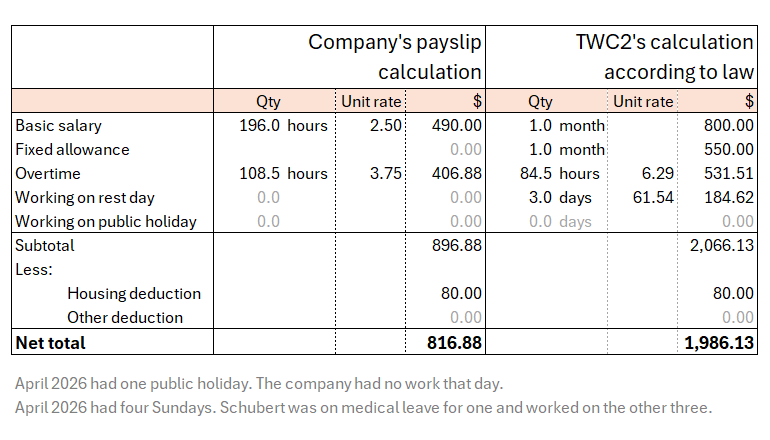
As shown above, Schubert was short-paid by over a thousand dollars in April. He thinks the shortfall was similar in other months.
Not quite yet
After we explain the steps in the salary claim process, Schubert leaves our meeting more or less firm in his decision that he should not delay much further and file a salary claim soon. We also assure him that under the law, even if the company cancels his Work Permit because they are unhappy with him for such audacity, they should continue to provide bed and board for the duration of the claim process all the way to its resolution. It’s in the rules. He likes hearing all this from us.
But he doesn’t say, “let’s do it now”. He wants to finish the month of May 2026 and have his May salary in hand before filing a claim. We agree that that will be a good idea. Unlike previous months when he remits nearly everything back to his family, this time he needs to have enough cash reserves to tide over a period of unemployment.
“Come back to us again when you are ready,” we say to him as he walks off with a jaunt. “We will help you file the claim.”
Silence
We don’t hear from Schubert again for the next two months, and we begin to wonder if he has had cold feet. Finally, we send him a WhatsApp message. He replies promptly. He is back home, he says. He filed a claim on his own at MOM, and the employer settled it within six weeks. In all, he received more or less all that he was owed.
Naturally, we are happy to hear that, but even more, we are proud of guys like Schubert. They come to TWC2 with a tangle of problems but after talking things over, their mind clears. They listen carefully as we explain the process, and then they go out and do the whole thing on their own.
17970