

Ridouan (name changed to avoid retaliation) is totally stressed out. His case has three hellish aspects and at best he can only get partial remedy for one. The three are:
1. Having had to work absurdly long hours, almost always from 5am to 9pm, seven days a week;
2. Not being paid at all for these extra hours;
3. Having to pay a kickback of $500 a month to the boss to keep the job.
Legal limit on overtime
Singapore’s Employment Act sets a cap of 72 hours as the maximum permissible overtime per month. By making Ridouan work from 5am to 9pm every day, he was totalling about 250 hours overtime a month. We hope the ministry will take action against the employer for so blatantly flouting the law.
Time lost cannot be recovered. There is no getting back the long days he put in over the two years of employment, with leisure and social life forgone and connections to family stretched to breaking point.
We can help him get backpay for the overtime hours. Unfortunately, he worked nearly 24 months, and under the Employment Claims Act, claims are limited to only the past twelve months. Even so, Ridouan calculates with our help that he is owed about $36,000 for just the second of the two years he was in employment.

Ridouan’s own notes about his working hours in the month of March 2025. He worked on public holidays too.
Why did he stay in the job for so long when he felt unjustly treated? The burden of the recruitment fee was the reason. Ridouan paid a nearly incredible sum of $11,000 to get this job. Even now, 24 months later, he tells us that there is about $2,000 of his loan still outstanding. Like so many other migrant workers in a similar situation, once trapped into an obligation to pay back the loans taken to fund the recruitment fee, a worker will find it nearly impossible to file a complaint and risk losing the job.
During recruitment
Two years earlier, when Ridouan was negotiating with an agent in Bangladesh for a job as a cook in Singapore, the agent told him the salary would be $2,000 a month. There was the implication that this would be an all-inclusive salary, rather than a basic salary. However, Ridouan cannot recall exactly how the agent put it, since it was quite long ago.
At the level of Work Permit jobs, there is no such thing as an all-inclusive salary. The law provides that there should be a basic salary (for up to 44 basic hours a week), plus additional components such as overtime pay, working on a rest day, and so on. So, already at this point, Ridouan was not properly informed.
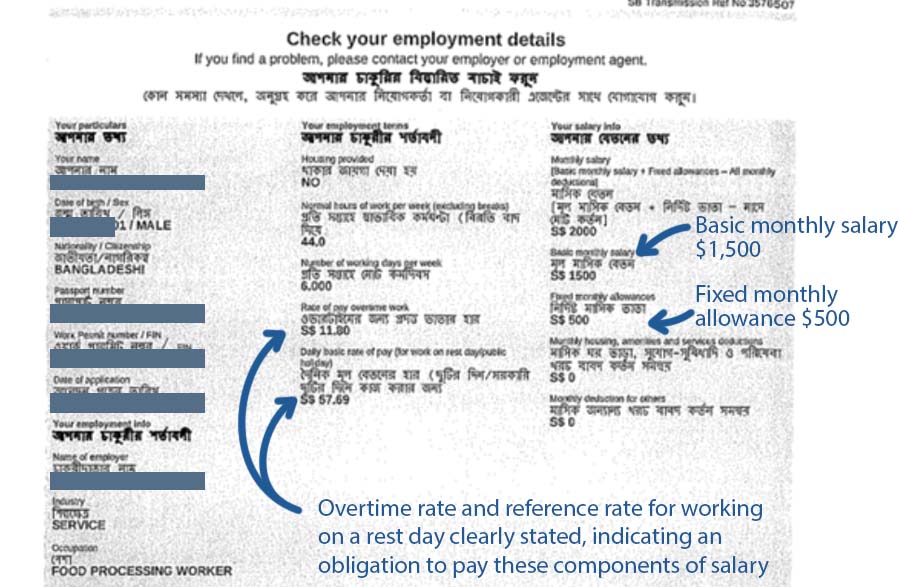
Ridouan’s In-principle Approval
When he received his In-principle Approval, there was still no reason to be concerned. As can be seen above, his basic salary was declared as $1,500 with a $500 allowance on top of it, totalling $2,000. Satisfied that everything looked to be in order, he came to Singapore and started work at a restaurant in Little India.
The first paycheck and a shock
On his first payday, he saw $2,000 credited into his bank account. All looked good. But then, the boss demanded that he withdraw $500 from an ATM and hand him back this amount in cash. This is known as a kickback and it is illegal. The agent had never mentioned anything about a kickback when the job was under negotiation.
Month after month, Ridouan had to give $500 back to the boss. Over the course of 24 months of work, Ridouan handed back $12,000.
Because the transactions were all in cash, prospects of making a successful claim over this are poor.
The law and the reality
Ridouan seems to accept this reality. And this is where we need to understand how something like this can happen despite the laws that Singapore has. Section 22(A) of the Employment of Foreign Manpower Act makes it abundantly clear that taking of such monies is an offence:
22A.—(1) A person must not deduct from any salary payable to a foreign employee, or demand or receive, directly or indirectly and whether in Singapore or elsewhere, from a foreign employee any sum or other benefit —
(a) as consideration or as a condition for the employment of the foreign employee, whether by that person or any other person;
(b) as consideration or as a condition for the continued employment of the foreign employee, whether by that person or any other person; or
(c) as a financial guarantee related, in any way, to the employment of the foreign employee, whether by that person or any other person.
(2) Any person who contravenes subsection (1) shall be guilty of an offence and shall be liable on conviction to a fine not exceeding $30,000 or to imprisonment for a term not exceeding 2 years or to both.
For good measure, subsection (3) of Section 22(A) outlaws all sorts of spurious salary deductions or demands on the basis of various benefits or costs, except those that are allowed under the Employment Act.
Yet, the law only operates if a complaint is filed, and it has to be either Ridouan filing it, or he supports it when called for investigation after another whistleblower has complained.
With debt hanging over his head, filing a complaint and getting the sack would be jumping from the frying pan into the fire. The sack would inevitably mean a long period of unemployment even as loan repayments must still be made. Ridouan didn’t have any free time to look for another job, so it’s not as if he could line up alternative employment while contemplating filing a case (and preparing to be fired).
Complicating things further, he was dependent on his boss or MOM to give him permission for a transfer. Unlike the case for Singaporeans who would be free to look for another job at any time, the same privilege is not enjoyed by a foreign worker like Ridouan. He knew his boss would never give him permission to seek a transfer. As for MOM, permission from the authorities was only possible after he had filed a complaint and suffered the sack.
Then there are industry sector rules. Unlike Singaporeans (again), a foreign worker like Ridouan cannot look for any job; he is bound by MOM rules that he stay within the same industry sector. Ridouan is a cook with skills in Bengali cooking. There aren’t a lot of openings for that.
It was entirely rational when he thought he had little choice but to stay on the job. Month after month, he gave $500 to his employer. It was only after the employer failed to renew his Work Permit that Ridouan had nothing more to lose and was “free” to file a claim.
Yet, we have to tell him that the prospect of recovering any of the kickback monies is remote. Every payment had been in cash. We know from other cases we have seen that the Ministry of Manpower does not actively investigate cases unless proof is readily at hand. Yet, if that is policy and we effectively signal to employers nothing much will happen if kickbacks are demanded in cash, won’t we be giving employers a free pass? It cannot be in Singapore’s interest to allow such flouting of laws and gross injustices to victims to fester unchecked.
Solutions
Admittedly, there is no simple solution, but a big part of the problem is that migrant workers themselves have no confidence that complaining will result in a happier outcome, for which two things are key:
(a) should they lose their job, which would be very likely, they should be able to move easily and without extra cost into a new job;
(b) their complaints should not be in vain and employers taking kickbacks are caught and punished, with restitution made to workers.
Confidence-building on these two fronts requires clearer processes, publicly communicated. It also requires publicity about previous cases that resulted in employers being caught and punished. Unfortunately, MOM tends to guard its investigative actions very closely, and nobody actually knows what they do; or if they do nothing at all – which is an easy speculation if there is no news of progress. Furthermore, MOM tends to use administrative penalties for which there is no system for publicising the outcomes (who were the crooks, what were the penalties). In the face of such opacity, nobody can have any confidence in MOM’s processes.
Regarding (a) moving into new jobs easily at no extra costs, rules about changing jobs can be made more flexible, e.g. giving workers like Ridouan the opportunity to seek jobs in other sectors, and more time to do so. This will modify his calculus about whether to file a complaint.
Regarding (b) complaints should not be in vain. More determined action by the authorities is needed. Based on our experience with cases, many workers victimised by kickbacks come back to TWC2 to say that they were told by MOM officers that unless they (the workers) have proof or can find proof, nothing much can be done. This is very discouraging.
Instead, the enforcement branch at MOM should be prepared to mount sting operations to catch such employers. Investigation officers, on receipt of a confidential complaint by someone like Ridouan, should be designing a sting to catch the employer in the act of demanding or receiving a kickback. It would be re-assuring to workers, and would instill confidence in MOM to hear of such pro-active and creative responses. TWC2 would be ever ready to help, given our deep understanding of the human dynamics between migrant workers and their employers, but first MOM must want to do it.
17211