
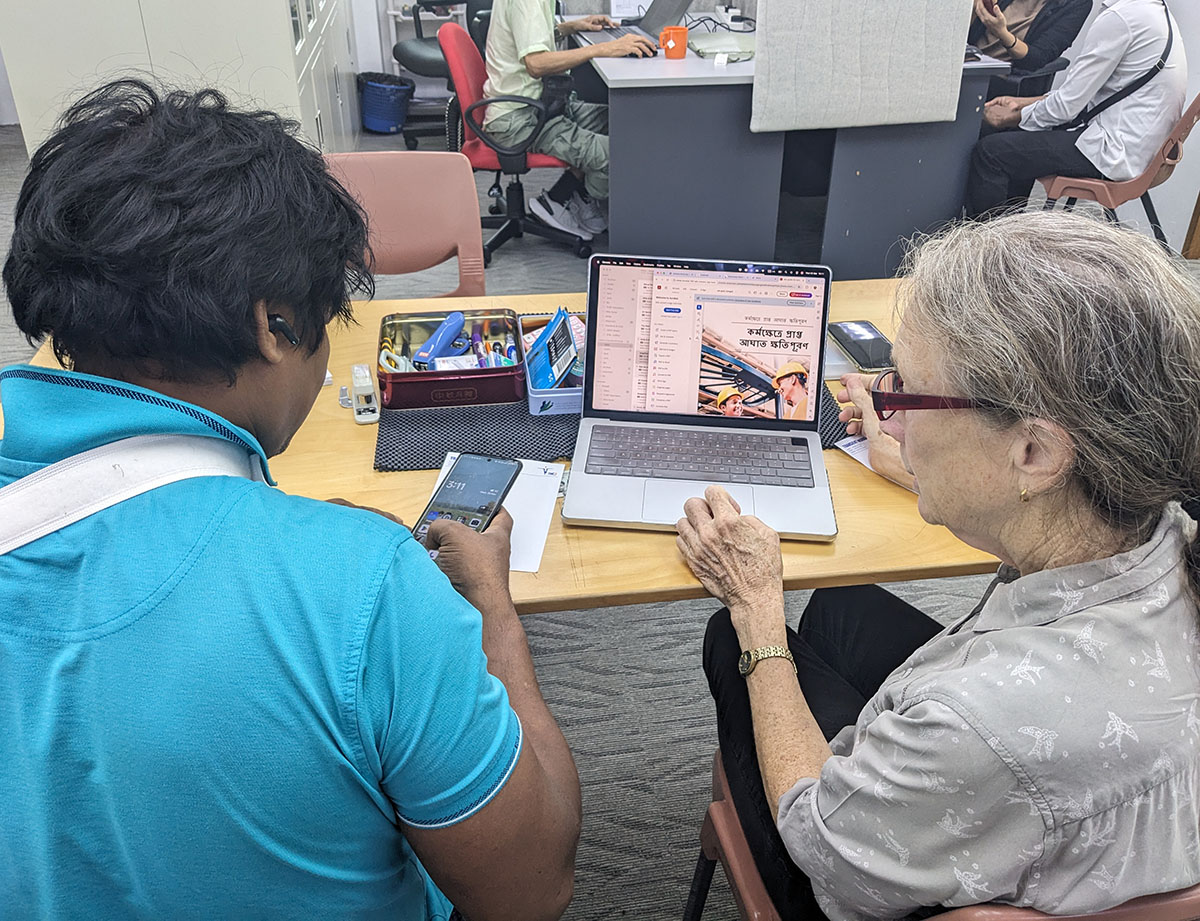
TWC2’s Debbie (right) explains the stages of a WICA claim to injured worker Gushan (name changed)
Injured workers’ experiences with Singapore’s work injury claims system are highly variable. The system itself has many imperfections, quite often leaving workers in the lurch. Compounding that are workers’ own misunderstanding or unrealistic expectations. Furthermore, the relationship they have with their bosses inevitably colours their opinion about whether they’re being treated fairly.
Here are two workers’ stories. They’re almost as different as night and day.
Anowar 20 months after the accident
Some time in June 2024, Anowar (name changed) fell two metres into a drain and injured two fingers. He also says that his back was injured too. After a few days of trying to manage it on his own, he went to the clinic in his dormitory, and was referred to a hospital. He was given painkillers and a medical certificate that would have let him go on sick leave. Instead, his employer promptly cancelled his work permit. As he had filed a claim for incapacity under the Work Injury Compensation Act (WICA), he was given a Special Pass to stay in Singapore.
Anowar’s treatment and claim processing seemed to have stretched for an unusually long time – all through the second half of 2024 and all of 2025. In the meantime, in early 2025, while he was still unemployed and on a Special Pass (allowing him to stay on in Singapore for the duration of treatment and his claim) he began to lose mobility in his left forearm, accompanied by significant pain. His doctor told him that this was very likely a result of his back injury. However, as it surfaced months after the initial injury, it was not possible for him to add this to his WICA claim.
After over a year of physical therapy, Anowar sees some improvement in his forearm, but it still seems far from recovery. He does his exercises in the mornings, and takes the painkillers that his doctor has given him, but not every day because the doctor has also told him that they can be bad for his liver. When he does not take them, his pain is worse. He feels the pain when he sits, when he stands, and when he sleeps. He finds himself unable to do the kind of work that has been his livelihood since he first came to work in Singapore over twenty years ago.
More recently, he received notification that he had been awarded three points in the WICA claim process, which means the doctor had judged that there would be a small degree of permanent impairment in his fingers. Thus, a commensurate amount in financial compensation was offered to Anowar. There didn’t seem to be any mention of his back or forearm in the documentation and it was therefore possible that the scope of the claim and assessment did not include the back injury (if any).
It is quite common for workers to fail to grasp these bureaucratic details. An injury claim and its subsequent assessment for compensation only proceeds on the basis of the specific injury to specific body parts as reported. A lay person might assume (only to be disappointed later) that any and every ailment traceable to the accident should be within scope. They should, but there has to be a demonstrable connection to the accident and be documented; a prolonged time gap between the date of the incident and the emergence of a symptom can raise doubts about that connection.
Anowar disagreed with this assessment of three points that only referred to his fingers. He filed an objection to this, but now the burden was on him to prove that his permanent impairment was greater than originally assessed since, in his view, it now should include the pain and weakness in his forearm. For that, he would need an MRI scan which costs about two thousand dollars, and he does not have the money to pay for it. He has been stuck in this impasse for over a year now.
It is perhaps because he has worked here for so long and seen so much of this wonderful country that Anowar seems dejected at its inability to restore him to good health. He cannot believe that the Singaporean medical system, which is dearly sought by the richest people in his country coming here as medical tourists, has been unable to cure him. Even if his insurance claim gives him five or six thousand dollars, he says, it would only be a matter of time before it is all spent. But he may have to bear the pain for the rest of his life.
Anowar is not on TWC2’s casebook. By the time he came to us for a consultation, it was already more than 20 months since the accident and the WICA process had nearly run its course. He had some questions and we answered them, though possibly those were not the answers he was hoping to hear.
Gushan 16 days after his accident
A week after Anowar came to speak to us, another Bangladeshi construction worker came for a consultation. Gushan’s left arm was still in a sling and his left thumb in a cast. He had been using a machine to cut plywood and he ended up cutting his thumb. His boss rushed him to Tan Tock Seng Hospital in his own car where Gushen underwent surgery immediately.
Naturally, in the initial week or two after a traumatic event like that, Gushan’s thoughts were very much on his pain management and prospect of a full recovery. However, it gradually dawned on him that he had no clear idea what lay ahead after that. He asked around and friends told him to visit TWC2.
His concerns were magnified when his boss suggested to him that he should ask his doctor whether it was possible to go back to Bangladesh and recover while at home, but Gulshan had been advised by the doctor earlier that he should show up at the hospital for a review every Friday. How was it possible to reconcile this schedule of reviews with the employer’s suggestion? Or was there another reason for the employer to propose the idea?
To better understand the context, we looked into what had happened in the 16 days between the accident and Gushan showing up at our office.
What we found was quite reassuring. The employer had filed an accident report with the Ministry of Manpower, which automatically triggered a WICA claim. This was consistent with the fact that the boss himself drove Gushan to the hospital. We could also see that in filing the accident report, the boss had filled in details of the insurance policy; the salary reported (for the purposes of the WICA claim) was also correct. All in all, the employer appeared to be acting responsibly.
At TWC2, we have seen many cases where employers try to get workers out of Singapore soon after an accident to avoid having to report the incident to the authorities (and thus suffer possible demerit points), and to avoid having to bear medical expenses. Quite often, while the injured worker was on “home leave”, the Work Permit would be cancelled without the worker’s knowledge.
In Gushan’s case, we didn’t think this kind of motive was involved. Most likely, the employer was genuinely concerned that Gushan might prefer to use the downtime to be with his family while recovering, which would account for him phrasing his suggestion as “Ask the doctor whether you can go home….”
After pointing out to Gushan that there didn’t seem to be any reason to doubt the employer’s intentions, we asked him, “So what exactly is it that is on your mind? What are you worried about?”
It turned out that Gushan was not doubting his boss at all. He had worked five years with him and was one of the most trusted employees in the small renovation company. Instead Gushan was wondering whether there might be any law that would prevent him from staying in Singapore to receive treatment. “I don’t want to break any law,” he explained. It seemed to us that Gushan was wondering whether this was the reason the boss raised the idea of him going home.
We had the most incontestable answer to that: “No, in fact there is the opposite rule. Now that a WICA claim has been filed, you are not allowed to go home until the case is concluded.” In truth though, it’s not a hard and fast rule; exceptions can be made but MOM has to give permission.
In any case, we expressed our opinion that it was not a good idea to go home. Not only was it important to attend the weekly medical review, he also needed to get his dressing changed regularly to avoid infection. Furthermore, with the fuel shortage arising from the Persian Gulf war, airfares were sky-high and flights were being cancelled with little notice. With follow-up surgery tentatively scheduled for late April, Gushan could not afford to be stranded in Bangladesh and miss the date.
We also took the opportunity to inform him of his entitlement to salary and medical leave wages for the coming weeks and month.
After an hour with us, Gushan was completely satisfied he got all the answers he came for. “You can always message us or come here again if you have any new question,” we said to him as he got up to leave.
Nil camans; 17694