
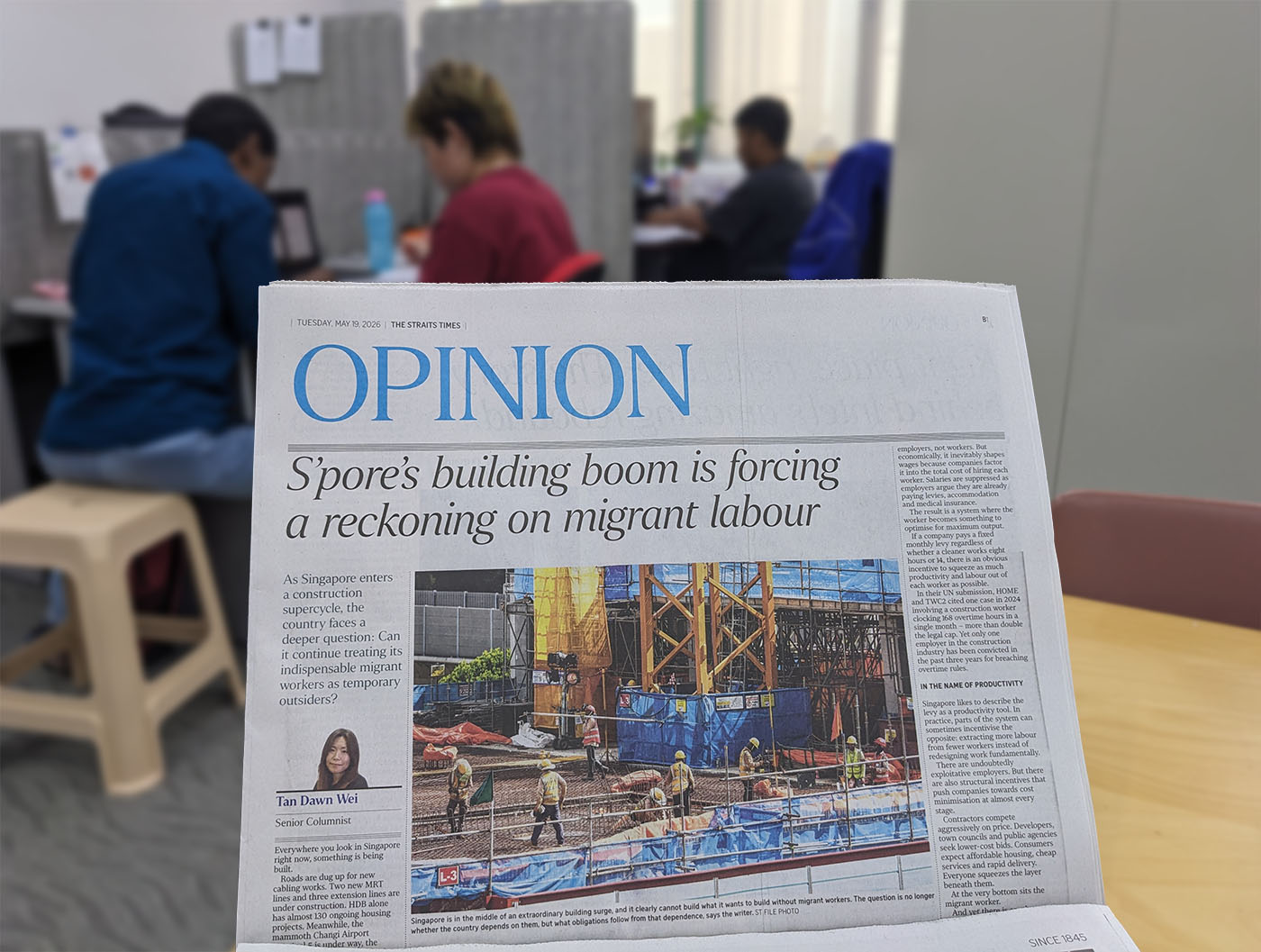
The print version of the op-ed seen against a typical scene from TWC2’s office where workers consult with our case officers.
It was a nice surprise to see an excellent opinion article in the Straits Times (19 May 2026) on migrant labour as we had not had any forewarning. In a welcome gesture, demonstrating the importance of the subject matter, Straits Times also lifted its paywall for the article which, oddly, went by two different headlines: S’pore’s building boom is forcing a reckoning on migrant labour and S’pore depends on migrant workers. Why do we accept conditions we would never tolerate ourselves?
Scroll down to see TWC2’s letter to the editor in response to this commentary in the Straits Times.
The 1,800-word commentary by Tan Dawn Wei, which might have sprung from the joint submission made by TWC2 and HOME for the United Nations’ Universal Periodic Review, covered many aspects of the issue and here, we will add our thoughts to some of the points made in it.
In a joint submission to the UN’s Universal Periodic Review process, which takes place once every five years, Singapore’s two stalwart migrant worker advocacy groups – the Humanitarian Organisation for Migration Economics (HOME) and Transient Workers Count Too (TWC2) – argued that despite reforms after Covid-19, many of the deeper structural problems within Singapore’s labour system have persisted.
(We were rather chuffed to see HOME and ourselves described as ‘stalwart’.)
As the newspaper’s headline suggests, the entry point to the commentary was Singapore’s perpetual construction activity, and the huge role played by migrant workers in the Construction, Marine engineering and Process (CMP) sector. As at December 2025, there were 482,000 CMP work permit holders, according to statistics from the Ministry of Manpower (MOM). They make up the largest sectorial group (39.4%) of work permit holders.
In its opening, journalist Tan Dawn Wei framed it very well:
Singapore clearly cannot build what it wants to build without migrant workers. The question is no longer whether the country depends on them, but what obligations follow from that dependence.
Bold text within quoted passages were made by TWC2, not the Straits Times.
Recruitment fees
Several angles surfaced by the opinion article are particularly germane. The first – in fact, what we at TWC2 sometimes refer to as the original sin – is that of recruitment fees and the massive debts workers take on in order to obtain jobs in Singapore.
Workers who owe large recruitment debts are unlikely to challenge unpaid overtime or poor conditions. Workers supporting families back home are unlikely to report employers if doing so jeopardises their income. Workers whose immigration status depends on their employer are unlikely to speak freely.
Further down the opinion piece, she added,
But the lowest hanging fruit is reforming the recruitment system itself. It is probably the most politically achievable and economically manageable adjustment available, and one that would signal Singapore’s seriousness about reducing exploitation.
Workers should not have to mortgage family land or borrow years of income simply to secure jobs here. Stronger regulation of recruitment agents and greater employer responsibility for hiring costs would be a meaningful start.
We ourselves have never described solving the recruitment fees issue as the lowest hanging fruit, but now that we think about, she may be right. The bad effects of this cancer are many, but one would be hardpressed to see any benefit for such a practice at a social level. The only vested interests who would rue the day we stamp it out have no moral leg to stand on, for everything they do is either unethical, illegal or both.
The problem of recruitment fees is intricately linked to the involvement of middlemen. Cut out the middlemen and problem should mostly go away. What may be left may be a variation of this problem where it is the employer who charges workers for offering them a job. This, though, is clearly illegal under Singapore’s Employment of Foreign Manpower Act, and since employers, by definition, are all based in Singapore, they are all under our jurisdiction. This is unlike the messy situation regarding recruiters and other intermediaries who sometimes operate in Singapore, other times from abroad.
Employment of Foreign Manpower Regulations 2012 >> First Schedule >> Section 5:
5. Except as the Controller specifies otherwise in writing, an employer shall not demand or receive any sum or other benefit from any employment agency or person in connection with the employment or change in employment of the foreign employee.
(TWC2 comment: “any person” surely includes the worker)
How do we cut out the middlemen? This is hardly rocket science, for example, most people buy air tickets directly from airlines through the internet. In fact, most Singaporeans find jobs through digital platforms, not recruitment agents. We should have one for migrant workers too, an idea we described in detail in Very much needed: a centralised jobs portal.
Whilst it is easy to grasp the sickening impact recruitment fees have on workers, few people realise that it hurts Singapore too.
When employers either directly or through recruiters find themselves able to charge $10,000 or more to each young man or woman they hire, the profit from the recruitment activity overshadows other selection criteria such as skills, experience or aptitude. Recruitment is skewed to hiring those who can pay, not those who would be the best candidate for the job. As a result, it undermines the quality of labour we import and the productivity that results.
Secondarily, the low productivity that results nudges employers to hire more workers than needed, which coincidentally aligns with the profit motive from more recruitment fees.
Economists have long warned that easy access to cheap labour can suppress innovation and mechanisation by making labour-intensive practices artificially affordable. In sectors like cleaning and construction, productivity growth may have slowed precisely because the economy has become too accustomed to solving manpower shortages through imported labour rather than fundamentally redesigning workflows.
When recruitment fees are high enough (as they often are), hiring cheap labour is a revenue opportunity, whereas automation is a cost (at least in the near term). What, at the employer and recruiter level, is a rational decision – hire more cheap, unskilled labour – is irrational and damaging for the larger public interest.
Bad employers drive out good
There are undoubtedly exploitative employers. But there are also structural incentives that push companies towards cost minimisation at almost every stage.
Contractors compete aggressively on price. Developers, town councils and public agencies seek lower-cost bids. Consumers expect affordable housing, cheap services and rapid delivery. Everyone squeezes the layer beneath them.
At the very bottom sits the migrant worker.
Not all employers are bad. TWC2 have come across employers who try to keep to high standards with respect to employee management. However, remaining ethical while your competitors undercut you because their workers’ wages are artificially depressed or because they enjoy the bounty of recruitment fees, is naturally difficult. Weak enforcement of existing laws and failure to eradicate the cancer of recruitment fees create an uneven playing field for businesses.
Bad employers gain an advantage. Even when ethical employers treat their own employees well, they may have to close one eye to what their subcontractors are doing to their workers because of cost pressures. High recruitment fees and the vulnerability inflicted on workers is not an isolated “bad apple” problem; it is systemic and it is very hard even for companies trying to be ethical to have clean hands.
Job mobility
A major factor worsening the vulnerability of migrant workers is the rule that they cannot switch jobs without consent from the existing employer. In TWC2’s experience, the majority of employers will not give consent; worse yet, even the request for a transfer may trigger retaliation by the boss.
Many remain heavily tied to their employers because changing jobs can be difficult without employer consent. Their housing is tied to their employment. Their right to remain in Singapore is tied to their employment. If conflicts arise, many fear repatriation before disputes are properly resolved.
This imbalance shapes behaviour long before abuse even occurs.
How is that shaped behaviour manifested? Through under-payment of wages, excessive overtime (sometimes leading to such fatigue that workplace accidents become more likely) and deplorable housing and transport arrangements, for example. Employers know that without any viable cost-free way to switch to another job, workers will have to tolerate such abuse rather than protest.
Non-domestic Work Permit holders have a small, 20-day, window of opportunity towards the end of their contracts to switch employers without needing to get permission. Yet, employers have come up with creative ways to stymie this option. For example, they may cancel the Work Permit just before this window period opens up, thus denying workers the opportunity to switch. Therefore even this small concession to workers’ agency is easily defeated.
Any attempt by employers to stymie this option should be seriously punished.
However, that small window of opportunity to find a new employer is laughably short and should be lengthened. Few Singaporeans, for instance, would be able to find a new job within such a short time. It might be better if we gave every migrant worker leaving one job, whether because of resignation or termination, a reasonable period, say 60 days, to find a new job. Making it easier for workers to move on to new jobs is not just a good thing for them, it is a good thing for us: Singapore gets to retain experience and skills.
The article’s closing reiteration is important. More needs to be done.
Singapore does not need a completely open labour system, but reducing workers’ dependence on a single employer – through easier transfers between companies, temporary bridging arrangements during disputes or stronger anti-retaliation protections – could lessen some of the precarity workers currently face.
Systems generally function better when workers are not trapped with bad employers and companies are forced to compete harder to retain labour.
Our letter to the editor
A few days later, on 21 May 2026, the Straits Times published our letter to the editor. We made specific proposals for improvements.
Three practical measures can address issues faced by migrant workers
The timely Opinion piece “S’pore depends on migrant workers. Why do we accept conditions we would never tolerate ourselves?” (May 19) provides a comprehensive overview of the issues faced by migrant workers.
The whole subject looks complicated and thorny, which may explain policy paralysis. Transient Workers Count Too (TWC2) has long proposed several practical measures that will make a huge dent in the issues that the commentary highlighted.
Migrant workers are constantly in fear of losing their jobs and being repatriated at the whim of their employers. They have to tolerate all sorts of salary or overtime abuses.
We cannot afford a system that waits for workers to raise complaints.
The Ministry of Manpower (MOM) needs to proactively audit salary payments and other law violations, and publicise cases where employers are penalised administratively, for deterrent effect.
The braver workers who have filed complaints almost always get fired. In theory, nearly all get a chance to seek new jobs. In practice, employers may prefer to hire new workers from abroad because they are more submissive, and, anyway, agents and intermediaries demand payment – typically several times the maximum amount allowed by law – for matching them with transfer jobs.
TWC2 has proposed that MOM preferentially approve work permit transfers over new hires from abroad, thus giving more confidence to workers to speak up.
At the same time, this helps Singapore retain experienced workers.
It is shocking that nearly all migrant workers have to buy their jobs, for buying is what recruitment fees amount to. Employers may be incentivised to hire on the basis of profit from the fees, rather than select workers on the basis of skills and aptitude.
TWC2 has long proposed that we need a centralised jobs portal where all work permit jobs must be listed, and all hiring done exclusively through the portal. No unlicensed agent should have access to the portal. Safeguards can be built into the portal to avoid demands for payment.
With the portal located within Singapore jurisdiction, enforcement will be easier than the current cross-border ambiguity.
Ethan Guo
Executive Director,
Transient Workers Count Too (TWC2)

For more information about our proposal, see Very much needed: a centralised jobs portal.