
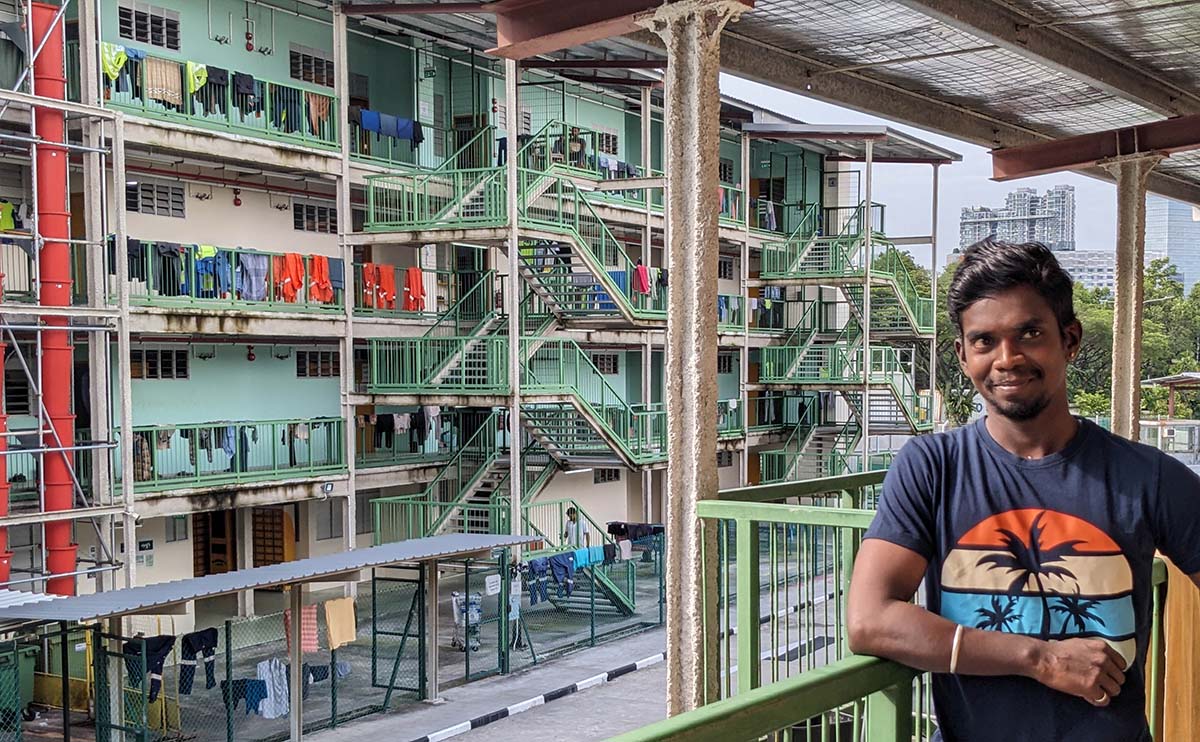
A worker gets ready to go downtown from his dorm on a Sunday
Bloomberg’s 9 April 2026 story Singapore’s New Worker Dorm Tests Government’s Public Health Pledge will have the unfortunate effect of echoing the Singapore government’s tendency to talk up dormitories and Covid-19 preparedness, sidelining badly needed conversations about debt bondage, wage theft and deceptive recruitment.
While it is true that current housing conditions for many low-wage migrant workers who are directed by their employers to live in mass dormitories are far from ideal, TWC2’s Executive Director points out that there are far more serious worries weighing on workers’ minds. The Bloomberg story quoted Ethan Guo saying,
“Dormitories are a secondary issue,” said TWC2’s Guo. “Their attitude is, as long as you pay me properly, I can tolerate everything else.”
The Ministry of Manpower (MOM) hardly ever engages in conversations about exorbitant recruitment fees, salary abuses and misleading recruitment. Exorbitant recruitment fees lead to severe indebtedness and a critical loss of bargaining power for workers and is often compounded by the many cases of salary abuses inclduing the fact that in many instances, the worker never fully recovers what he is owed despite utilising MOM’s formal processes. In the absence of such conversations, boasts about ventilation and wardrobe placements, as trumpetted in their feed to the Bloomberg article, feel like diversionary tactics to avoid the top issues that stress workers out, let alone the plain injustice of working under the burden of debt and then not being properly paid.
The Bloomberg story springs from an announcement about the government opening a new dormitory, called NESST Tukang– the first to be built and wholly owned by the government – with features to defend against infections like Covid-19.
The complex aims to rectify issues such as hygiene and overcrowding that helped Covid spread so quickly.
Former French Prime Minister Georges Clemenceau’s comment that “generals always prepare to fight the last war, especially if they won it” comes to mind.
Rooms and recreation spaces are arranged around a central courtyard, rather than along a double-loaded corridor that’s standard in most dormitories, according to a spokesperson from JTC Corp., the government agency that helped develop the site. Every bedroom has windows on two opposite walls, allowing cross-ventilation to reduce the transmission of airborne diseases. Workers also get their own service yard to wash and dry clothes, replacing communal laundry facilities.
Yet, even in this new dormitory, arrangements still have a whiff of mass incarceration.
Workers still sleep 12 to one room, but the new layout includes en suite bathrooms, as well as partitioned pods and lockers that double as walls, blocking the sight lines between beds.
No one seems to be asking whether, the boast about better ventilation notwithstanding, the placement of wardrobes to block sightlines (in the absence of privacy when twelve men have to be housed together) still obstructs airflow.
Bloomberg also reports that the infrastructure is not keeping pace with the growth in worker numbers. Most dorms are still of the old standard and, due to the shortage of bedspaces, many workers are still living in poor conditions, including in private apartments or temporary facilities at construction sites.
“The absolute worst conditions I’ve seen have been in private apartments,” said Guo. Workers “generally have a very good impression of Singapore. They see the photos on their phone and think it’s clean and beautiful. They arrive and see what’s provided to them, and they’re shocked.”
And then, too often, the shock is overtaken by more shocks: when they’re asked to do work that is different from what had been described by the recruiter, or when salary paid is less than earlier promised.
At TWC2 we hear from thousands of migrant workers through our hotline. In 2024 we had conversations with 13,000 workers and in 2025, we had 26,000. Just about every conversation is centred around an issue other than accommodation: deception, non-payment, illegal deployment, long working hours, contract substitution, wrongful termination. Underlying many of these crises is the debt burden, leaving many of them mentally tortured, unable to resist abusive practices and exploitative demands.
A good night’s sleep in a good dorm is important. But what about the waking nightmare all through the working day?