
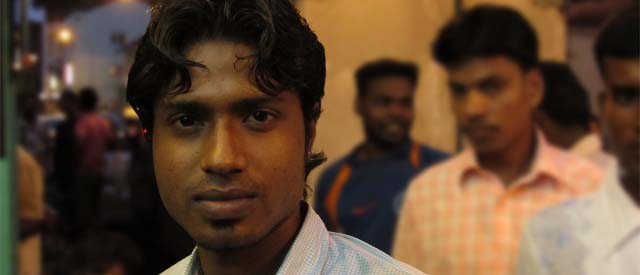
By Rahul Advani
Even before the start of my interview with Al Amin Kuddus, 24, he looked uncomfortable. “I have a boil under my arm” he tells me. “The pain is so strong I cannot even sleep”.
As I ask him to lift his arm, he winces, hissing deeply at the pain. How he developed the boil he does not know. What is clear though, is the direness of his situation.
He came to Singapore three years ago, with high hopes about his future and ready to achieve his goal of providing for his family. He began working for a manpower supply company in the shipbuilding and repair industry, doing electrical work. That job went well enough, and it was during his second job working in construction that he met with an accident that has left him jobless and disappointed.
October 21, 2011 began as just another ordinary day for Al Amin, as he was lifting steel bars as part of his construction job. However, that day changed his life forever. It was whilst carrying the heavy bars that he tragically slipped, fracturing a bone in his back. Not that he knew it then.
No longer able to work, he stayed and rested in his employer’s house, where he was later told that he would be transferred to a sweeping job. It turned out that he only ended up sweeping houses for one day. As a result of his injury, even this, he tells me, he found incredibly painful.
One month after the injury, he was finally allowed by his boss to go to Changi Hospital, where after receiving an X-ray, he discovered that his back was in fact injured.
“I still haven’t got an MRI scan”, he tells me. Asked why not, he responds: “It is too expensive.”
By law, Al Amin’s employer is required to pay for his MRI which would detect and reveal details about the fracture in his back. Al Amin tells me that his employer refused to even believe that he ever developed an injury, and intransigence that has left him stuck in a state of helplessness. With the employer refusing to provide a Letter of Guarantee (for payment) the procedure cannot be carried out. But without an MRI scan, which should reveal the exact contours of the fracture, he cannot secure further medical treatment.
It seems Al Amin readily accepted his boss’s refusal, taking no for an answer, which in part may be due to his humble and easygoing nature. It may however also be linked to the very culture of Bangladesh in which he grew up – a culture characterized by respect for authority, in some ways a result of the country’s social inequality.
He is not alone in this problem. Many others like him who come from a society such as Bangladesh where the powers exercised by employers over workers are often enormous and unregulated, end up showing undue deference to their employers, even when refused medical treatment.
He tells me he is going to visit the clinic soon to treat the boil under his arm. I wish him well. As I leave, he smiles at me, conveying gratitude for the opportunity to tell me his story yet masking the pain that is troubling him so deeply.
—
Postscript: TWC2 gave Al Amin the money he needed to get his armpit boil treated at a polyclinic — your donations put to good use. It was successful, but the employer is still refusing to guarantee treatment for his back.