

On 9 January 2025, the day after she arrived in Singapore – even before her formal work pass was issued by MOM – Nitya (name changed) was sent to work at Sengkang General Hospital with three other new workers. All of them were on Training Employment Passes (TEP), a pass type that we have previously written about here, here, here and here. At the hospital, nobody attended to them and after a futile wait of 90 minutes, they left.
The next day, the four of them were sent back to the same hospital by their agents and this time, someone received them. This someone checked their In-principle Approvals (IPA) and “rejected” them. IPAs are documents issued by the Ministry of Manpower (MOM) indicating that the foreigner has a work pass approved for them, which is to be collected after arrival in Singapore.
This being the second day in a row that things didn’t go according to plan, Nitya registered her unhappiness with the agent who had arranged this job for her.
One more try, the agent told her. On 11 January 2025, they were sent to the hospital again with the instruction that they should inform the staff there that they been sent by one Robin. Once again, when a manager at the hospital looked at their IPAs, he refused to take them in or assign any tasks.
Calls were made. 15 to 20 minutes later, the agent tried a different trick. It’s mind-blowing that this was even tried, but we’ll describe the trick later. We don’t want to blow out readers’ brains so early in the story.
MOM “tackling” abuse of the scheme
It should be said, however, that since TWC2 blew the whistle on the Training Employment Pass in the middle of 2025, the Ministry of Manpower (MOM) has “mounted several enforcement operations to tackle the abuse of the scheme”. See Parliamentary questions, September 2025, part 2 (Training Employment Passes). By the later part of 2025, we saw fewer and fewer of such cases.
Nonetheless, even as of February 2026, we still have older cases of such victims dependent on TWC2 for help. Fewer new TEPs may be issued, but old cases linger with little support for affected individuals while investigation drags on.
Before Singapore
Having completed a diploma in hotel management from a college in Punjab, India, Nitya thought about looking for work in Singapore. On 13 November 2024, she spoke with a cousin working here as a domestic worker, asking how to go about looking for a job.
Not long after, the cousin put Nitya in touch with a husband-wife pair named Mr Money and Ms Honey. Seriously, those were their names. Nitya is pretty sure that Money is normally based in Delhi and Honey works out of Malaysia. Even at this early stage, payment was demanded. Nitya had to pay 50,000 Indian Rupees (about $713) as “application fee”.
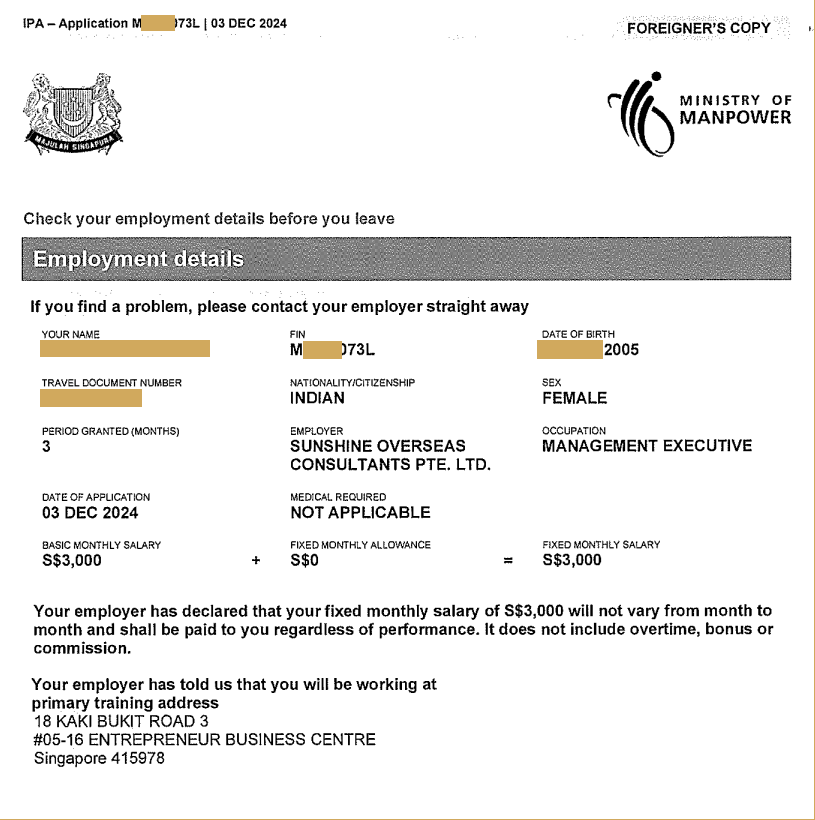
Things moved quite quickly. Within two weeks, on 27 November 2024, Nitya received from Honey and Money an In-principle Approval document (IPA) for a Training Employment Pass. She didn’t quite understand what a TEP meant (nobody outside Singapore would) but she noticed that it was only for a three-month period of employment when she had specifically asked for a two-year job. When she asked Honey and Money about this, they explained it away by saying that without working experience, she was not eligible for two-year work passes. She would have to do “training” for six months, and after that, they would apply for a two-year work pass for her. Nitya had no way to check if this explanation was genuine, but the salary was good – the IPA stipulated a fixed monthly salary of $1500 basic + $1500 allowance, totalling $3,000 per month – and it would be a shame to pass up this job just because it was only a three-month stint.

So, at the end of November 2024, Nitya paid two more installments of her agent fee (one lakh rupees each) and bought a ticket to come to Singapore, departing 8 January 2025. By this point, she had paid 2.5 lakh, or about S$3,570.
Two days before departure, Nitya learned of MOM’s “Check a Work Pass” webpage. She keyed in the FIN number stated on the IPA (M0359356P) and to her horror, she saw the page’s response, “No record found”.
She promptly complained to Honey, whose reply was something about how MOM’s server was slow and prone to “system errors”. It would take time before the system would recognise her new FIN number, explained Honey. Although that sounded rational, Nitya could not banish her nagging doubts.
Lo and behold, 15 – 20 minutes later, Honey sent Nitya a completely different IPA. Now the employer was Sunshine Overseas Consultants Pte Ltd. The FIN number was also different from the first IPA. This time it was M****073L, and when Nitya checked it on MOM’s website, it came up as valid. Her name and passport number showed up alongside the FIN number. However, the site “does not show the company name, or salary, or anything,” says Nitya to TWC2. How genuine was the new IPA? she wondered, with no way to find out.
When we checked MOM’s “Check a Work Pass” page at the time of the interview (January 2026), we found that a foreigner who has been issued an In-principle Approval letter by MOM should be able to see the name of the employer together with key details of the salary. Perhaps, at the time that Nitya checked (January 2025), this option was not available. If so, we’re glad that improvements are being made in response to feedback from workers and NGOs.
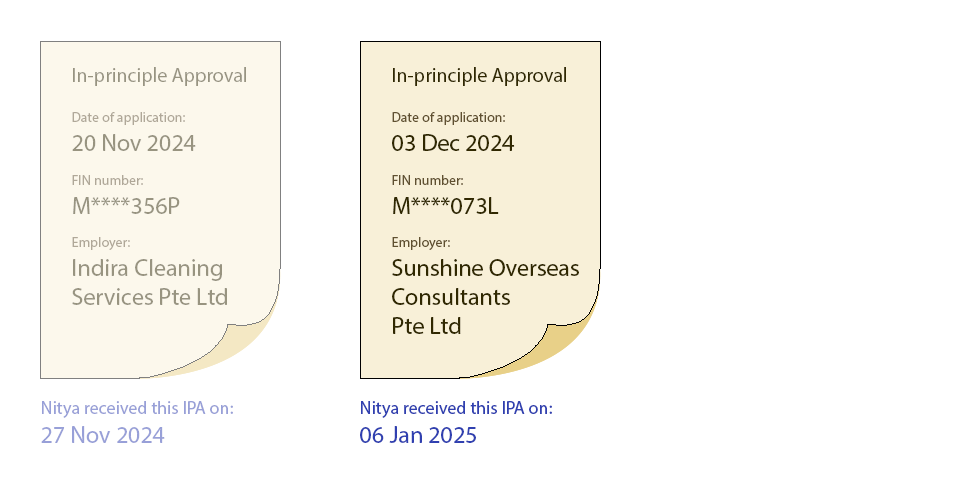
Since she had already bought her flight ticket, she came to Singapore anyway, and passed through Immigration with no incident. This indicates that the IPA with her second FIN number was real. Immigration’s computer system recognised it.
However, if the second FIN number was genuine, it also means that the first must be fake. The entire first IPA (Indira Cleaning) must have been a total forgery.
 Let’s pause here for a moment. Even though MOM has clamped down on the issuance of Training Employment Passes, the weaknesses of the IPA system are still there. Workers being hired on other kinds of work passes can still be cheated. For example, from the story so far, we’ve seen that IPAs are issued in PDF format. Total forgeries are easily generated, giving jobseekers the impression that there are work passes approved for them when there aren’t. Or, the terms of employment stated on IPAs can be illegally modified, deceiving workers about their salaries, etc.
Third try at Sengkang General Hospital
Which IPA did Nitya show Sengkang General Hospital?
“I showed them the Sunshine IPA,” she replies. That’s the genuine one. As for why the manager there still rejected them, there are many possible reasons, starting with the fact that it’s a Training Employment Pass (TEP) and Nitya was supposed to be a Management Executive, or that she had not yet been sent to MOM to collect her work pass.
Still at Sengkang General Hospital and rejected once more, calls were made. Amazingly, within 15 minutes, Honey Whatsapp’d over another IPA (also for a TEP) and Nitya was told to show it to the manager.
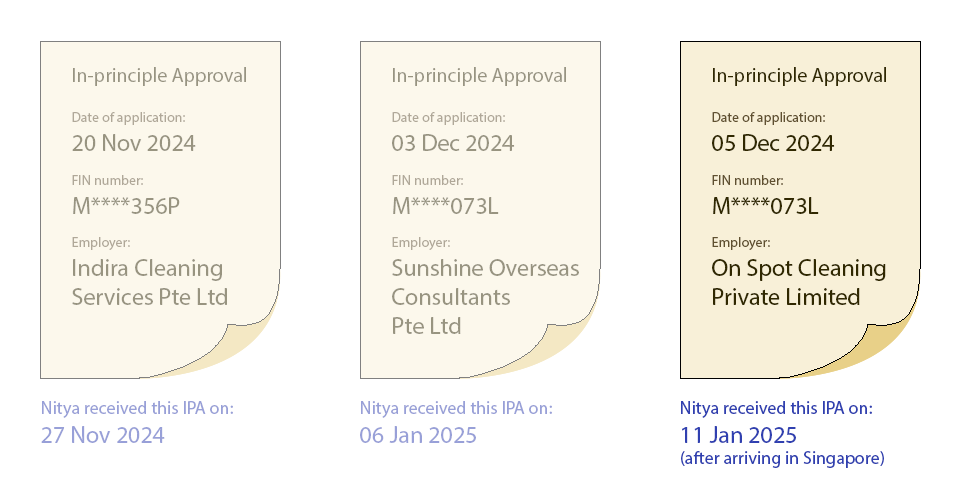
The manager took one look at the latest IPA and refused to have anything to do with it. Anyone in his shoes would be suspicious when a foreigner presents two different IPAs (albeit with the same name and FIN number) within the space of several minutes.
Naturally, Nitya protested to her recruiters. “I said to them, ‘This is not fair’,” she recounts to TWC2.
Never mind, we’ll send you elsewhere
Honey’s response was that she would be deployed to another company for cleaning work. On 13 January 2025 she was sent to SPG Helping Hands to work under someone named Zeenat. SPG Helping Hands sent her to different homes for cleaning and cooking jobs. On average, she had to work at four or five different homes each day; she worked from 7am to 11pm. After about two weeks, Nitya told Honey she could not continue any longer as she found it very hard.
Let’s pause here again and review what additional offences, other than forgery and deception (cheating), have been committed.
- Nitya was sent to work before being issued with her Training Employment Pass. This is against the rules.
- Nitya was deployed to work with a totally different company (SPG Helping Hands). This is illegal deployment.
- Nitya’s IPA – the genuine one – says she was to be a Management Executive. Cleaning and cooking in various households is not consistent with that.
Nitya would be moved around from one illegal deployment to another. Ten to fourteen days with Giri Sparkle Cleaning Services, another ten to fourteen days as a cleaner at PLQ Mall in Paya Lebar, and so on. We don’t wish to fatigue our readers with too many repetitious details.
The longest work stretch was when she was deployed to Tan Tock Seng Hospital as a Healthcare Attendant. She was there for about two months from early March to early May 2025 and all this while at this hospital, her work identification card bore the name of another company “UEMS”.
It’s worth noting that she was not sent to MOM to be issued her TEP Work Pass until 25 March 2025. By then, she was already working at Tan Tock Seng.
The three-month TEP expired on 24 June 2025, but she continued to be deployed to work for a few days more. After that, Honey got her a visa to enter Malaysia, which she did in late July. Nitya stayed there with no work until late August when she came back to Singapore (Honey got her a one-month tourist visa to Singapore). Our sense is that Honey did want to keep Nitya, repeatedly promising to get her a proper two-year work pass – why else would Honey go through the trouble of getting Nitya a Malaysian tourist visa, followed by a Singapore tourist visa? However, Honey and Money do not have an operational company in Singapore, and therefore have no work available for those they hire, so Honey and Money would always be illegally deploying Nitya even if a longer term visa was obtained.
One might ask, what about her official employer, Sunshine Overseas Consultants Pte Ltd? Didn’t they take charge of Nitya after arrival in Singapore and give her work or training?
The company is owned by a Singaporean woman in her thirties. Nitya never met her. The agents who recruited Nitya continued to give her work deployment instructions throughout. It is unclear if the woman who is named in official records as the sole shareholder and director of Sunshine Overseas is even involved in the management of the company, or is only fronting it – not that it absolves her of responsibility.
Run out of patience
What’s in it for Honey and Money to go through all this trouble to keep Nitya with them? Profit, perhaps.
They might have seen Nitya as compliant. All these months, they underpaid her massively and up to this point in our story, she had not filed any claim with the authorities. Furthermore, they demanded that Nitya pay up the balance of the previously-agreed recruitment fee, and Nitya felt she had no choice but to do so. In July, she transferred $1,050 (two transactions $650 and $400) to Honey and Money; this was in addition to the 2.5 lakh Indian Rupees she had paid before coming to Singapore.
Less than two months later, when Nitya re-entered Singapore (on a tourist pass), it was her chance to do something about getting justice. She had run out of patience. She found TWC2 in September 2025. We helped her compute what she was owed (over $10,000), following which, she lodged a claim at MOM. We also helped raise the issue of the abuse of the Training Employment Pass and illegal deployment with the authorities.
While there is no need to get into the details of the salary claim here – it’s somewhat tangential to our focus on the weaknesses of our regulatory system, and how difficult it is to get remedy for the victim – it has to be mentioned that the outcome was totally unsatisfactory. The employer (Sunshine) did not settle at mediation and the matter went up to the Employment Claims Tribunal. On the day of the hearing, the employer did not even show up at court, and Nitya received a judgement in her favour.
The court order said that Sunshine Overseas had to pay up by 15 January 2026. But would the employer cough up the money?
Go home
Even with that question remaining unanswered, MOM told Nitya she had to go home regardless of whether or not the employer paid up the court-ordered amount of over $10,000. This did not sound right at all, but she had no choice about it. TWC2 bought her a flight ticket – she had no money, and with TEPs, the employer is not responsible for repatriation – and we sat with her one more time, a week before the payment deadline of 15 January, for an exit interview.
Transcript:
TWC2: Do you think a typical migrant worker in Singapore would be able to manage himself or herself? Without an NGO?
Nitya: No, this is my personal experience. It’s not…. It’s… very difficult alone actually, because every month rental, every month food, MRT, everything. How can manage?
TWC2: Who would have told you about what… the process is? Who would have given you the kind of information as to what the systems are and how to make a complaint and all that. Was it just us or other people?
Nitya: Yeah, no. Actually, I everything I put on the ChatGPT, so chatGPT give me the TWC2.
TWC2: Oh, we were on ChatGPT. Alright, OK.
Nitya: Ya, so then I emailed on the email address, then David sir reply my email, then they fix appointment. So I came here.
TWC2: Right…
Nitya: And after that, and you guide me for everything.
Transcript:
TWC2: I know, I know at the end of the day we’re still waiting …
Nitya: Yeah.
TWC2: …for the 15th of January when, which is a due date for the payment of the court order. Um, and we know that the court order was for the owed salary of ten thousand dollars and something.
Nitya: Yes.
TWC2: Right. But, um, we also know that there’s a good chance that the employer will still refuse to pay by the 15th of January. So we are not getting our hopes up.
Nitya: Ya.
TWC2: We don’t know what we’ll do after that, but we’re not getting our hopes up. But other, but other than that, it’s still, um, a very frustrating outcome with no certainty and no assurance of success. Tell me your overall opinion of this outcome.
Nitya: The outcome, er, like, I’m not sure… [inaudible]… totally time wasted because I waste my one year, one year of my life and also I pay too much amount. Like I take the loan from the bank and then I pay for this. And the loan is still running.
TWC2: And the court order was only for the salary that was owed.
Nitya: Ya.
TWC2: Did you… you paid some agent fee before that as well.
Nitya: Ya. I paid agent fees like about a three and a half lakhs.
TWC2: And that’s not covered by the court order.
Nitya: Ya.
TWC2: All right. And…
Nitya: And the… after that, the company never pay my salary, approx ten thousand [unclear] and this my shortage and every month, I arrange my rent. After that, I come NGO [TWC2] and NGO pay my rent every month.
TWC2: Actually, of the twelve months that you have spent in Singapore, you only worked about two months since [unclear].
Nitya: Ya.
TWC2: Am I right?
Nitya: Ya.
TWC2: So, you could have earned a hell of a lot more if you had a proper job and was working through this period.
Nitya: Yes.
TWC2: So it was not just the agent fee that was wasted; it was not just the time wasted or the, er, the rent…
Nitya: Rental also, actually every month I pay three hundred and fifty dollars.
TWC2: It’s also the lost opportunity…
Nitya: Ya.
TWC2: … to earn more by working more.
Nitya: Yes.
TWC2: You only worked about two months out of the twelve months.
Empty
Come 15 January 2026, and we hear from Nitya that no payment was made by that deadline. She is not surprised.
She adds that MOM has told her that if the employer does not pay up (they did not), MOM will bar them from employing foreigners in future. Frankly, this would be a mere slap on the wrist. The “prosecution” word is nowhere to be found. Toothless.
She has also had a consultation with an officer from Pro Bono SG, a charity arm of the Law Society of Singapore, she tells us. The officer advised her to begin gathering information on any valuable assets owned by the company, as this may be useful during enforcement proceedings. How a young migrant worker with no friends, family or other contacts in Singapore can do this is left unexplained. Moreover, enforcement may involve out-of-pocket costs, potentially ranging from a few hundred to a few thousand dollars, the officer advised.
On an individual level, the outcome of her case is frustrating enough; but it is even worse at the public interest level. The huge regulatory gaps that enabled her agents/intermediaries and employer to cheat and exploit her remain wide open. Even as MOM seems to have become stricter about TEP applications, the same regulatory gaps remain with other work passes: fake IPAs, made to work before work passes are issued, illegal deployment, non-payment of salary…. and non-enforcement of court orders.
Frustrating though Nitya’s year-long experience was, the story is about more than her case alone. The story is about Singapore.
16745