
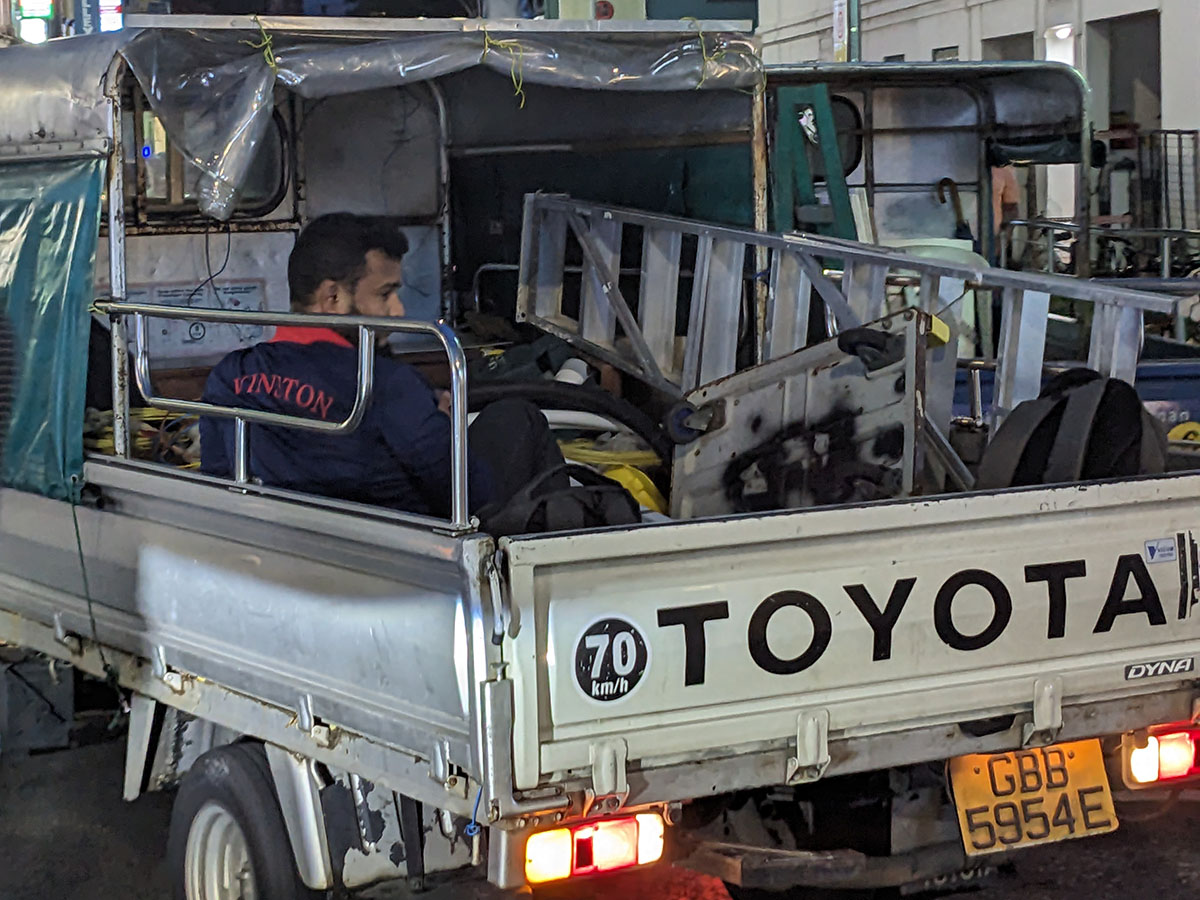
Migrant worker in lorry with plenty of loose equipment
On the morning of 15 December 2024, a fatal accident involving a lorry in Tuas left a 40-year-old migrant worker dead and two others injured. While there has yet to be a definitive investigation report, photos and accounts on social media suggest that an unsecured metal box had shifted during the ride which caused the tragic death [see footnotes 1 and 2].
While we can call this an “accident”, this case unmasks the structural injustices that allow migrant workers to be transported in such unsafe conditions, where heavy goods such as toolboxes or construction materials are carried together with workers at the back of goods vehicles. Sudden braking or collision can send these items flying into passengers, resulting in crush injuries and fatalities.
In Singapore, Rule 4(4) of the Road Traffic (Carriage of Persons in Goods Vehicles) Rules 2010 explicitly states [footnote 3]:
No person shall drive, or cause or permit a person to drive, a goods vehicle which is carrying any load if the load is in such position that danger is likely to be caused to any passenger riding on the goods vehicle by reason of the load or any part thereof falling onto the passenger.
The Ministry of Manpower further elaborates [footnote 4]:
Any loads being transported must be properly secured, including lashing to prevent side lateral movement or when vehicle is braking, and should not pose any danger to the workers in the rear deck or other road users.
While these regulations look good on paper, recurring accidents—some of which are fatal—indicate that enforcement remains patchy. Moreover, these rules do not sufficiently deter employers from compelling workers to ride with large and heavy objects that can shift violently when brakes are slammed.
To understand the realities on the ground, we spoke with three long-term migrant workers at our Cuff Road Project about the precarious nature of their daily commutes.
Worker no. 1
He has worked in Singapore since 2014 in the construction and renovation industries and has experienced a range of employer practices. As I show him the picture from the Mothership story about the Tuas accident and ask him whether he feels the boxes were safe, he grimaces at the image and shakes his head. He recounts his worksite transportation experiences across the jobs he had held, which paints a mixed bag of employer compliance.
During the hour and a half that our volunteer was interviewing workers for this story at The Cuff Road Project, several lorries came to park nearby. They were bringing workers to Little India to buy food. After the workers disembarked, we took the opportunity to look more closely at these lorries to see what goods or equipment they carried.
Nearly all the lorries we saw had material on board. Rarely were the items properly fastened.
The pictures here are therefore not directly related to the accounts and experiences that our interviewees spoke of. Nevertheless they show how common the practice is of carrying goods and equipment alongside workers on the backs of trucks.
While his second employer chartered air-conditioned buses for transportation — a situation he recalls happily — his third employer seemed to care little about safety. On several occasions, our worker had to ride in the rear of the lorry that also carried heavy toolboxes while also sitting atop items that shifted when the vehicle swerved or braked. While he was thankfully not hurt, the recent accident in Tuas serves as a stark reminder of what can happen during such collisions. Furthermore, his contrasting experiences underscore that safer alternatives clearly exist (buses) when employers are willing to invest in them. Lorries, it seems, are not an economic necessity but a choice – a choice that only shows how little we value the lives and limbs of migrant workers.
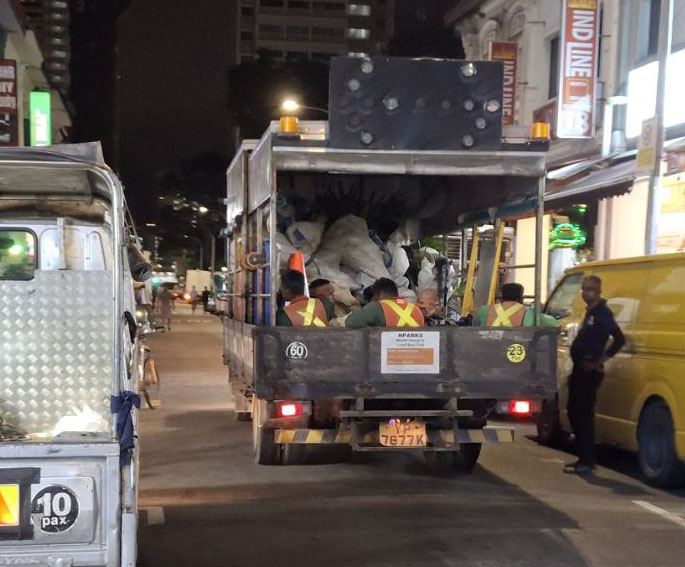
This picture is sllightly blur because the lorry was driving away. We believe the bags piled higher than the men contain branches and leaves. Wood can be heavy.
Worker no. 2
He shares similar experiences, having worked in the construction industry for 12 years. He too has had to ride alongside unsecured toolboxes and ladders. While he acknowledges that there are laws requiring objects to be secured and tied down, he also mentions that refusing to ride alongside unsecured objects isn’t an option if they are told to do so by their employer.
Ironically, as we are speaking, a lorry comes to park alongside us; it has loose items strewn on the floorboard. We can also see a large metal toolbox flushed to the side of the truck, very much like the box photographed in the recent accident. Worker 2 brings up his observation that such boxes are commonplace in the lorries he often rides in, highlighting a persistent disregard for worker safety.
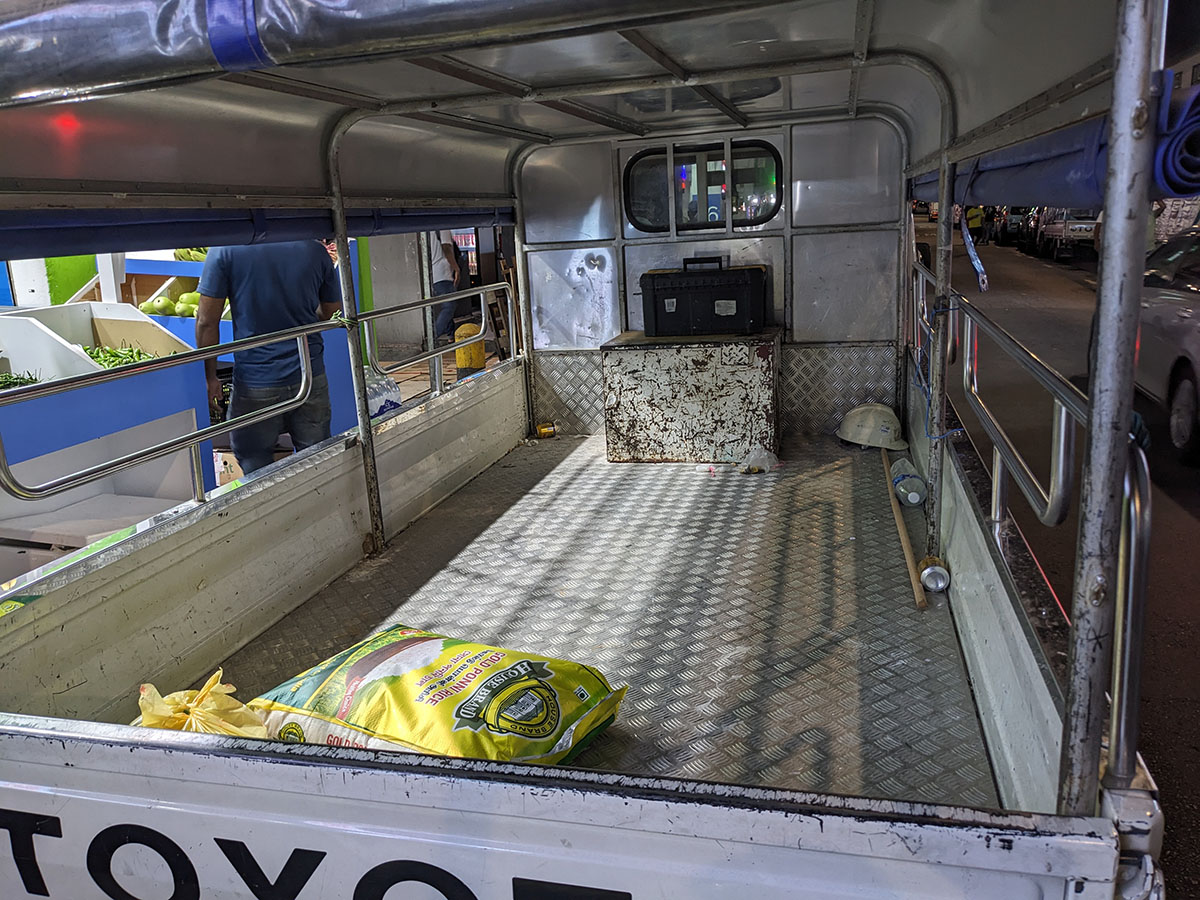
This lorry is largely free of loose cargo but is the heavy box secured?
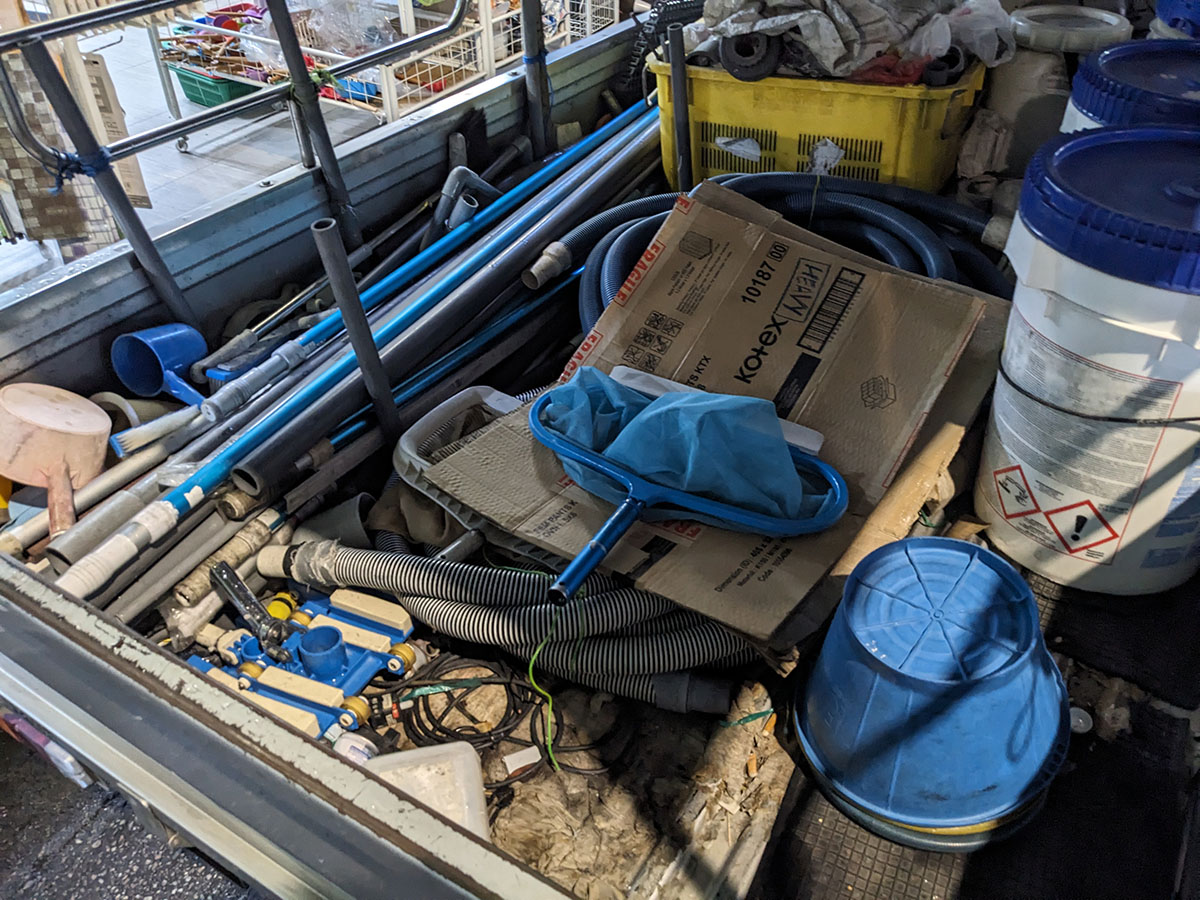
There is hardly any place for men to sit, yet this lorry brought men to Little India (we took the photo only after the men had alighted).
Worker no. 3
The last worker we interview for the night is working as a welder in a workshop, mostly riding public transport to and from work. Occasionally though, he and his colleagues have to travel to project sites in lorries, sitting next to his welding equipment and material such as large metal rebars. He tells me that injuries from violently shifting rebars are commonplace when riding on lorries, and he has also been personally injured by them before. Although there have not been incapacitating injuries, workers often have to receive medical attention for these incidents, suggesting that these injuries can be quite serious.
He opines that he much prefers taking public transport as opposed to the cramped and uncomfortable space in the lorry. He feels glad that he does not have to sit in lorries most of the time, unlike other migrant workers in the construction industry.
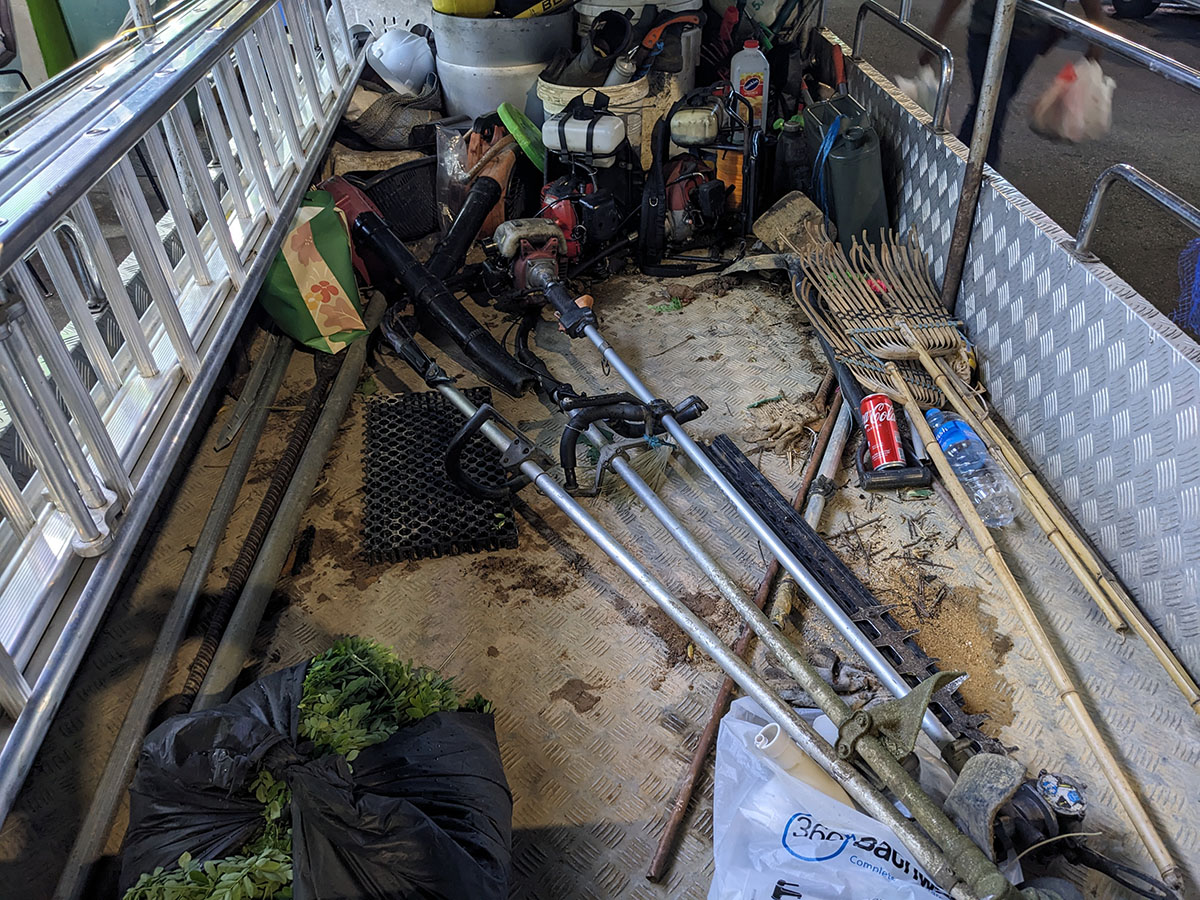
This lorry has grass-cutting equipment with sharp blades (bottom right) and electric motors (upper part of picture) that are heavy enough to cause skull fractures if flung against a person.
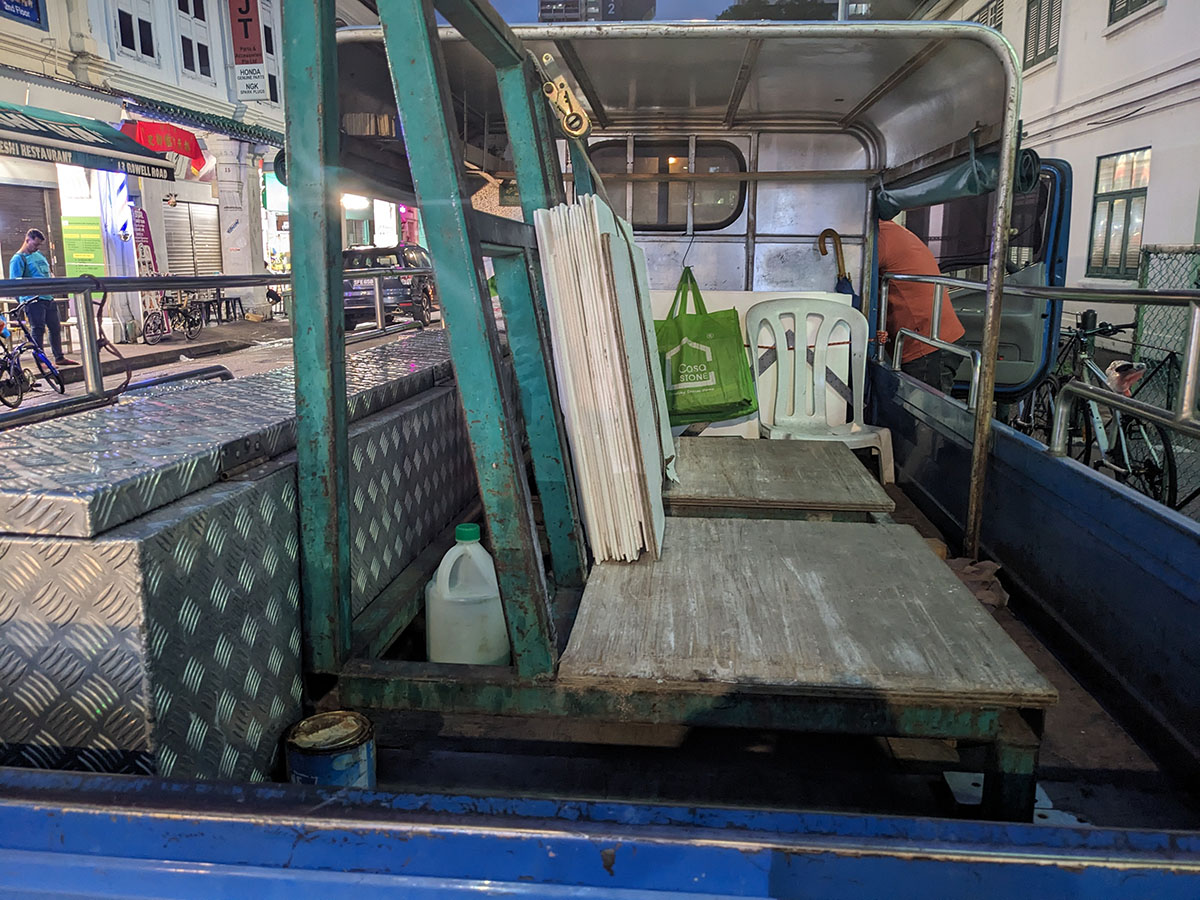
The white panels are secured to the green frame, but it’s not obvious to us whether the frame itself is secured to the bed of the truck.
Systemic failure
These stories, though from different men in different industries, paint a similar picture: a systemic failure to enforce and prioritise safer transport, resulting in migrant workers being pressured to ride with loose and heavy cargo.
There is an urgent need for systemic change in transportation safety for migrant workers. Migrant workers face significant risks when ferried in the back of lorries alongside heavy objects — risks that can largely be eliminated if they are transported in buses or passenger vans. If we can ferry our National Service conscripts safely and comfortably by chartered buses on our public roads, it seems like a glaring double standard that the men responsible for building their barracks and homes are made to endure unsafe and cramped conditions in these lorries.
While Singapore’s Road Traffic (Carriage of Persons in Goods Vehicles) Rules 2010 do penalize errant employers, these measures alone are not sufficient. A worker’s commute should not be a daily gamble with their safety. Legislation and enforcement must be coupled with strong measures to encourage (or compel) companies to separate people from heavy items — either by providing fully dedicated buses for workers or, at the very least, a goods vehicle free of large, unsecured cargo. Without stronger intervention, employers looking to cut corners will persistently put workers’ lives at risk.
In the long run, a complete ban on carrying workers in the back of lorries may be the clearest solution. While the government has recognised the issue, at the same time, raising concerns about the economic impact of such a ban [footnote 5], there should be a firm timeline to phase out this practice for the safety of our migrant workers. Even an interim step of disallowing heavy goods to be transported on the same deck as workers will save countless lives and injuries.

1. ‘One dead, two injured in lorry accident in Tuas’ <https://www.straitstimes.com/singapore/lorry-passenger-dies-in-tuas-accident-driver-arrested-for-careless-driving>
2. ‘Man, 40, dies after lorry ferrying migrant workers crashes at Tuas, driver, 41, arrested’ <https://mothership.sg/2024/12/tuas-accident-lorry/>
3. Rule 4(4), Road Traffic (Carriage of Persons in Goods Vehicles) Rules 2010, Road Traffic Act (Chapter 276) < https://sso.agc.gov.sg/SL/RTA1961-S663-2010?DocDate=20220630>
4. ‘Inter-agency advisory on safe transportation of workers’ <https://www.mom.gov.sg/newsroom/announcements/2022/1231-inter-agency-advisory-on-safe-transportation-of-workers>
5. ‘Oral Reply by Senior Minister of State for Transport Dr Amy Khor to Parliamentary Question on the Transportation of Workers on Lorries’ <https://www.mot.gov.sg/news/details/oral-reply-by-senior-minister-of-state-for-transport-dr-amy-khor-to-parliamentary-question-on-the-transportation-of-workers-on-lorries>
3933; 15673; 14793