
In late December 2024, Kakal (not his real name) walks into TWC2’s office and tells us:
- he paid ten lakh Bangladeshi taka (about $12,000) to get his current job in the third quarter of 2023;
- he was promised that this sum would include construction skills training but this was not arranged;
- he has a valid Work Permit as a Process sector worker;
- he has not received his salary since February 2024 (ten months ago);
- for the months before February 2024 when he was paid, the salary was paid in cash;
- whereas his In-principle Approval said his basic monthly salary would be $524 a month, he was paid only $18 a day (roughly equivalent to $468 a month);
- he has not been issued payslips nor does he have timecards to prove his working hours;
- he has never met the boss of the company he was supposed to work for;
- he was sent from one location to another doing all sorts of different tasks, including construction (for which he does even have a Basic Skills Certificate).
Moreover, he adds:
- his “agent” was the one directing him to worksites;
- his “agent” was the one giving him money purported to be salary;
- his “agent” took away his bank ATM card and his log-in PIN;
- his work permit expires next month but when he asked his “agent” about renewal, a further $6,000 was demanded from him (fortunately, Kakal did not pay).
We are curious about the “agent” that Kakal speaks of. Whoever he was, he was performing the role of an employer, directing him to worksites, paying his salary and arranging his accommodation. He was even performing the role of a horrid employer, taking away Kakal’s bank card.
Kakal explains that this person is definitely not his official employer. The company stated on his work permit (we’ll call it Company K) reportedly has an Indian boss – though Kakal has never met him – but this agent is Bangladeshi. Kakal gives us this Bangladeshi’s name (we’ll call him Masin in this story) and contact information. We discover that Masin is an S-Pass holder in Singapore, but is not a manager or supervisor in Company K. He is an employee of a different company altogether, located in the Ubi area, and which we will refer to as Company M.
Does Masin actually work for his employer, Company M? Our suspicion is that he does not. He probably works for himself.
Why do we think that? Because Kakal reveals that Masin has his own office downtown, and there are some 200 workers under him. Managing 200 workers sounds like a fulltime job.
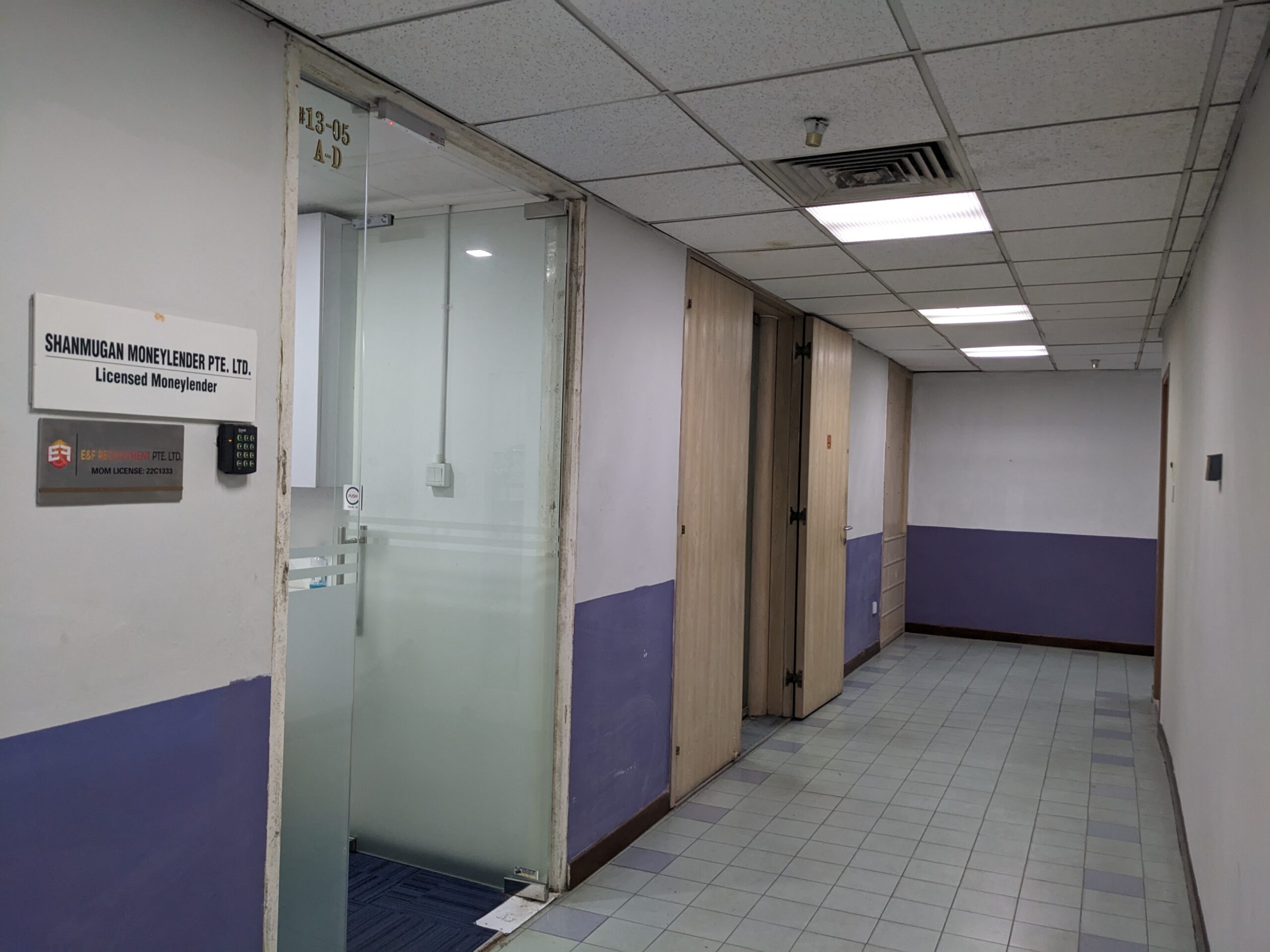
The sign outside the office unit says it’s a moneylender.
At about 1:30pm on a Thursday, we take a look at the office address that Kakal gives us. It is a subdivision of an office unit that has the signboard of a moneylender at its front door. The subdivided unit is a single room, no bigger than 12 square metres (our estimate), with three desks inside, each with a computer on it. Seated at the middle desk we see a woman, and at the desk furthest from the door is none other than Masin. We recognise him from the photo we earlier saw of him. The desk nearest the door is unoccupied.
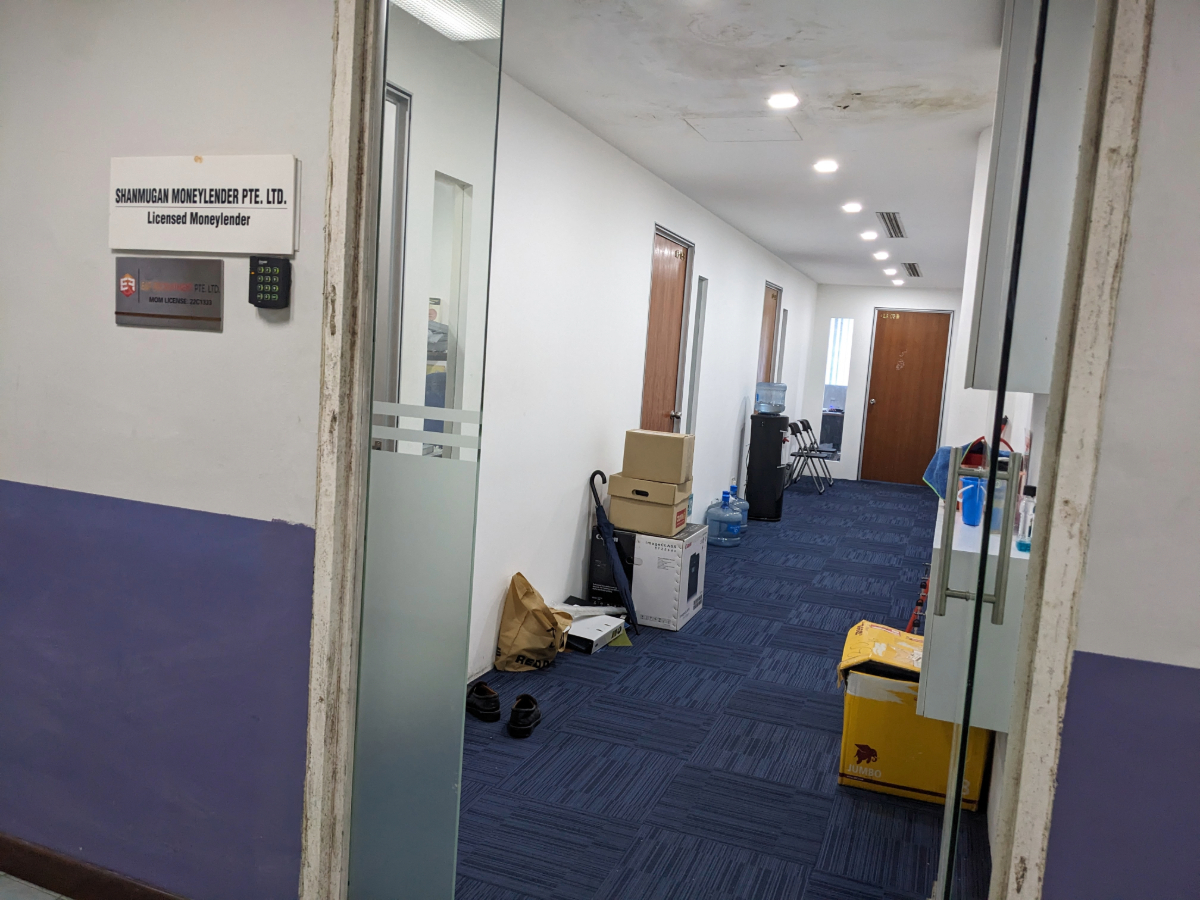
However, the unit is subdivided into four rooms. Masin occupies Room D at the far end of the corridor (centre-right of picture)
We will allow for the possibility – though we think it’s a remote possibility – that Company M, which is the employer on Masin’s S-Pass, operates out of that office. But there is no signboard with Company M’s name. Instead the only signboard to that suite of offices is the one naming the moneylender. (Given the huge sums of illicit recruitment profits sloshing through, sharing premises with a moneylender somehow seems appropriate.)
What we think the operation is like
At TWC2, we have seen all sorts of irregular operations set up to exploit workers, but this one seems to be on quite a different scale. In this operation, Company K, Kakal’s official employer, appears to be merely a front company; its owner(s) not at all involved with the men officially under their employ. It is unlikely that all 200 men managed by Masin are officially under Company K (but Kakal doesn’t know for sure), so this suggests that there are several front companies in this scheme to provide cover for such a large number of men.
At the time of recruitment, agent Masin promised Kakal that he would be sent for construction skills training. This was to justify the massive recruitment cost of $12,000. Yet Kakal was brought into Singapore straight away when the skills training centres are in Bangladesh. By flying Kakal here without first enrolling him in a training centre, it is obvious that Masin had no intention of fulfilling the promise of arranging a training course for the worker.
Kakal had applied to be a construction worker, and didn’t know anything about the distinction between a Process sector worker (as stated in his Work Permit) and one in the Construction sector. He had a vague idea that construction workers need to undergo some sort of basic skills course, but didn’t know that there are no skills training centres for workers like him in Singapore. He didn’t think it suspicious to be brought into Singapore straight away. Masin was taking advantage of Kakal’s ignorance of this simple fact.
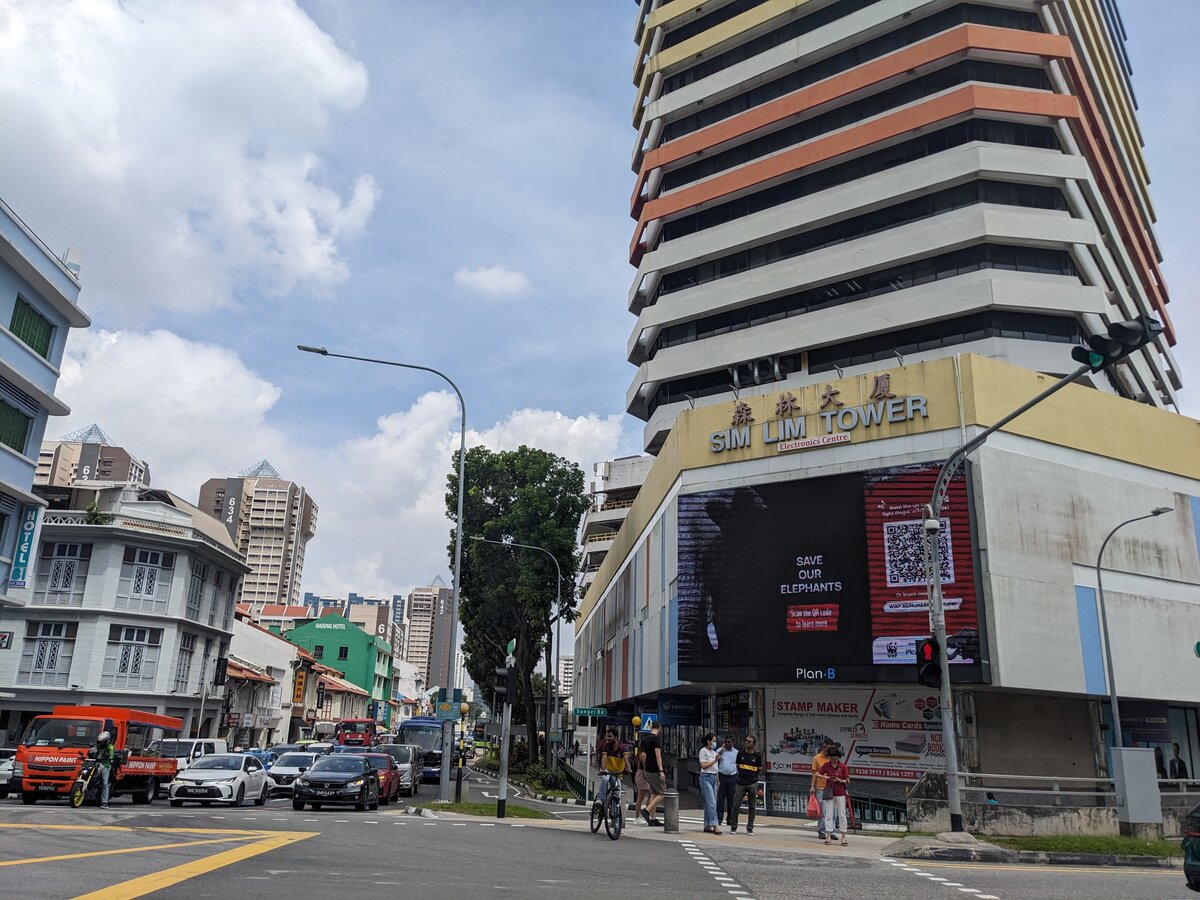
We do not know how much involvement Masin’s official employer, Company M, has in this scheme. However, since managing 200 workers just in his spare time is not possible, logic suggests that Masin must have been released from the company to do his agency work. That he even has an office in Sim Lim Tower, and is seated there at the head table in the middle of a weekday, is noteworthy.
Illegal deployment and cross deployment
In Singapore, it is generally forbidden for an employer to deploy a work permit employee to another company’s worksite to do work under the instruction of the other company. Such an offence is termed “illegal deployment”.
There are exceptions that allow for “cross-deployment” and a glimpse of these rules (pertaining to the Construction or Process sectors) can be found here: https://www.mom.gov.sg/passes-and-permits/work-permit-for-foreign-worker/sector-specific-rules/cross-deploy-a-worker. Basically, the webpage says
With cross-deployment, you can post your construction or process workers to work for another company in the same industry during lull periods.
You can cross-deploy workers only if you are in the construction or process industry. The workers must perform similar work within the same industry.
It may well be that Company K, Kakal’s official employer, was authorised to cross-deploy Kakal to other employers and their work locations in the same industry sector (Process), based on the rules described above, but the details in Kakal’s story suggest aspects that do not look as clean as they should:
1. Is it believable that Company K was in a lull period for all 15 months that Kakal has been in Singapore, thereby justifying cross-deployment of Kakal to other workplaces throughout this time?
2. Masin was not an employee, manager or officer of Company K, yet it was Masin giving directions to Kakal to go here and go there. (Unfamiliar with the minutiae of rules in Singapore, from Kakal’s point of view, he had little reason to question Masin’s authority to deploy him around. After all, it is Masin who pays him his wages, at least up till February 2024 when payments stopped.)
3. Kakal’s Work Permit said “Process sector”, but Kakal reports being deployed to construction sites.
A possible complication stems from a circular that the Ministry of Manpower sent out on 1 August 2024. See this link. It says,
The Ministry of Manpower (MOM) is aware that some Employment Agencies (EA) currently employ work pass holders and deploy them to client companies to supplement the latter’s workforce. MOM wishes to remind you that such supply of labour services is only allowed under certain conditions for the construction and process sectors, or if your EA has been given express approval to do so.
The above suggests that under certain conditions even Employment Agents can cross-deploy their employees to other companies.
However, we do not think this has any bearing on Kakal’s case because,
1. Kakal’s employer, Company K, is not an employment agency;
2. Kakal’s In-principle Approval says there was no Singapore employment agent involved in his recruitment.
Process sector as backdoor to construction work
Kakal’s Work Permit indicates that he is hired as a Process Sector worker. But because he is used (by agent Masin) as a stopgap worker, supplied to various sites from time to time, there is a very blur line between him working in Process and working in Construction. In Kakal’s own words, “if not have Jurong Island work, sometimes [Masin] send me to do construction work other place.”
What this implies for construction standards mandated by the Building and Construction Authority (including safety standards) is worrying. It’s a backdoor for untrained workers to be engaged in construction.
The whole situation is such a mess, we cannot believe that our laws and regulations intend for any of this.
In the meantime, we have helped Kakal file a salary claim. We fear it won’t be straightforward because of the complications of his work history. Our take-away is that helping Kakal get his dues is not enough. Something needs to be done to clean up this kind of set-up wherein “agents” take charge of workers in the absence of the workers’ employers, while the agents themselves are supposed to be working for another company. Otherwise, this business model may flourish, affecting more and more workers.
15720