
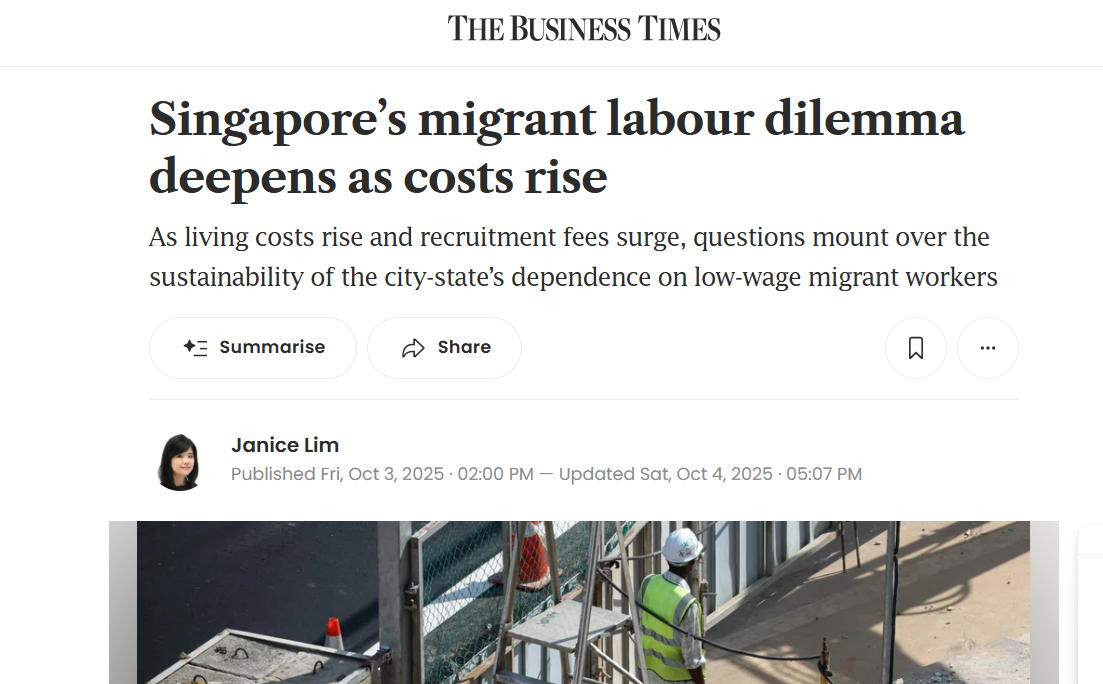
The standfirst in a Business Times article, 3 October 2025, caught our eye. The headline says “as costs rise”, but the standfirst qualifies it by referring to “living costs” and “recruitment fees”. It is far more common in Singapore’s mainstream media to report from the perspective of the government or business, and we are used to seeing stories lamenting the rise in business costs, so it is refreshing to see an article that begins with reference to the migrant worker’s point of view.
Here’s the link, but it is behind a paywall.
Below we will add our comments to the major points the article makes about the situation as it stands now and the likely headwinds in the medium term. However, we also notice that there is little discussion about recruitment costs in the body even though it is mentioned at the top. It’s a significant omission because the massive recruitment costs are the major reason for the disempowerment of workers, resulting in their inability to withstand exploitative behaviour (including depressed wages) by employers. We can’t truly analyse the economics of migrant labour without grappling with recruitment costs.
On wage stagnation
Business Times opens with how a migrant worker, despite having worked 12 years in Singapore, struggles to afford a meal at McDonalds. His income has risen, but whether it has been enough is the issue.
The 35-year-old is among the thousands of migrant workers in Singapore who have had to grapple with rising inflation over the past few years, with low wages that have not necessarily kept pace with costs.
TWC2 has been flagging this problem for years. We have mentioned this in countless articles, including as far back as March 2014: Through six years working here, Suman’s salary stayed much the same. More recently, post-Covid, we have written about a gardener in the Botanic Gardens The gardener with a nice smile (March 2023) who was earning a basic salary of only $14 a day, and how a son working in Singapore twenty years after his father had worked here found himself with a salary exactly the same as what his father received Two generations of migrant workers (January 2023).
In August 2023, we published a research report Struggles and sacrifices as cost of living rises based on a survey of nearly 500 male workers.
It is therefore helpful that the Business Times is highlighting the issue. The article then goes on to discuss the implications for Singapore. Before doing so, however, the article also mentions that even as contracted salaries remain low and relatively stagnant, what workers actually get in their pockets is too often reduced by wage theft. Quoting a spokesperson from HOME (an NGO in the migrant worker space in Singapore):
[HOME] adds that wage theft is already a “rampant” phenomenon. She explains that workers may be underpaid – or not at all – for their work, have their wages unlawfully deducted, or are asked to provide kickbacks to renew their work passes.
On job mobility
In case any reader did not already know this, the Business Times article explained that Work Permit holders are tied to their employers. Migrant workers in this category cannot change jobs without their employer’s permission, which is rarely given. Consequently,
Associate Professor Walter Theseira, a labour economist at the Singapore University of Social Sciences, says this structural barrier means migrant workers have very little ability to seek new opportunities while in Singapore, and therefore face fairly limited ways they can increase their incomes.
The structurally low wages of work permit holders in Singapore are a feature, and not a bug of the system, says Prof Theseira.
“The whole point is to allow the Singapore economy to utilise labour that is cheaper than local workers,” he adds. “It is not a policy objective to have migrant workers earn the same wages as Singaporeans.”
The system is designed to suppress wages.
There is a discussion of the Progressive Wage Model, which is Singapore’s way of arm-twisting employers to pay higher salaries to citizen workers in the absence of any minimum wage in law. By restricting the application of the Model to citizens and permanent residents, there is, in many industry sectors, the bizarre situation where a migrant worker performing the same job alongside a citizen co-worker is paid as little as 25% of what the latter earns.
“Is there any morally defensible reason for excluding migrant workers from the Progressive Wage Model?” asks TWC2’s [Executive Director Ethan] Guo.
Addicted
Inevitably, the spectre of business costs rising should we make a concerted effort to raise migrant salaries is brought up.
Calls to raise the wages of migrant workers, however, are often met with the counter-argument that doing so would further stoke inflation in Singapore and cost employers and consumers more, potentially impeding economic growth.
The article cites the possibility of using part of the $6.7 billion in foreign worker levies collected by the government for short-term relief, benefitting migrant workers.
The Ministry of Manpower sets a quota on the number of lower-skilled foreign workers companies can hire; it also imposes a levy that companies have to pay monthly for each worker. For 2024, the government collected S$6.7 billion in foreign worker levies.
TWC2 would be skeptical about using the levy for short-term relief. We understand that the primary purpose of the levy is to moderate the demand for foreign labour in tandem with quotas. It is also used to nudge upskilling – though we would argue that the results aren’t brilliant. Once we begin to blur the objectives by using the levy monies for wealth or income redistribution, policy-making becomes messy and complicated. For example, in trying to set the right level of levy, which objective takes precedence?
In any case, not only does short-term alleviation do nothing to address the structural problem, temporary money transfers have a way of becoming permanent. It creates dependency and there is never a good time to turn off the gravy train.
We are already in a terrible state of dependency. Our whole economy has become addicted to cheap foreign labour, and we have let the gap grow too large between the living wage we think Singaporeans need – implied by the Progressive Wage Model – and the actual salaries we pay migrant workers. Now, closing the gap is going to cause a lot of pain and disruption. It will feel like cold turkey. We should have nudged migrant salaries steadily up over the years rather than get addicted to the heroin of cheap labour.
Healthcare subsidies
It’s fine for foreign worker levies to go into general tax revenue. And a major use of general tax revenue is to provide a social safety net in Singapore. What is shocking, however, is that migrant workers are excluded from our social safety net. Not only does the levy depress wages – and thus the levy can also be seen as a tax on migrant workers’ potential earnings – they are also (if they earn enough) liable for income tax. In any case, they pay the Goods and Services Tax every time they buy something from the shops.
How is their exclusion justifiable?
Rather than use levy money for income redistribution targetted at migrant workers, it would be more palatable to the general public to extended healthcare subsidies to them too, either at the same level as enjoyed by permanent residents or some other scale. Good health among all people living on our island benefits everyone else and is an economic virtue.
A far better first step in dealing with the disposable income problem that workers face, can come from a complete redesign of the recruitment system, eliminating recruitment fees – we have been advocating such a structural overhaul for years. First-time construction workers have to pay over $10,000 to get a job. Among the service sector workers (mostly Burmese) that TWC2 has met, recruitment fees in the $5,000 to $7,000 range are common.
If we eliminate these fees, that’s analogous to putting $5,000 to $10,000 extra in workers’ pockets.
International competition for migrant labour
Business Times goes on to make an important point, one which TWC2 has been highlighting for the past few years. It is that more and more countries with aging populations are opening up to migrant labour and the present conditions – recruitment costs, salaries, restrictions on job mobility – may handicap Singapore in the coming competition for labour.
“Far from being a fringe phenomenon, and despite concerns about immigration globally, competition is likely increasing due to low fertility and aging populations in many countries,” says Prof Theseira.
Large emerging economies such as China, Malaysia and Thailand are already massive importers of foreign labour, though Singapore’s wages are likely still more attractive than in these countries.
At the same time, more developed, labour-constrained economies such as Japan and South Korea are increasingly recognising that they need to start turning to migrant workers to fill labour shortages.
“I think sooner than later, we will have to reckon with reliance on low-wage migrant workers,” Prof Theseira adds.
We have also highlighted one other aspect: the falling birth rates in source countries. See our June 2023 article: Twenty years from now, where will our cheap labour come from? We pointed out in that article that Bangladesh’s Total Fertility Rate (TFR) has fallen to 2.0, which is a shade below replacement rate. In Tamil Nadu, the TFR has fallen to 1.8. Bangladesh and Tamil Nadu are the sources of nearly all our construction and shipyard workers.
Despite these known facts – about wage stagnation, competition for labour and declining birth rates in source countries – Singapore seems terribly complacent in reforming our migrant labour model.