
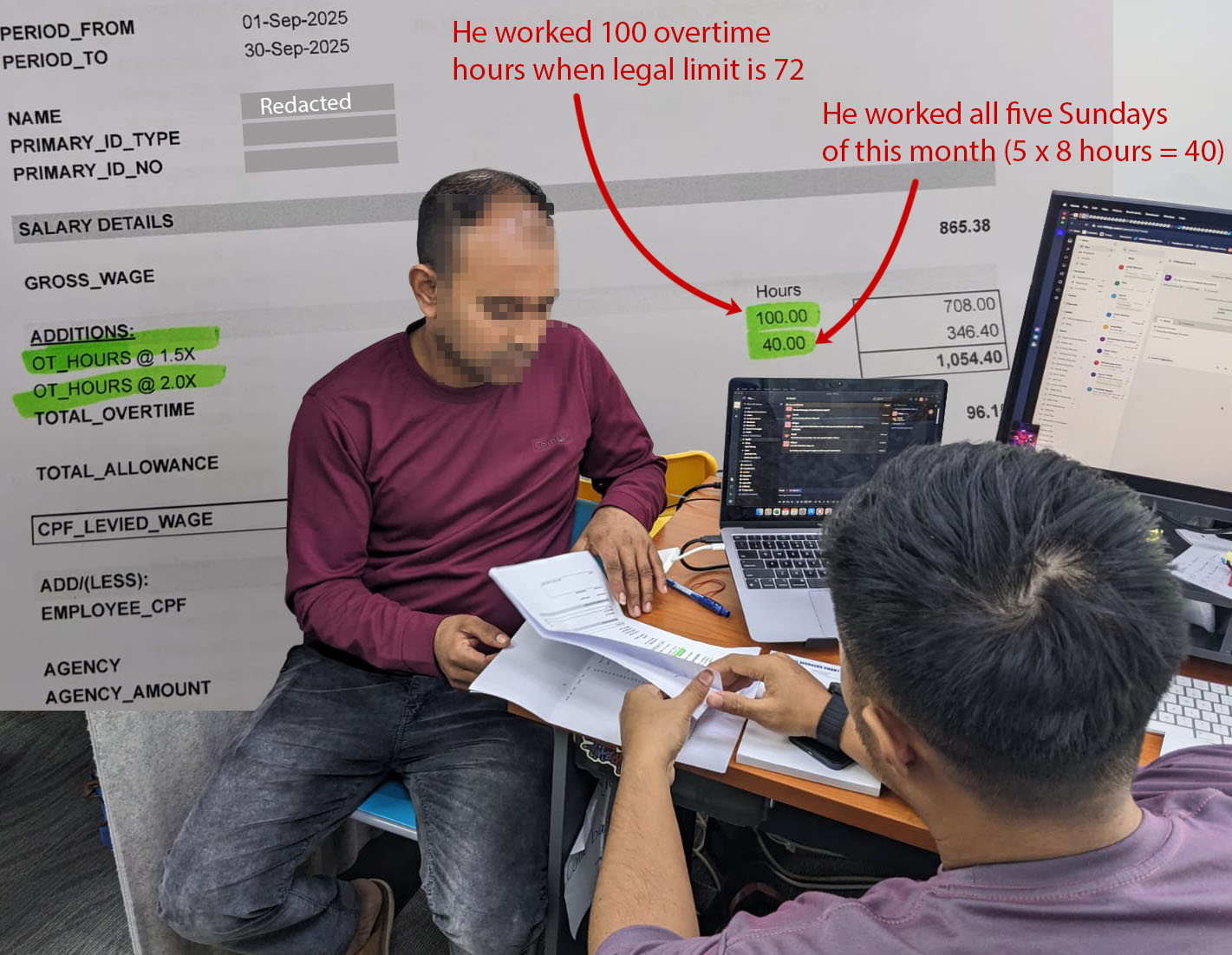
A worker showing his payslips to a TWC2 case officer – payslips that show excessive overtime, and rest days forgone
A large proportion of workers who had not been paid their salaries are also victims of other violations relating to excessive overtime and long work days. Many too had to give up their weekly rest days and report for work with no substituted rest days.
These were the stark findings of a study that mined data from our case files, coupled with face-to-face interviews with several workers.
The Employment Act provides that employees should enjoy a weekly rest day, and should not be compelled to work on those days. The legislation also sets a cap of 12 hours as the maximum length of a workday, and says that no employee should be made to work more than 72 overtime hours in a month.
Our intern trawled through over 11,000 rows of spreadsheet data to find out how often the law is violated, and the results are stark. The graphs in our report (link below) show workers having to give up more than half their rest days, and/or routinely working more than 12 hours a day. With such long workdays, they frequently ended up exceeding, in many months, the 72-hour overtime cap.
TWC2 sits on a valuable lode of data collected in the course of salary casework. To help workers calculate how much they are owed, our case officers diligently compute, day by day, the hours worked. While the aim of the exercise is to arrive at an accurate claim amount, the spreadsheets nonetheless contain incredible detail about workers’ clock-in and clock-out times.
In this research project, we mined the data for insights into violations of rest days and work-hours limits. We found that the great majority of migrant workers in our salary cases found themselves working for employers with little regard for the law.
We identified two workers who were required to work on all their rest days through eleven to twelve months. But they were only the worst cases. Over 70% of workers had to give up at least one in four of their rest days, i.e. losing at least one rest day per month.
About two thirds of workers found themselves clocking more than 72 overtime hours in half or more of the months on record. There was even one worker who was made to work three times more than allowed by the Employment Act for four months in a row. The law setting the 72-hour limit seems to be far removed from their reality of employment.
About half the workers found themselves working more than 12 hours on one in three days, breaching another provision of the Employment Act. Some workers report having to work 14- to 16-hour days routinely.
Our qualitative interviews reveal that workers feel they have no choice but to accede to employers’ demands to work such long hours. Singapore’s foreign worker system allows employers to cancel work permits at short notice, with the worker to be repatriated (exceptions apply). Burdened with debt arising from the loans workers have taken to pay recruitment fees, workers dread the prospect of losing their jobs. Consequently, employer demands for long hours cannot be resisted.
Flouting the law seems rampant, at least among employers that are also delinquent with respect to salary. This study shows how authorities can use salary claim data to sniff out employers who break the law, like TWC2 has done in this exercise.
 Our research report (PDF, 17 pages) can be downloaded by clicking the link at right.