
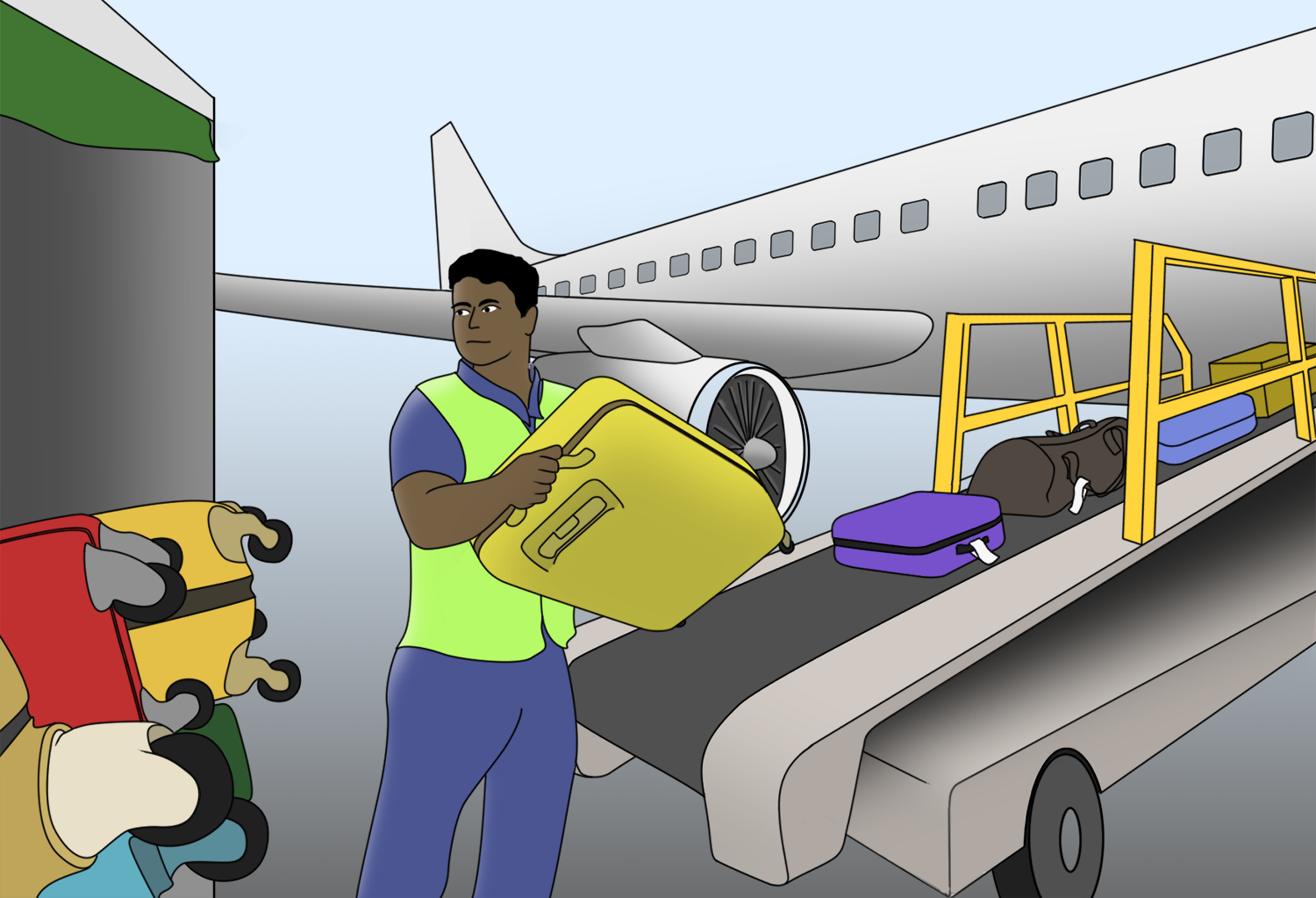
Two well-dressed young men from Tamil Nadu, India, came to TWC2’s office for a brief consultation. The outline of their story went like this: They had been recruited around October 2025 to work at Changi airport as “Logistics Managers”. Employment Passes were obtained for them with declared salaries of $8,000 a month on their In-principle Approval letters (IPAs) which serve as the official documentation for working in Singapore. They both spoke English fluently. One had a bachelor’s degree, the other had a master’s degree.
All of a sudden, about four months into their jobs here, they found their Employment Passes “Invalid” on their phone apps. Their employer said it was not them who cancelled their work passes. If true, then logically it could only have been the Ministry of Manpower (MOM) that did it. But why? The men didn’t know.
Despite the lovely job titles, they were baggage handlers loading and unloading luggage from aircraft. They were paid $1,500 a month, a far cry from what was stated in the IPAs. In late 2025, the minimum salary for Employment Pass holders was $6,000 a month. We had a suspicion that $1,500 was the salary agreed at the recruitment stage, but we didn’t get around to asking explicitly if it was so. We noticed however that at no point in our conversation did they raise the question of a salary claim; they only seemed upset to be losing their jobs. This was consistent with our suspicion.
For context, a fresh graduate in India may be able to get a salary of 20,000 to 30,000 rupees a month (about $273 – $410). So, for these two baggage handlers, to earn $1,500 a month in Singapore, even after having to bear their own rental cost, is still a good option.
It is unlikely that the two guys would have known prior to coming to Singapore that Employment Passes had a minimum salary of $6,000. They didn’t even know they were going to be getting Employment Passes; all they knew was that they would be getting a legitimate work pass to work here.
Their salaries were paid – they had no complaint about unpaid salaries – but in cash. They tried to open a bank account, but the bank said they needed a letter from their employer, and somehow this was not forthcoming. It seemed that the employer really did not relish the idea of paying salaries electronically.
Not mandatory to pay Employment Pass holders electronically
It is worth noting that in the case of Employment Pass holders (as these two guys were), it is not mandatory for salaries to be paid through bank accounts. This is unlike the rule for S-Pass holders. We find this very strange, opening up huge opportunities for under-declaration of salaries (evading income tax) and perhaps other nefarious activities.
A minute or two later, they remembered something. Either prior to coming to Singapore or soon after arrival here (our notes are not clear on the timing) they were required to pre-sign twelve blank salary vouchers. How the employer was going to use them, they did not know, but to us it was a huge red flag – pre-signed salary vouchers can never be for legitimate purposes. Still, they had to do as asked if they wanted the job.
After hearing their story, we advised them that if they filed a complaint, even if it’s just about losing the job and not about salary issues, they risked being caught up in an investigation with unpredictable consequences. They said they intended to file anyway, but we don’t know if they changed their minds after that or went ahead nonetheless.
Not just two guys at the airport
A story about fraudulent applications for Employment Passes no longer surprises us. At TWC2 we see cases like this with regularity: foreigners hired under work passes of high-salary categories when they are working in low-level jobs – which would have been what they had applied for in the first place. Applications submitted to MOM for work passes made by employers and licenced agents must be rife with false declarations. On this site alone, we have story after story of false declarations.
What distinguished these two well-educated Indians’ story was their mention that “All the baggage handlers at the airport are on Employment Passes,” adding that “They are employed by around thirty subcontractors, all doing the same.” We have no way to verify this statement; we can only take it at face value, but we could see no reason why this would not be true. These two guys, after all, were right there working alongside all the others. They would know.
Did lax governance contribute to the problem?
This raises the possibility that if what they say is true, and MOM acted on a whistle-blowing complaint, suspending all the Employment Passes involved, the entire baggage handling capacity of Changi Airport would be crippled. It’s hard to wrap one’s head around such a single-failure vulnerability, yet, seeing how widespread false declarations in work pass applications have become, this might well be the reality on the ground.
This is what happens when the authorities have essentially retreated from active policing of their systems. Contractors supplying labour to the airport find ways to hire as cheaply as they can – they need to win tenders, after all – and if it becomes known that MOM does not bother to check what they declare in their submissions, why not take advantage of that? It’s hardly any surprise then that Employment Passes are used to hire baggage handlers for $1,500 monthly salary.
Before long, this kind of “cheating” becomes normalised.
Why didn’t the employer apply for Work Permits for their baggage handlers? The Work Permit category would align with the monthly salary of $1,500. This is perhaps because Singapore has complicated rules about which nationalities are allowed to do which jobs. Our understanding is that baggage handling would be classed as a service job, but Work Permits in this sector are generally not open to workers from “Non-traditional source” countries, such as India. Service Work Permits are largely for Malaysians or workers from China, Taiwan and Korea. This would explain why contractors hoping to bid for airport baggage handling contracts, yet wanting to hire from the subcontinent (cheaper) have had to resort to subterfuge in using Employment Passes (no nationality restrictions) to get workers for these lower-pay jobs.
The solution must be two-fold: Firstly, the cancer of false declaration must be nipped in the bud with active checks, and not be allowed to grow until an entire industry resorts to “cheating”. Once it’s become prevalent, MOM would be faced with a difficult choice of either (a) enforcing the law and crippling an industry, or (b) closing one eye to avoid economic disruption, but then in so doing, giving perpetrators a free pass.
Secondly, seeing how Singaporeans or workers from authorised source countries for service jobs, such as China and Korea, are not interested in these low-paid positions, MOM should keep pace with reality and be more flexible about their work permit rules.
There is a sign that this is happening. This page from MOM’s website (accessed 13 April 2026) says that from 1 September 2026, new occupations will be opened up to migrant workers from Non-Traditional Source (NTS) countries.
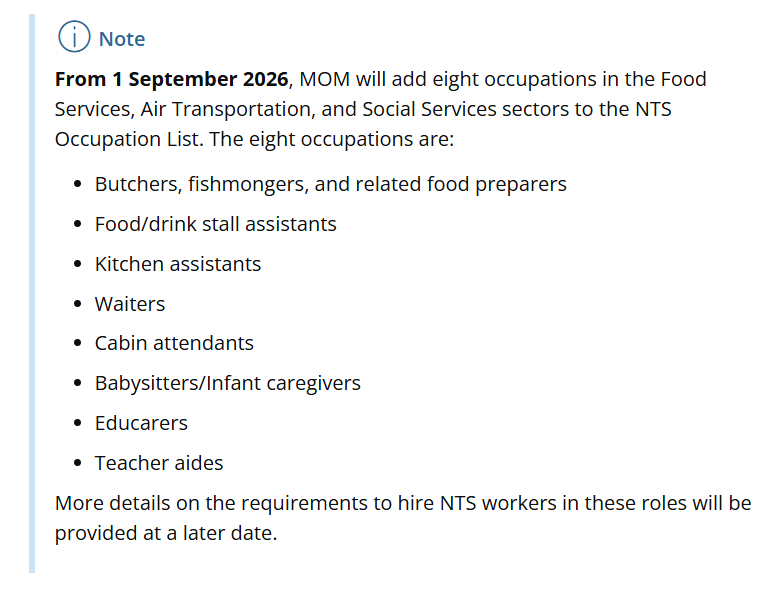
Unfortunately, although air transportation is mentioned, the occupation of baggage handling is not sublisted. Only “Cabin attendants” is mentioned.
For now, it’s not clear how this problem of baggage handlers on Employment Passes, assuming it is as widespread as these two guys reported, is going to be solved.