
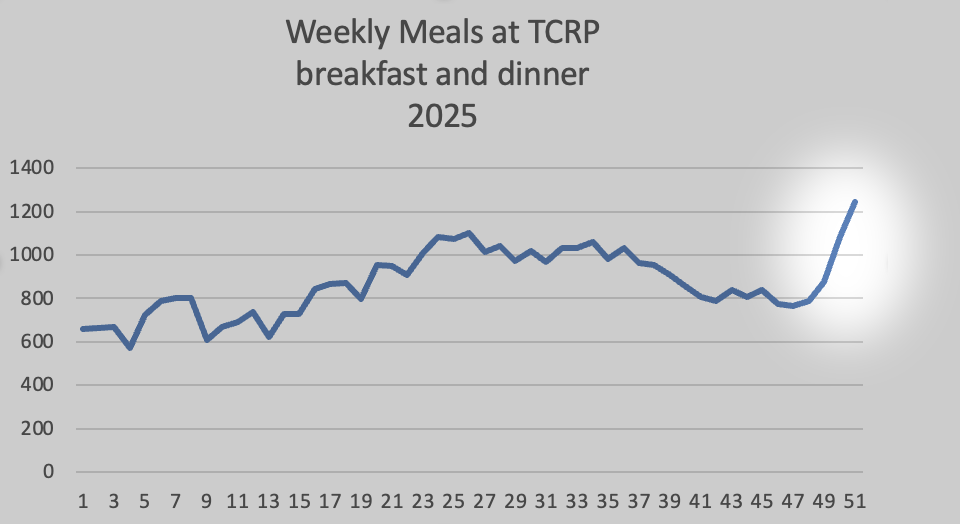
Number of meals served in each of 52 weeks in 2025
The graph above shows the number of meals TWC2 served each week at our Cuff Road Project in 2025. The steep increase at the end of the year was caused by a large group of workers from three companies, which we have written about in the last three articles. These three companies were said to be linked to each other, and by end December 2025, there were over 120 workers who had been thrown out of work.
This uptick in our meals statistics is a disgraceful indictment of our system.
The employer of a Work Permit holder is required by law to provide housing, meals and medical care to any worker who has filed a statutory claim for salary or injury (see footnote). Indeed, this is good law; we just cannot abandon migrant workers on the streets. However, from these 120+ workers, we have numerous examples of lax enforcement, which raises the question of why there is this gap between theory and practice.
Housing and meals
The majority of the 120+ workers continued to be housed in dormitories. However, a substantial minority of them were evicted from their dorms after their Work Permits were cancelled. When seven workers came to TWC2’s office one day to update us about their salary case progress, we asked about their accommodation and learned that three had been evicted. We took the opportunity to get more details from these three about their housing situation.
Transcript:
TWC2: … and then after [filing] the salary claim, were you still staying in the dormitory?
Worker: Now? Now, hotel. Working time, I stay Jalan Papan [dormitory]. Now is stay hotel.
TWC2: Were you staying in the same hotel since?
Worker: Every day, [inaudible] hotel, it change. Daily change. Er, example, today stay Jalan Papa… er, er Jalan Besar. Tomorrow Aljunied. Er, after, Chinatown, Serangoon. Every day change.
TWC2: So you have to check out every day from a hotel and then check in into another hotel later the same day, is that correct?
Worker: Check-in time, er, everyday, not same. Six o’clock, seven o’clock, nine o’clock, ten o’clock. Check-out time everyday same, ten o’clock.
TWC2: So if the boss changes the hotel for you every day, what time does the boss tell you the address or location of the new hotel?
Worker: Every day not same. I talk, er, six o’clock, five o’clock, eight, eight o’clock, nine o’clock. Not same. Every day [not] same same time. Er, change time.
TWC2: Then, how about food? Your boss is supposed to provide food for you, right? So, erm, how is that arranged?
Worker: Every day [unclear] many, many call: “Boss, my MRT money no have, how to take?”
TWC2: Hold on, wait, wait. The boss does provide food, does he not?
Worker: Yes, yes.
TWC2: If you are moving from one hotel to another hotel, is the food delivered to the hotel where you stay? Or is it delivered somewhere else?
Worker: No, no. Only… my boss only, er, only give [at] Jalan Besar.
TWC2: The food is… the catering food is delivered to a Jalan Besar location.
Worker: Only one location.
TWC2: But you don’t stay in that location.
Worker: Every day, erm, every day change. Every day change.
TWC2: So if your hotel is in Chinatown, you have to go to Jalan Besar to get your meals – breakfast, lunch and dinner. Is that correct?
Worker: Yes, correct. MRT money, I talk boss: “MRT money give, I take makan.” My boss talk: “No talk. No talk, no give. I no give MRT money. Go Jalan Besar and take food.”
As they described it, they were being moved from one hotel to another on a daily basis. They had to check out each day at 10am, loiter around in bus stops and public spaces with their backpacks – their larger luggage were stored at the company office – until informed by their boss where they would be sleeping for the night. There were days when they were not told till after dark which other hotel to go to.
Does such an arrangement meet the standard required by law of providing acceptable accommodation?
It went on for the whole of December. They were thrown out of their dorm at the start of the month, and were still in this limbo when we interviewed them on 29 December. Despite informing their case handlers at the Ministry of Manpower, nothing improved. We cannot help but wonder: Does MOM adopt such an employer-friendly interpretation of the law that they see nothing wrong with such behaviour by employers?
The other part of the audio recording concerns food. As can be heard, the men say that while the employer “provides” meals, they are provided at a location that is unconnected with their accommodation. Beyond the question of wasted time travelling around to collect their meals, the boss refused to provide them with money for transport (“MRT money”). For all practical purposes, the men were not getting meals even though the law says these should be provided.
This is not a new problem. For several years now, workers have been reporting similar behaviour by employers, though it is not common. For example, we wrote about another case in March 2024: Employer bullies worker. Can nothing be done? In this case, Rafiqu, after much protesting and sleeping rough for a few days, was finally given a bed in a dormitory in Tuas. But no meals were provided there. Instead, the employer insisted that he should travel to the company office in Sembawang three times a day to pick up his packed meals. Each trip would take two hours or more. It was ridiculous, but the MOM officer told Rafiqu that nothing could be done since the employer was fulfilling the obligation to provide meals.
Another worker, another kind of food crisis
Separate from the food and hotel craziness faced by the seven men, we also discussed food issues faced by another worker. Proddi (name changed) was among the 120+ laid off by the three companies but at least he did not have to move from hotel to hotel. We wrote about Proddi’s employer’s brazen attempt to get his thumbprint onto blank salary vouchers in the previous story. This time, we asked him whether he had received any food support from his employer since his Work Permit was cancelled at the beginning of December.
He said his employer had given him $100 to buy his own meals in December, but for January, “no money give”. Even the $100 given to him for December was far short of what is needed to sustain anyone in Singapore. One needs at least $10 to $12 a day to buy two or three meals. That $100 couldn’t even last him ten days.
While employer behaviour like this is deplorable, what is worse is that we’re not seeing any action from the ministry. TWC2 wrote in to alert them to the unacceptable food situation in December, but as of the time of drafting this story about two weeks later, we have not received a reply. Nor has any worker reported to us of any intervention by the authorities.
Medical treatment
The same clause in the law (see footnote) also stipulates that employers remain responsible for medical treatment when a case has been filed and even after Work Permit cancellation.
Tovirul (name changed to protect him from retaliation) had to go to Changi General Hospital over a dental abscess. It was serious and for the initial treatment alone, the bills totalled $3,600. Surgery was still necessary and the hospital said it would cost around $20,000. A Letter of Guarantee was required from the employer (one of the three associated companies) undertaking to cover this cost, but such a letter was not issued by the employer.
So the surgery did not take place. When Tovirul mentioned it to TWC2, we alerted MOM to this failing on the employer’s part, and also that under the law the employer remained responsible. After all, they would have been required to purchase medical insurance. This page on MOM”s website (accessed 3 January 2026) says:
As an employer, you must buy and maintain MI with coverage for inpatient care and day surgery, including hospital bills for conditions that may not be work-related. The coverage for each Work Permit holder has to be at least $60,000 per year.
“MI” is bureaucratese for “medical insurance”.
Here at last, we have something positive to report, or at least so we thought. About two days after TWC2 wrote to MOM, we were informed that action had been taken and that the employer had been told to sign the Letter of Guarantee so that Tovirul’s dental surgery could proceed. About five or six days later, we saw Tovirul again at our free meals programme. He told us that the employer was still stonewalling and nothing had been signed or submitted to the hospital.
His saga goes on. Just like the workers who have to move from one hotel to another every day. We have to put this story to bed for publication, but their travails… not so soon.

Employment of Foreign Manpower Act > Employment of Foreign Manpower (Work Passes) Regulations 2012 > Fourth Schedule > Part III
Section 16:
“16. Except as the Controller specifies otherwise in writing, the employer continues to be responsible for and must bear the costs of the upkeep (including the provision of food and medical treatment) and maintenance of the foreign employee in Singapore who is awaiting resolution and payment of any statutory claim filed before 1 April 2017 for salary arrears under the Employment Act 1968, any tripartite mediation for salary arrears sought under the Industrial Relations Act 1960, any mediation request submitted or claim lodged for salary arrears under the Employment Claims Act 2016, or any claim for work injury compensation under the Work Injury Compensation Act in force before 1 September 2020 or the Work Injury Compensation Act 2019. The employer must ensure that the foreign employee has acceptable accommodation in Singapore. Such accommodation must be in accordance with the requirements in any written law, directive, guideline, circular or other similar instrument issued by any competent authority. These responsibilities cease upon resolution and payment of the claim for salary arrears or the work injury compensation.”
17232, 17247, 17246, 17354, 17244, 17234,