
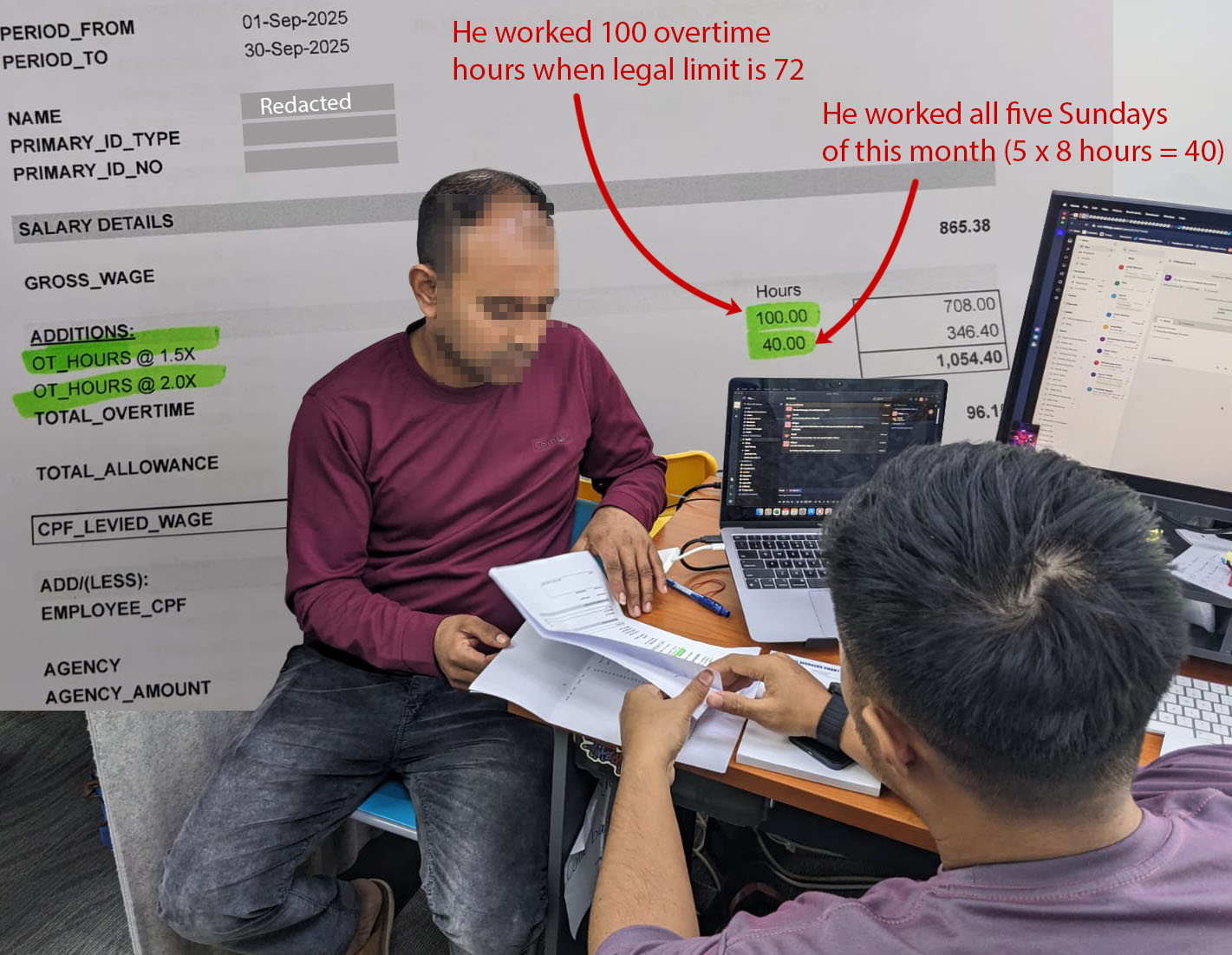
Awlad (name changed) consulting with a case officer at TWC2
Our research report Overworked and underprotected reveals how widespread it is for migrant workers to be made to work excessive overtime and to forgo their rest days with no substitution.
In this post, we will take a closer look at the data for two workers who showed up at TWC2 in January and February 2026 seeking help for their salary problems. Both had been receiving their salaries but the amounts were incorrect. They worked plenty of extra hours, but were not properly paid for them.
These two construction workers, Awlad and Shono (names changed), were not part of the research study; they came to TWC2 after the study had closed. However, the fact that workers continue to come in with time sheets stating absurdly long working hours supports our study’s findings that exploitative demands by employers have been so normalised that it’s a structural feature of the migrant labour landscape.
We were not even looking to write this story; we were not looking out for workers like Awlad and Shono. We just encountered them by chance – Awlad on a Monday when he came in for a consultation, and Shono the next day. This again supports our study’s findings that such violations are commonplace. We don’t have to go looking for them. Swing your arm, and you will hit a migrant worker made to work his life away.
Awlad
I point to the numeral “4.0” marked against the first row of his September time sheet. “What does four mean?”
“Four hour overtime,” Awlad replies.
“At what time does overtime begin?”
“Five o-clock.”
That means that he worked four extra hours from 17:00h to 21:00h, and I check with him to be sure.
“Yes,” he confirms. “Nine o’clock finish.”
This would be overtime work after the normal hours of 08:00h to 17:00h.
I was pointing to the first row in the image below. That’s his time sheet (an annexure to his payslip) for the month of September 2025, though the computation period was actually 22 August to 21 September. What was immediately striking about the time sheet was the frequency with which the numeral “4.0” appeared. It was normal for him to be working till 21:00h every Monday to Saturday.
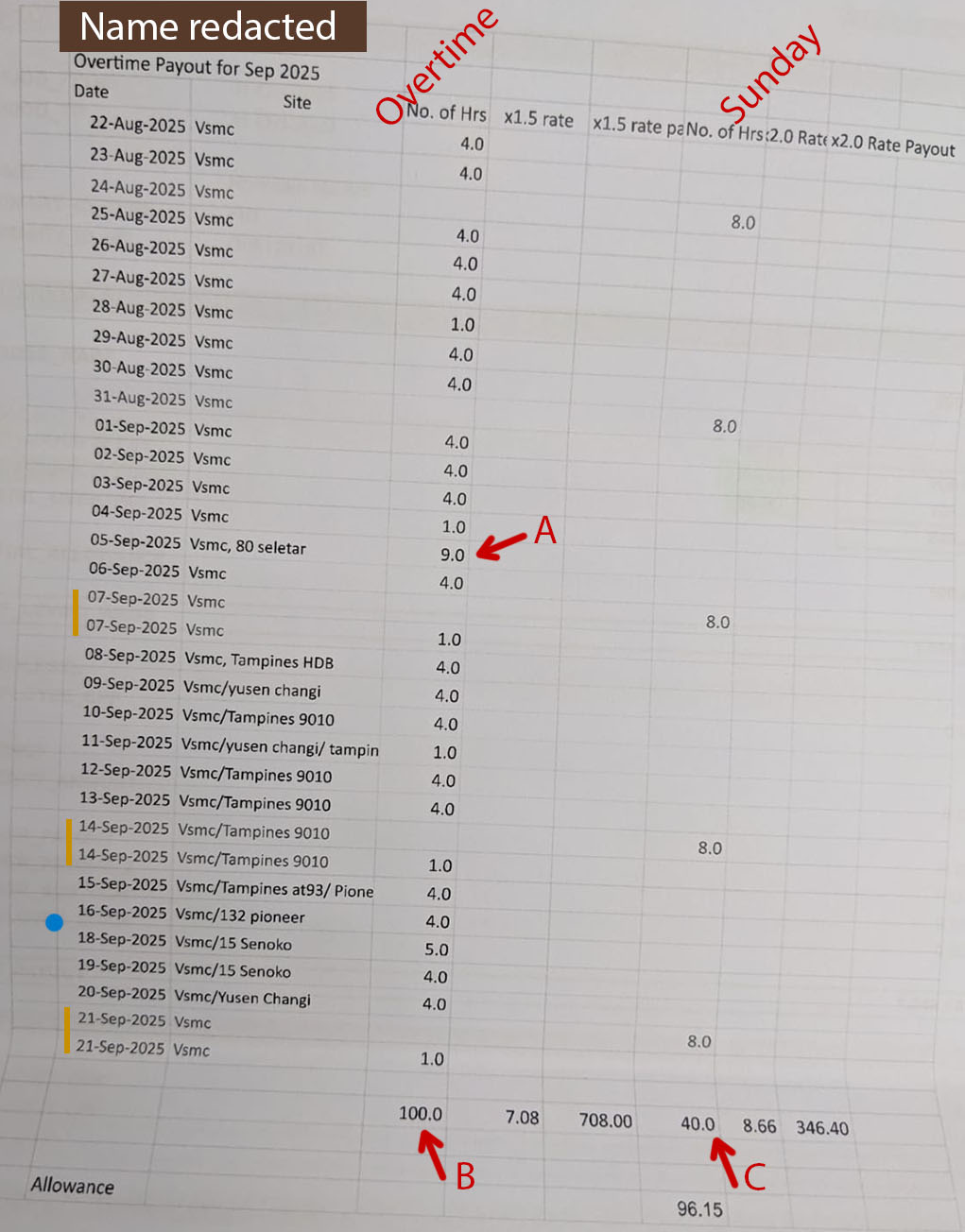
Also striking was the fact that Awlad, an experienced electrician, worked at least eight hours on every one of the five Sundays during this span of time. There were two Sundays (7 and 21 September 2025) when he worked nine hours (8 Sunday hours + 1 overtime hour). In the image above, these are marked by yellow bars.
The blue dot indicates the only day off he had during the entire period (17 September 2025). There are many possible reasons why he wasn’t at work – including that he wasn’t well, or he took unpaid leave, or that he simply wasn’t rostered – but we don’t ask why because we don’t want to detract from the main point of this story which is about the work hours, not about the days he wasn’t working.
The “highlight” of this time sheet is marked with the letter A. On Friday, 5 September 2025, Awlad worked nine hours of overtime. That meant he was at work from 08:00h (his normal starting time) to 02:00h the next morning. Amazingly, he was back on the job the same morning (6 September) at 08:00h, working all the way to 21:00h. He must have been groggy at work, and the safety risk that issues from that should give one pause.
Asked what such long hours felt like, he says, “sometimes I cannot feel my body.”
In total, he worked 100 overtime hours for the September salary period (marked by letter B), and a further 40 hours of Sunday work (C), which should have been his weekly rest day.
Two provisions in the Employment Act have been broken:
- The legislation says that no worker should work more than 72 overtime hours in any month. By making Awlad work 100 such hours, it is a criminal violation.
- It also sets a cap of 12 work hours a day. Twice in this month (5 September and again on 18 September), Awlad’s schedule broke this law.
The next image is Awlad’s time sheet for the following month, October 2025.
The highlight would be Saturday 11 October 2025 (marked with letter D). He worked eight hours of overtime, finishing at 01:00h the next morning. Fortunately, the following day was a Sunday, and he got the day off.
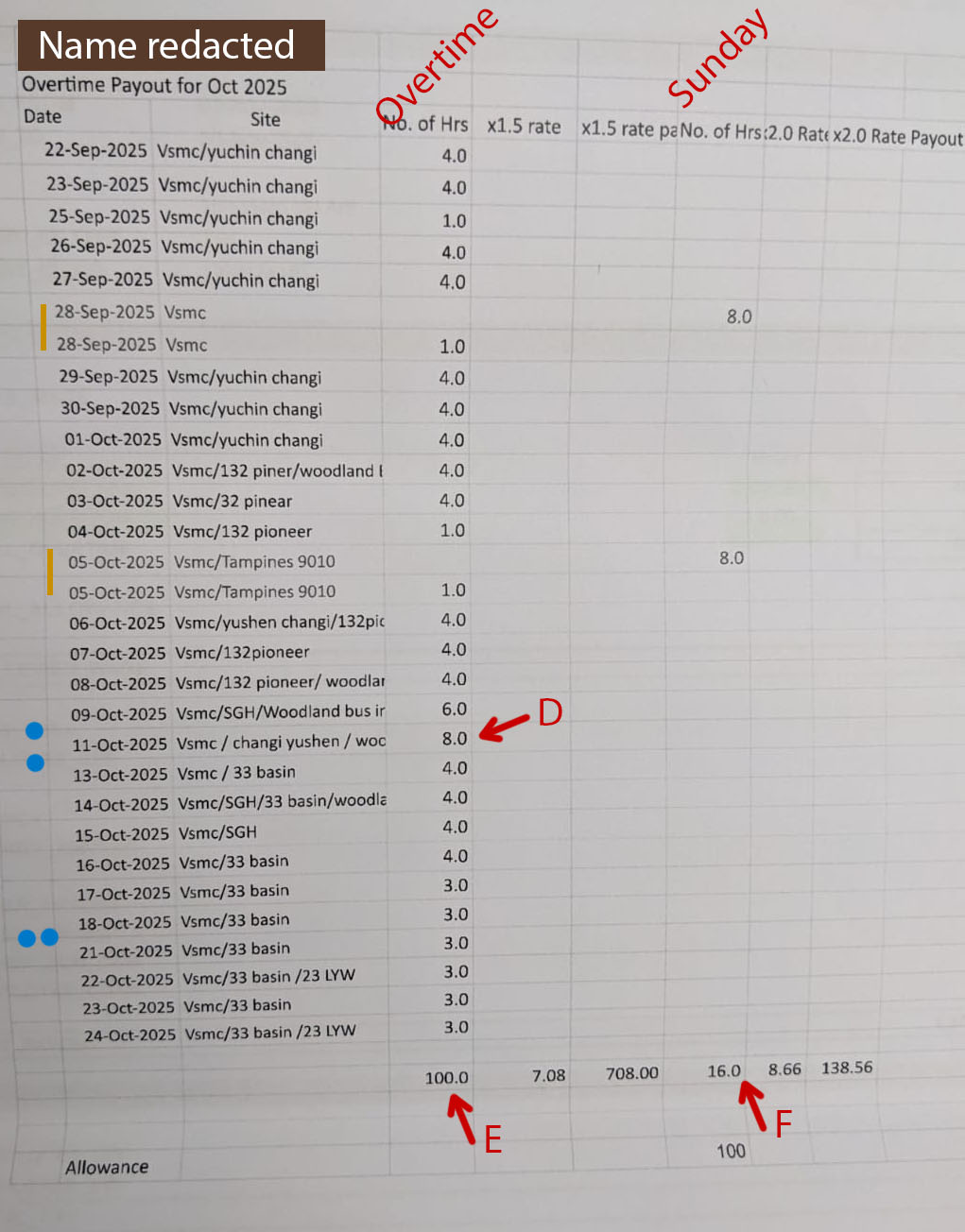
There were four Sundays in this payroll month of October. Awlad worked the first two, but enjoyed the third and fourth. Nonetheless, it should be borne in mind that he worked every Sunday in the preceding September period, so altogether he worked seven consecutive Sundays.
Like in September, he totalled 100 overtime hours in October, as indicated by letter E. The employer broke the law again.
Shono
“What does ‘plus six’ mean?” we ask the Tuesday client Shono, whose trade skill is in the installation of ceiling panels.
“Food allowance,” he explains.
“Why is this given on some days but not other days?”
“Only if working on Sunday, holiday or night shift,” he adds.
“Night shift” is a bit misleading, because Shono uses the term to mean an extended workday from morning into the night. It does not mean going to work for a discrete shift spanning just the night.
Every time we look at workers’ time cards, we have to ask questions like these before we can interpret the sometimes cryptic notations.
Below are Shono’s time cards for May and June 2025. The clock-in times are clearly stated. Most days he worked from 08:00h to 22:00h, a span of 14 hours. Deducting an hour for lunch break, this means he was working 13 hours a day, which is contrary to the Employment Act Section 38(8) which says “an employee must not under any circumstances work for more than 12 hours in any one day.” The law provides for exceptions but these are very narrowly defined and unlikely to apply day after day, as in Shono’s case.
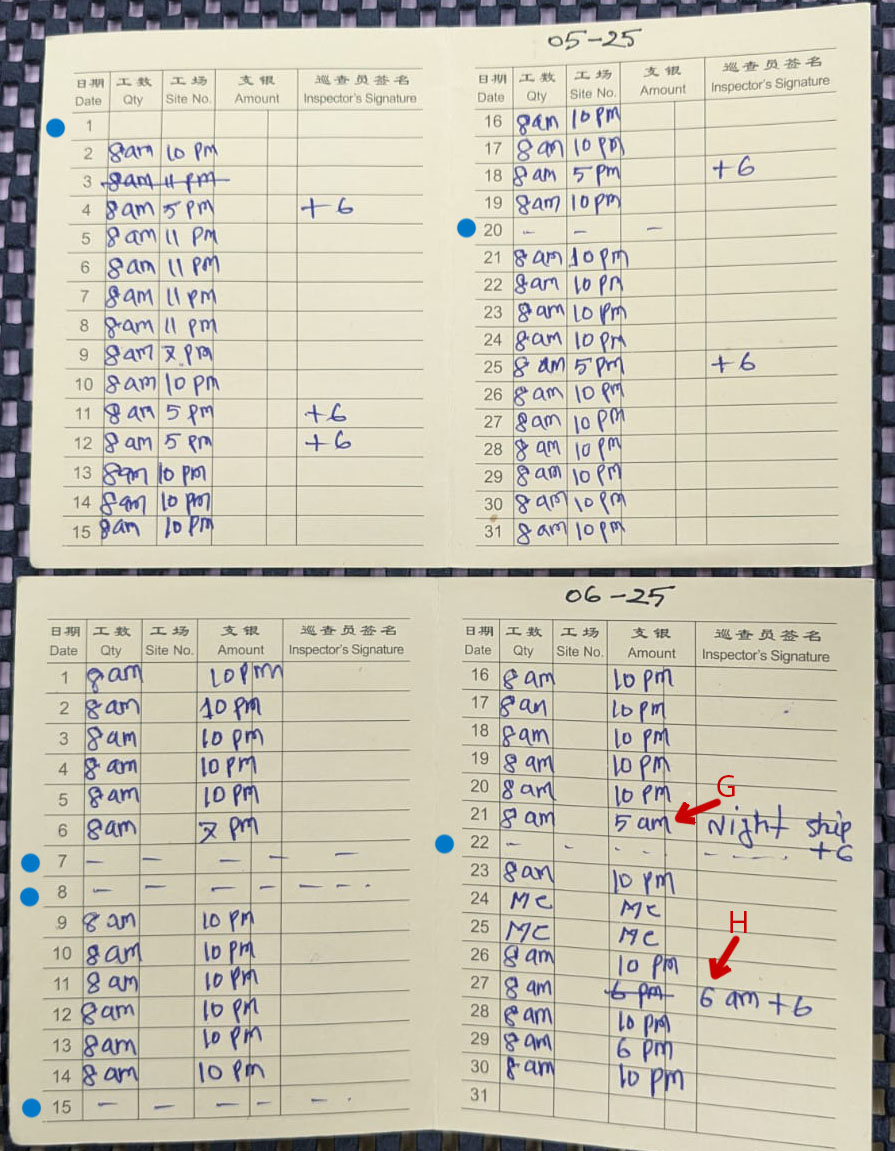
In May, Shono got only two days off: the Labour Day holiday on 1 May 2025, and Tuesday 20 May 2025 (we don’t know why). He worked every Sunday.
In June, once again, the typical workday stretched to 22:00h. He also worked on two Sundays (1 June and 29 June). He enjoyed three Sundays off, and also the Hari Raya Haji public on Saturday 7 June.
However, there were two very bad days this month, marked G and H in red. On Saturday, 21 June, he worked from 08:00h all the way to 05:00h the next morning. A similar thing happened again on Friday, 27 June, when he worked overnight till 06:00h. Two hours later – did he even get a chance to go back to the dorm for a shower, let alone sleep? – he was back on duty at 08:00h… working all the way to 22:00h.
It would happen yet again on Wednesday, 16 July 2025 (marked J in the image below), working till 06:00h the next morning, then resuming work from 08:00h.
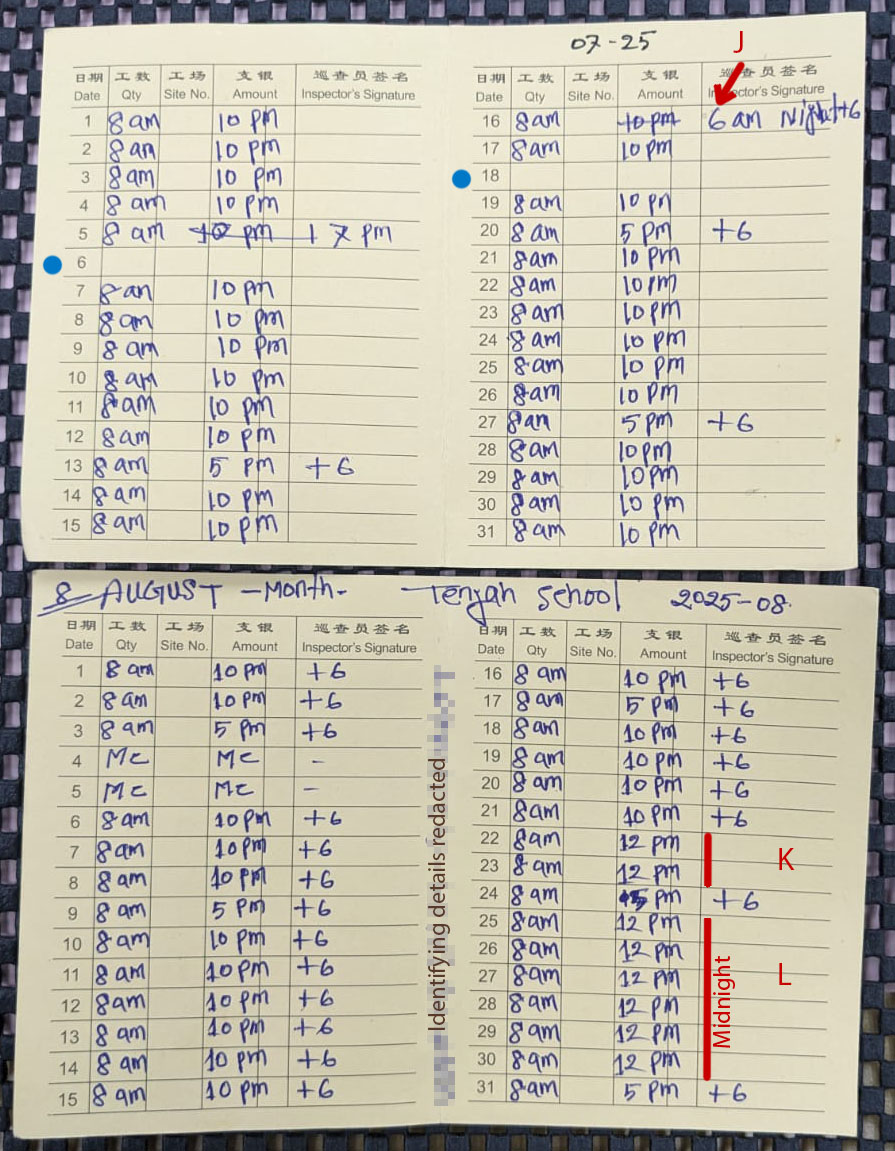
By the time we look at his August time card, we’re almost inured to what the time notations mean. This month too, the typical work day didn’t end till 22:00h. In fact, on eight days (marked K and L) he worked till midnight (he didn’t know that midnight is normally written as “12am” by convention).
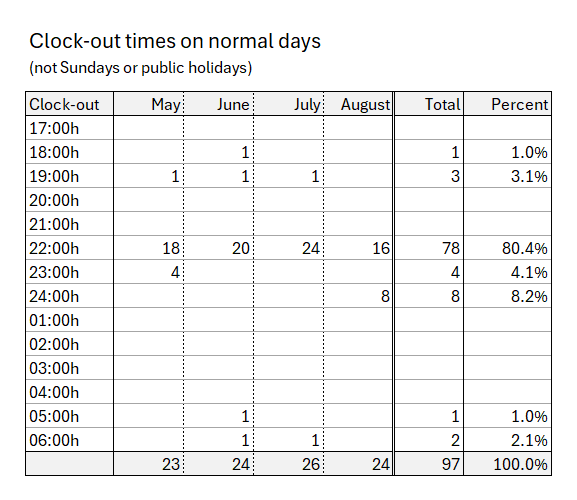
The tables below distill the above details into summaries. We can see that 80 percent of Shono’s work days involved working to 22:00h. Those days and any other day later than 22:00h, would mean violation of the Employment Act’s cap of 12 hours as the maximum duration of a work day. Overall, 96 percent of Shono’s workdays (excepting Sundays and public holidays) went beyond the legal maximum.
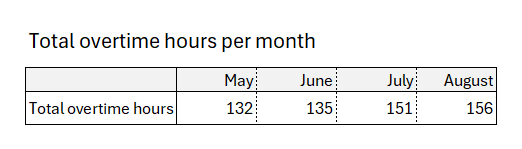
The next table simply shows the total overtime hours Shono worked in each of the four months. As mentioned above, the legal maximum is 72 hours. The employer was breaking the law all four months – at a cost to Shono’s health, even if it’s not immediately apparent.
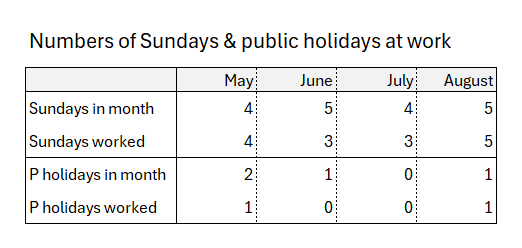
Finally, here’s a look at the Sundays and public holidays that Shono had to work.
Beyond that, there’s really not much more to say in a concluding section. The time logs speak for themselves. Excessive overtime is a big issue affecting a huge swathe of migrant workers, but the reason they don’t often complain about it is simply that they need the extra income. Their salaries tend to be so low, their debts (incurred to pay recruiters’ fees) so heavy, most of them just bear it.
But that is no reason why Singapore should tolerate it. Our laws were enacted for a reason: overly tired workers increase the risk of accidents and injury at site. Lives and limbs are at stake, even if the numbers on time cards seem very technical and dry.
17528, 3288