

Ye Mint (name changed) points to the amounts owed to him for unpaid basic salary, overtime, rest day pay, public holiday pay and sick leave, totalling nearly $9,000.
Globally, the average person has a 6.7 to 8.6 percent chance of getting appendicitis within his or her lifetime. It is the most common abdominal surgical emergency worldwide. It is eminently treatable, with full recovery after one or two weeks following a laparoscopic appendectomy.
Eleven days after his surgery and nine days after discharge from the hospital, Ye Mint (name changed) has fully recovered, walking into TWC2’s office, looking as fit and healthy as any 27-year-old.
Why is he here? Why is he not at work?
He has been fired.
Why?
“I was hospitalised for appendicitis.”
Ye Mint’s case officer interjects: “But that’s what the provisions of the Employment Act are for. There are provisions for medical leave and medical leave wages.” These provisions imply that employers are expected to take such short-duration emergencies in stride until the employee recovers and is able to return to work. They shouldn’t be sacking employees the moment they fall sick.
The Tripartite Guidelines on Wrongful Dismissal explain in paragraph 9 that:
Dismissing an employee to deprive the employee of benefits/entitlements the employee would otherwise have earned is wrongful.
Ye Mint was entitled to the benefits of sick leave and sick leave pay.
However, Ye Mint doesn’t even realise that he has been wronged. Like so many foreign workers, their concept of work and employment is that bosses have almost complete discretion, which is understandable when they come from countries where casual labour (as opposed to formal employment) is commonplace. Instead, he is coming to TWC2 for a totally different problem – underpayment of salary. It is a depressingly common problem faced by migrant workers like him, but getting paid is a right that all employees, formal or informal, understand. Through the four months of employment at a well-known restaurant, he worked an average of about 120 hours of overtime a month (under the law, total overtime hours should not exceed 72 per month), and never got a weekly rest day (he worked seven days a week).
We help him calculate how much he is owed (nearly $9,000) and assist him in filing a salary claim. Separately, we help him file a wrongful dismissal claim as well.
Recruitment fees
Since nearly all migrant workers have to pay large amounts to get their jobs – see our report on Burmese workers’ recruitment experiences – we ask Ye Mint a bit more about how he got this job with a restaurant in Sultan Plaza. This simple question unveils a third set of shockers.
This wasn’t his first job in Singapore, he says.
“But you said you first came to Singapore in October 2025, and you started working at the Sultan Plaza restaurant the same month,” we point out.
“Yes,” Ye Mint replied, “but before that, I worked in another restaurant.”
“When?”
“In October 2025, the same month.”
We have to pause to take it in.
“How long did that first job last?” we next ask.
“Two days.”
We have to pause again to take it in. We then refined our question into two parts: how much paid for the first job and how much for the second job.
“$5,500 for the first job,” Ye Mint replies, “and $1,800 for the second job.”
It being quite scandalous that a young man had to pay $5,500 for a job that lasted a mere two days, we have to get a more detailed story.
“Okay, please sit down. Let me get some writing paper.”
The language teacher and her contacts
Ye Mint’s Singapore story began around the third quarter of 2025 when, after a few years working in factory jobs, he enrolled in a language school in Yangon. He hoped to pick up some Chinese, having heard that being able to speak Chinese would be an asset when looking for service jobs in Singapore.
He soon realised that the teacher doubled as a job agent. She added Ye Mint to a WhatsApp chat group which was regularly updated with available openings in Singapore. Ye Mint, like any other student, could choose from that list and ask for an interview over WhatsApp, which the teacher’s contacts in Singapore would then arrange. However, a non-refundable deposit of $500 had to be paid for each interview.
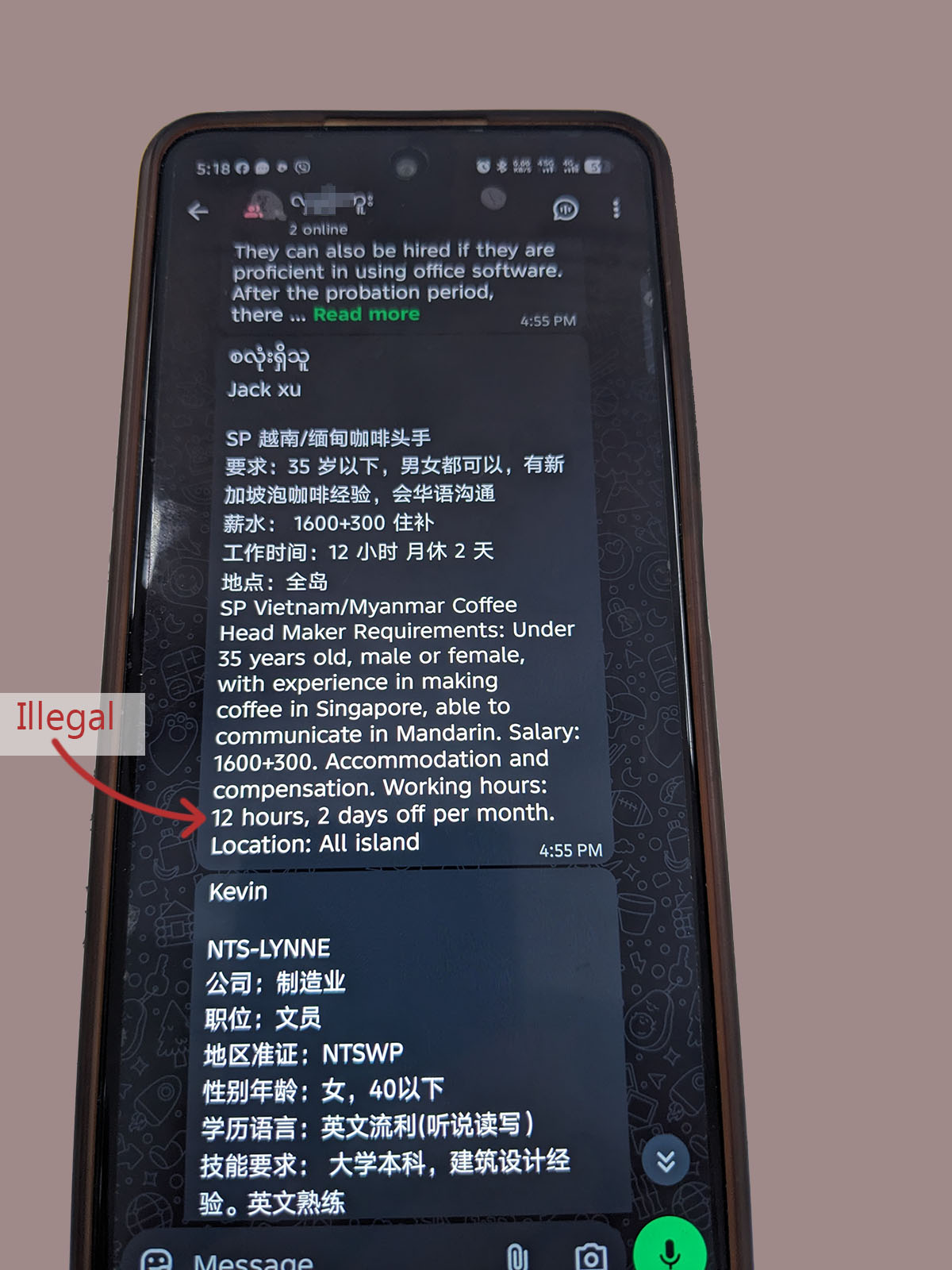
One of the many job advertisements in the WhatsApp chat group. It is worth noting that the ads do not contain the licence numbers of the employment agents. It is mandatory under the Employment Agencies Act to display such credentials. It is a criminal offence to fail to do so. That the advertisers are almost surely Singapore parties can be gleaned from the bilingual text, and also, from Ye Mint’s experience when he wished to apply for two of these jobs, he was put in touch with persons based in Singapore.
Is it possible that the advertisers do not have licence numbers? Yes, it’s possible, but then they shouldn’t be advertising at all. It is also an offence for unlicensed parties to act as if they are job agents.
This is another example of how brazenly agents flout Singapore law, with no fear of enforcement.
Ye Mint chose one of the advertised jobs. He paid $500, and an interview was arranged by a job agent based in Singapore. But although he “passed” the interview and a job offer was made to him, he rejected it because the salary was too low. “The total salary was only $1,400 a month,” he tells us.
Because he rejected the offer, the $500 would not be refunded.
A second advertisement was selected and a second interview arranged. Once more, Ye Mint was successful and he received a job offer with a $1,600 salary, which he accepted. Now he had to pay the full fee of $5,000. Although the amount was denominated in Singapore dollars, the payment was actually made in Myanmar, and to the teacher. What proportion of that was re-directed to the teacher’s Singapore contacts, Ye Mint does not know (we make an educated guess below).
Frantic October
Ye Mint arrived in Singapore on 2 October 2025. He had received an email beforehand informing him what to do and where to go after arrival at Changi Airport. He managed with no difficulty. After a medical check-up later the same day, he started work the following day, 3 October 2025.
The very next day, after his lunch break, his supervisor approached him to give him bad news. The manager wanted him gone, she said. She didn’t know why.
Ye Mint protested to the employment agent who had arranged the job interview and who had given him directions for his arrival at Changi. They agreed to give him a partial refund of $1,650 and look for another job for him. It is interesting that although the recruitment fee of $5,000 was paid to the language teacher in Myanmar, the agency in Singapore was taking responsibility for it and offering a refund.
Moreover, the amount ($1,650) suggests that the Singapore agency took $3,300 out of the $5,000 that had been paid – if the agency followed the Singapore rule that if a worker they had placed in a job is fired within six months, they should refund half of what had been paid.
In a follow-up article, we will also discuss why these figures leave many questions about false declaration in official documents.
Within days, the agency also found a new job for Ye Mint. Fortunately, the salary looked attractive enough for Ye Mint to accept the job. However, they demanded another fee of $3,450. Below is the WhatsApp message wherein this amount is stated, also explaining that after netting off the refund for $1,650, Ye Mint had to pay a further $1,800. Included in the message was a DBS bank account number. We notice that the fee of $3,450 is remarkably similar to what we had imputed as the fee of $3,300 for the original job.

Message from the agent about the $3,450 fee payable for matching Ye Mint with the Sultan Plaza restaurant job.
As mentioned at the start of the story, he only worked four months or so at this job, terminated for falling sick with appendicitis. At no point in time was there any issue with his work performance, so this could not have been a reason for termination.
No sure thing
Yet, obvious though it may be to the lay person that Ye Mint’s appendicitis was the trigger for being fired, proving it in the Employment Claims Tribunal (or at appeal to the High court, if necessary) is not as straightforward.
Paragraph 7 of the Tripartite Guidelines on Wrongful Dismissal explains:
As both employee and employer have a right to contractually terminate employment with notice, dismissals with notice are presumed not to be wrongful. (emphasis added by TWC2)
The Guidelines include an example for illustration:
C was dismissed with notice. His employer did not give any reason for the dismissal. When C asked for a reason, the employer continued to not give a reason, and explained that it was termination in accordance with the contract. C is unable to point to any facts, incidents or situations which could suggest that the employer’s intention was anything other than termination in accordance with the contract.
This dismissal with notice was not wrongful.
Having only worked for four months, the applicable notice period for Ye Mint was just one day. It would be the easiest thing in the world for the employer to pay him one day’s pay and say that it was termination with notice, and not a dismissal. Ye Mint, as claimant would bear the burden of proof that the employer intended to deprive him of a statutory employment benefit (sick leave and sick leave pay), but how is anyone to prove what’s going on in another person’s mind if the other person refuses to disclose his motives?
Of course, the sheer timing of the dismissal cries out for an explanation, but how a court may rule on this is no sure thing. Yet, if a court leans against Ye Mint’s argument, it would strike many people are grossly unfair.
That unfairness is particularly exacerbated by the fact that he had paid thousands of dollars to obtain two jobs that turned out to be ridiculously short-lived. It would be less acute an issue if Ye Mint did not have to “buy” his jobs in the first place, and if our migrant labour regime facilitates his finding another job (at no cost) as soon as possible.
Therefore, eliminating recruitment fees and making it easier for unemployed migrant workers in Singapore to move into new jobs are key parts of a holistic solution to the question of justice. TWC2 has made many proposals in earlier articles on this website how these objectives can be achieved. Yet little progress is evident.
Instead of solving the issue at source through policy design, we seem to prefer to let injustices happen and then deal (imperfectly) with a flood of individual claims and cases, even if that means a need for a massive bureaucracy and its consequences on taxpayer money.
17679