
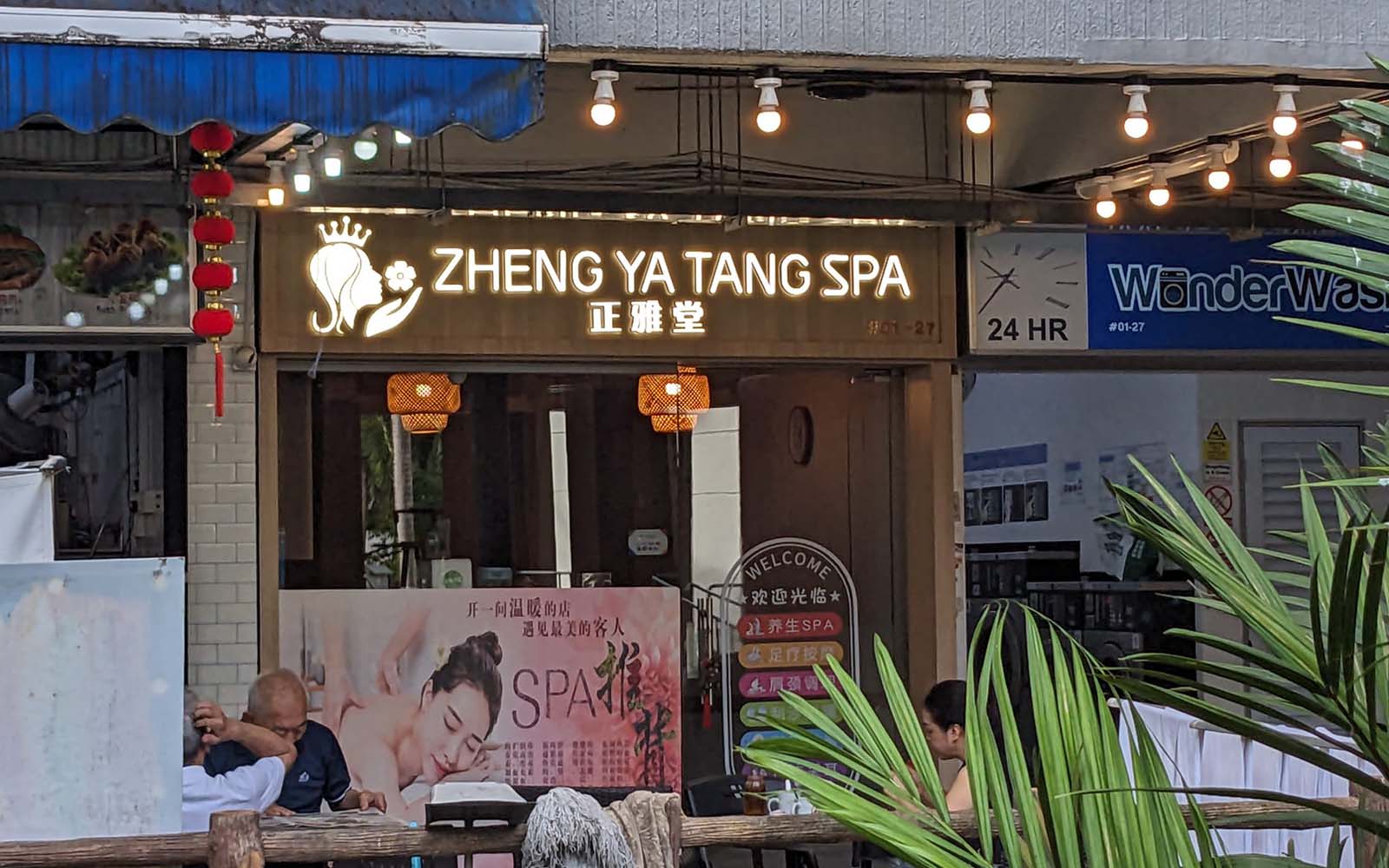
Xoan’s job at this shop was foot massage. On slow days, he would be sent out to distribute flyers to drum up business.
He was couch surfing. He would spend one or two nights with a friend, then move to another friend’s place for another night or two. He had to quit his shared rental room after losing his job because he had no money to pay the rent. It was $400 a month. Xoan (name changed) had been in this situation for the past few weeks, depending on the few friends he had in the Vietnamese community.
There is a gap in law, and Xoan, who had held an S-Pass, fell right through it. Whilst the Employment of Foreign Manpower Regulations require employers of Work Permit holders to continue to house their employees if the workers have to remain in Singapore to pursue statutory claims (e.g. claims over salary non-payment), there is no similar rule for employers of S-Pass holders. The mandatory support for Work Permit holders applies even if the employers have cancelled their Work Permits. S-Pass employees, on the other hand, are left to fend for themselves.
Xoan had been hired as a non-medical masseur by Zheng Ya Tang TCM & Spa Pte Ltd, a shop in the North Bridge Road area. He arrived from Vietnam on 8 July 2025, but two months later, the employer cancelled his S-Pass, saying that the business had been sold and the new owner did not wish to keep him.
The problem was that Xoan was only paid $600 for each of those two months, July and August, with most of the money going on rent. This was despite the fact that the In-Principle Approval (IPA) stated a monthly basic salary of $3,000 topped with an allowance of $150. The IPA is a document issued by the Ministry of Manpower (MOM) indicating that it had approved an S-Pass for a foreign employee; among its stated details is the salary that the employer declared to the ministry as the applicable salary.
Furthermore, Xoan worked extended hours, so a lot of overtime pay was also due. He was working about six hours a day of overtime. This in itself represents another violation by the employer: no employee should be required to do such long hours.
Not having been properly paid, Xoan could neither afford accommodation or food once the job ended – a problem created by the employer. Yet, the law says he has to pay his own expenses going forward.
It gets worse. After the salary claim was filed – he calculated that he was owed about $15,000 – mediation was unsuccessful. A measly offer of $1,300 was made to him and Xoan naturally rejected it as grossly insufficient. That meant that the case would have to be referred to the Employment Claims Tribunal (ECT). The backlog at the ECT has been growing over the past year or two, and Xoan was told that his court date would only be around April 2026, some six months ahead. How was he to survive?
Access to justice is not just about the technicalities of process. It has to be seen holistically, and must come with support for victims so that they have the wherewithal to sustain themselves for a grueling fight.
As if not being paid his salary wasn’t bad enough, Xoan (or his family) had paid $7,000 to an agent to get this job. How much of that went to the boss himself (if any at all) Xoan didn’t know, but he had his suspicions. He was beside himself with worry over his family’s finances.
Clearly, something is not right with our system and our laws that can leave people in such a dire situation.
Why the gap?
We do not think the policy gap, leaving former S-Pass holders without any support, is an oversight. We think it is a deliberate policy, albeit one borne out of wishful thinking rather than a sober appreciation of reality.
S-Pass holders have 30 days to look for new jobs once the Pass is cancelled. The Ministry of Manpower may believe that they should therefore be able to support themselves without too long a break. This is not the reality. New jobs are hard to find, and 30 days is way too short.
For Singaporeans, the jobs they are mostly interested in are typically jobs that are not open to foreigners, so they largely compete against other unemployed Singaporeans for available positions. Even though our resident unemployment rate is low, Singaporeans don’t often land a new job within 30 days.
For unemployed S-Pass holders, the jobs available to them are far fewer, because only certain employers are able to offer S-Pass jobs. Moreover, S-Pass jobs are open to anybody from anywhere around the world. In essence, the unemployed S-Pass holder has to compete against the entire world to land a new job here. Furthermore, many employers are prejudiced against former S-Pass holders who have launched salary claims against their previous employers however justified the claims may be; they would rather hire someone from abroad than take in an unemployed individual already in Singapore with a pending case.
Without recognising this reality, the policy of not offering support to S-Pass holders is almost cruel in its make-believe.
TWC2 has long argued that we should incentivise employers to hire foreigners who are already in Singapore, so as to reduce the social burden of having to look after unemployed foreigners in our midst. That will no doubt mean raising some barriers to employers freely hiring newbies from abroad.
Even when we amend the policy to incentivise employers to soak up the pool of unemployed foreigners here, there will still be the unfortunate individual who, for whatever reason, cannot find a new job. This person may be injured and unable to work, or have skill sets that few employers are looking for. Therefore we will still need some kind of social safety net for former S-Pass holders while their cases remain unresolved.
Why don’t they have savings?
We anticipate the argument that S-Pass is a category for jobs with mid-level pay and therefore it should not be farfetched to expect that they should have personal savings to fall back on. In some cases, maybe, but we cannot assume it is always so.
Firstly, as Xoan’s case shows, the job was supposed to pay him $3,150 a month in fixed salary (before overtime pay is added on). But he was paid next to nothing. This is quite a common scenario in salary claims cases. How can we design policy on the basis of “but they should have savings” when this is the reality?
Secondly, one of the most common uses of S-Pass hiring is to circumvent an employer’s ineligibility to hire on Work Permits. Many types of jobs are simply ineligible for Work Permits. Xoan, for example, was a masseur. The company needed someone to do foot massage. The company might have felt that such a job really does not justify a salary of $3,150, but since (as at July 2025 when Xoan was hired) the minimum salary for any S-Pass job has to be $3,150, that’s what the company offered him. There was possibly the intention from the very start to pay him less than that – and a boss’ thinking may go: If I am anyway going to flout the contracted salary, why not pay him not just a little less than agreed but a whole lot less?
In other words, offered S-Pass salaries are too often insincere and prone to underpayment and salary disputes. For policy-makers, any assumption about savings will run aground on this reef.
This is hardly helped by MOM’s own policy in a related area: educational qualifications for S-Pass jobs. As discussed in our article Singapore opens S-Pass jobs to illiterate rickshaw pullers, there are no more minimum standards. The door to hiring all sorts of people for low-skill work under the so-called mid-skill category of S-Pass is now wide open. If MOM had maintained the previous policy of requiring a minimum technical diploma for S-Passes, there would be a better correlation between skill and salary, and the incidence of “S-Pass cheating” (using S-Pass to hire employees to do low-skill work that does not justify the salary) should be lower. And perhaps the backlog at the ECT would not be so bad.
A simple fix
It will go a long way if we simply opened the Work Permit category to many more low-skill jobs, e.g. massage, hairdressing, food service, so that employers don’t have to be dishonest and hire under the S-Pass. There are very few Singaporeans looking for such jobs anyway. And when employers still don’t pay salaries properly, the workers will come within scope of the Work Permit safety net when they file claims, with the benefit of housing, food and medical care.
Instead of clear-headed thinking, we see bad policy all around.
17036

So, what happened to Xoan? readers may wonder. With nowhere to stay, he decided to go back to Vietnam at the beginning of December 2025, with plans to return to Singapore in April for his ECT hearing. Possibly, he can find temporary work in Vietnam for the next few months.
But even here, MOM’s policy fails him. As a former S-Pass holder, the employer is not responsible for buying him an airticket (unlike the case for Work Permit holders). So, Xoan had to find the means to buy his own ticket each way. It’s a few hundred dollars each time, roughly equivalent to what he might have to pay as rent.
Access to justice is a severely compromised matter.