

The United Nations’ Protocol to Prevent, Suppress and Punish Trafficking in Persons (2000), also known as the Palermo Protocol, sets out states’ responsibilities to combat human trafficking. Singapore acceded to the Protocol in September 2015.
A few months later, in January 2016, Singapore ratified the ASEAN Convention Against Trafficking in Persons.
The Palermo Protocol and the ASEAN Convention have similar aims. Compare, for example, their definitions of human trafficking:
Palermo Protocol
Article 3 –
(a) “Trafficking in persons” shall mean the recruitment, transportation, transfer, harbouring or receipt of persons, by means of the threat or use of force or other forms of coercion, of abduction, of fraud, of deception, of the abuse of power or of a position of vulnerability or of the giving or receiving of payments or benefits to achieve the consent of a person having control over another person, for the purpose of exploitation. Exploitation shall include, at a minimum, the exploitation of the prostitution of others or other forms of sexual exploitation, forced labour or services, slavery or practices similar to slavery, servitude or the removal of organs;
(b) The consent of a victim of trafficking in persons to the intended exploitation set forth in subparagraph (a) of this article shall be irrelevant where any of the means set forth in subparagraph (a) have been used;
ASEAN Convention
Article 2 –
(a) “Trafficking in persons” shall mean the recruitment, transportation, transfer, harbouring or receipt of persons, by means of the threat or use of force or other forms of coercion, of abduction, of fraud, of deception, of the abuse of power or of a position of vulnerability or of the giving or receiving of payments or benefits to achieve the consent of a person having control over another person, for the purpose of exploitation. Exploitation shall include, at a minimum, the exploitation of the prostitution of others or other forms of sexual exploitation, forced labour or services, slavery or practices similar to slavery, servitude or the removal of organs;
(b) The consent of a victim of trafficking in persons to the intended exploitation set forth in Paragraph (a) of this Article shall be irrelevant where any of the means set forth in Paragraph (a) have been used;
In late October 2023, two workers came to TWC2 seeking help for their salary concerns. From their descriptions of the events leading up to their present situation, we could see violations of these trafficking standards. Using their examples, we will describe here how trafficking behaviour is manifested in real life.
Operational indicators
It is important to bear in mind that human trafficking is not a simple dichotomy, as commonly perceived. It is a spectrum of abuses, ranging from mild to outrageous. The abuses are also varied in nature, ranging from wage violations to psychological threats, excessive work, and restraints over movement. There is scope for debate as to how bad the abuses have to be before a case is classified as a human trafficking case.
To help states and other parties detect and counter trafficking, the International Labour Organisation (ILO) has published operational indicators encompassing a variety of abuses. Among the many indicators of labour exploitation that ILO listed are these two from the category Deceptive recruitment:
- Medium indicator: Deceived about wages/earnings.
- Strong indicator: Deceived about the nature of the job, location or employer.
There are another two strong indicators from the category Coercion at destination which will be relevant to one of the cases we discuss below:
- Strong indicator: Confiscation of documents.
- Strong indicator: Debt bondage.
Also relevant to this article are another three indicators, from the category Exploitation:
- Medium indicator: Wage manipulation.
- Medium indicator: No respect of labour laws or contract signed.
- Strong indicator: Excessive working days or hours.
Our two workers’ experiences can be said to check many of these boxes.
The fire protection guy
In the second half of 2022, Kabir Esmail (not his real name) was in communication with the boss of a company he had worked in before. The boss reached out to him saying he needed two extra workers experienced in the field of fire protection systems. Kabir indicated his interest, and the boss made him an offer via WhatsApp in June 2022, stating a salary of $1,200 a month. This was repeated in another WhatsApp message of 28 August 2022.
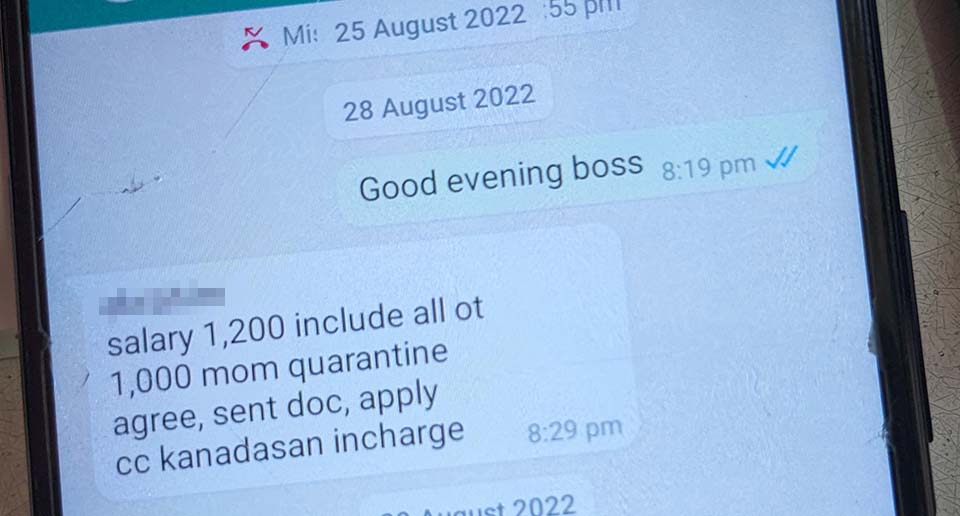
The offer made by the boss. The worker’s name has been pixelated out
The offer took this form: A salary of $1,200 a month (a figure that includes overtime pay, which is contrary to law); the worker to pay the company $1,000 as cost for the quarantine stay, said to be required by the Ministry of Manpower (MOM) (also contrary to MOM directive). If Kabir agreed to these terms, he was to send an application and his documents to a certain Kanadasan.
Fixed monthly salary cannot be inclusive of overtime pay. This was laid down by the High Court judgment in Monteverde Darvin Cynthia v VGO Corp Ltd [2013] SGHC 280. However, for the purposes of this story, this point is not important, though it does show how the employer was in violation of one of the trafficking indicators (respect for the law) from the outset.
For reasons unclear, Kabir didn’t join the company immediately. It might have been because, at the time, he was still working for another employer. Finally, in December 2022, he asked the boss of the fire protection company if he could join in January, The boss said yes and repeated the offer of $1,200 in monthly salary. Below is the WhatsApp message of 20 December 2022, which also noted that since Kabir was already in Singapore, he didn’t need to go through quarantine. Thus, Kabir wouldn’t need to pay $1,000 to the company — which payment would anyway be illegal.
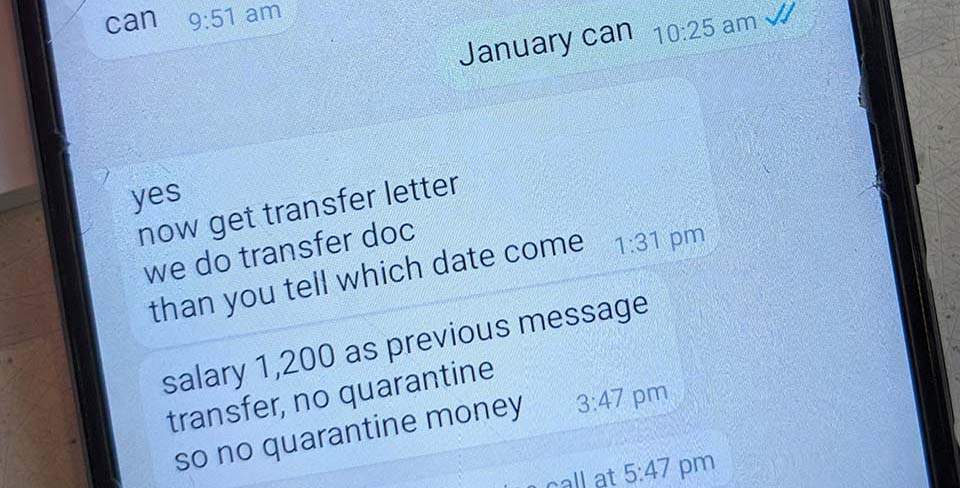
On 20 December 2022, the boss repeated his offer.
Yet, when the company applied to the Ministry of Manpower (MOM) for a work permit, it declared the basic monthly salary to be $572 per month. The implication of this was that even though the boss and Kabir had agreed on a certain salary, should there be any dispute in future, the enforceable salary might be whatever was officially declared to the ministry ($572).

In the In-Principle Approval generated by MOM, with details submitted by the employer, the basic monthly salary was stated as $572, a figure that Kabir had never been told about or agreed to.
When Kabir noticed the figure of $572, he raised it with the boss. According to Kabir, the boss said something to the effect that there was nothng to worry about and he’d still be getting $1,200 a month. As for the false declaration to the ministry, he (the boss) would “settle” the matter.
The boss kept his word. Sort-of. In the months following, the employer seemed to have applied the rate of $1,200 for payroll calculation rather than the basic salary of $572 per month stated in the In-Principle Approval. Yet, to be exact, in no month did Kabir receive precisely $1,200; the company was always paying him a little less. Kabir explained that, sometime into the job, he discovered that the $1,200 was only applicable if he worked every day of the month. For each Sunday that he didn’t work, there would be a deduction of about $40. There were apparently other deductions as well.
We can see several trafficking indicators in Kabir’s case:
There was wage manipulation in the way that legally-mandated weekly rest days were used as justification for wage deductions. From another angle, we can also see it as an issue of excessive working days, when an employee is expected to work 30 or 31 days a month, with penalty of salary deduction if he does not.
The under declaration of Kabir’s salary on official documents can be seen to be deception about wages since, if Kabir tried to get the authorities to enforce his right to overtime pay, the authorities might use the declared salary of $572 as the reference point rather than the verbally agreed salary of $1,200. The under-declaration can also be seen as another indicator, that of no respect for labour laws or agreed contract.
The case has only just come to TWC2’s attention and Kabir is considering how he wants to proceed.
The construction supervisor
Murad (not his real name) was on the older side for a first-time worker in Singapore, being 35 years old when he arrived here in July 2023. We noticed from his documents that he was also unusually well educated, having obtained a master’s degree in Business Management while in Bangladesh. TWC2 is well aware that sometimes educational documents are fake, but Murad assured us that his were not and we have nothing to indicate that he was not being truthful. For now, we should take them at face value.
It does not surprise us that someone with a master’s degree would come to Singapore to work in construction. We have heard enough stories from South Asia of well-educated people unable to find meaningful employment that it would not be unusual for Murad to choose to work abroad. In any case, the job stated in his documents was that of Construction Site Supervisor, at least a notch or two above entry level.
Murad paid ten lakh (one million) Bangladeshi taka to an agent to find him a job in Singapore. That’s roughly $12,000 in Singapore currency. On the face of it, it was a well-paying job in the S Pass category, with a basic monthly salary of $3,050 and a fixed monthly allowance of $800. Murad could expect to get $3,850 in fixed salary each month.
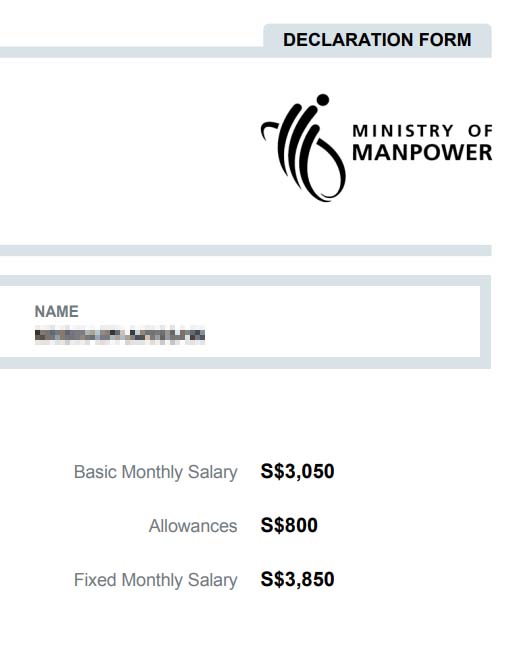
Murad’s employer submitted these salary details to the Ministry of Manpower in its application for an S Pass for Murad. In signing off the submission, the employer would have declared these details to be true and reflective of the employment agreement it had reached with the employee.
He started work in early August 2023. He was somewhat surprised to discover that he was sent by his employer to a project site that was under the control of another company, but maybe that was how things worked in Singapore. Being new here, he didn’t really know. Nor did he feel he could protest when the employer took away his passport.
In the first week of September, he received his salary for his first month of work (August). He was made to sign a pay slip showing his basic salary to be $19 a day, with total earnings for the month only $668. The amount, reduced by $150 for catered food, was paid in cash.
In the first week of October, the pay slip for September showed total earnings of $697. Once again, there was a deduction for food and the nett amount he received, in cash, was around $540.
Both pay slips showed that the employer was applying a basic salary at the rate of $19 per day. Such a rate was wildly inconsistent with the earlier documentation that Murad had in hand.
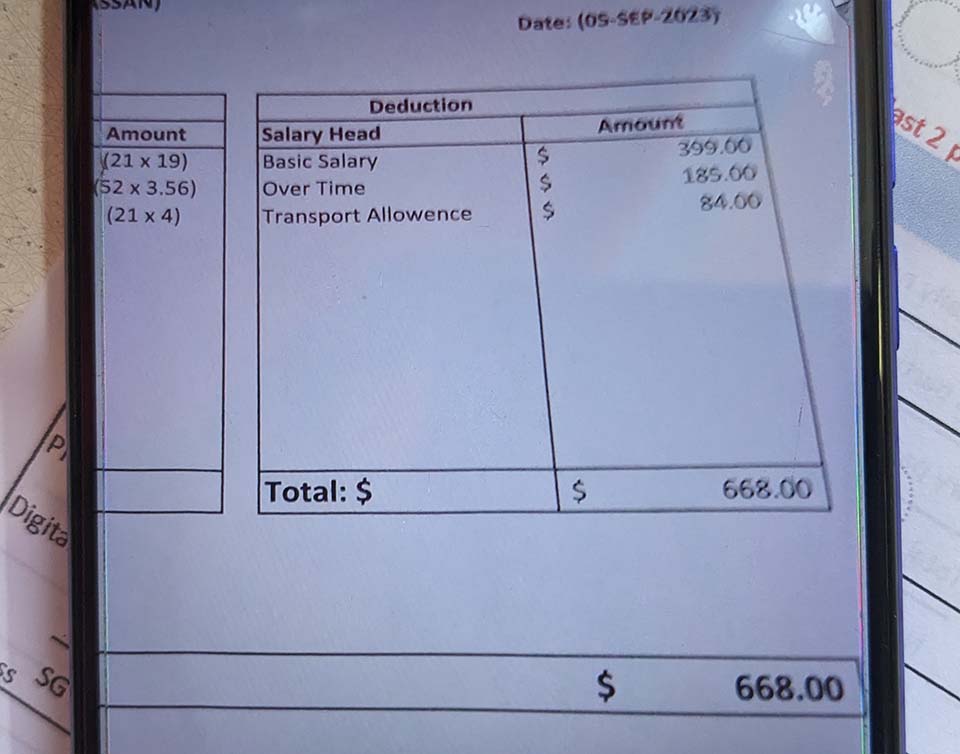
Murad’s payslip for work in the month of August 2023. At the left side of the image, one can see the employer appplying a daily basic rate of $19 per day, very far from the declared basic salary of $3,050 per month.
Murad made his way to TWC2 for assistance.
The case is just beginning, but already one can see the contours of it and how it checks many of the trafficking indicators.
With a recruitment cost as large as $12,000, it is very probable that the employer had a cut, and thus would be aware that Murad would be heavily in debt. The employer might be hoping to exploit the vulnerability of Murad, thinking perhaps that the consequences of losing the job would be so financially ruinous, Murad would put up with a pathetically low salary rather than complain to the authorities. This is debt bondage – when a worker feels trapped in his job from the debt he had taken on to get that job. It is a strong trafficking indicator.
Murad’s passport was taken away from him. Confiscation of documents is another strong indicator.
The salary scam needs no elaboration. We see deception, wage manipulation and no respect for labour laws.
Also noteworthy was the way Murad was sent to work on another contractor’s site as a general labourer when he was to be a construction site supervisor; this flags as deception about the nature of the job, location or employer, another strong trafficking indicator.
Singapore’s Prevention of Human Trafficking Act (2014)
Singapore has legislation that, at least on the face of it, gives substance to the Palermo Protocol and the ASEAN Convention. A closer examination of the text, however, reveals serious limitations. For example, it defines “abuse of the position of vulnerability of the individual” very narrowly, with no mention of exploitation of a worker’s indebtedness. Debt bondage is also defined very narrowly, in ways practised perhaps in the nineteenth century, but fails to encompass the more modern ways of debt traps.
On the other hand, the Prevention of Human Trafficking Act (2014) (PHTA) does make clear that anyone who recruits by means of fraud or deception would be committing an offence.
Whether or not the authorities will see the above two cases as trafficking remains to be seen; Kabir Esmail and Murad have only just come to TWC2 to discuss their predicaments. Kabir himself has not even decided whether he wishes to lodge a formal complaint.
The point we would make is that the irregularities that both men spoke about are hardly uncommon. At TWC2 we hear such stories repeatedly – which only goes to show how rampant trafficking-like behaviour is in migrant labour practices.
At the same time, we have yet to see broad, effective use of the PHTA for these nasty abuses. As noted by the US State Department in its 2023 Trafficking in Persons Report (reporting on Singapore in 2022):
The government investigated most suspected labor trafficking cases as labor law offenses under the Employment of Foreign Manpower Act (EFMA), or the Employment Act, which carried lower penalties than the anti-trafficking law.
Moreover,
In 2022, authorities initiated 25 trafficking investigations, 20 for sex trafficking and five for labor trafficking, compared with initiating 11 sex trafficking investigations in 2021. The MOM and the Singapore Police Force (SPF) determined none of the suspected cases violated the PHTA and proceeded with charges under either the Women’s Charter or the Penal Code, dismissed cases, or issued warnings.
In short, the PHTA was not used.