
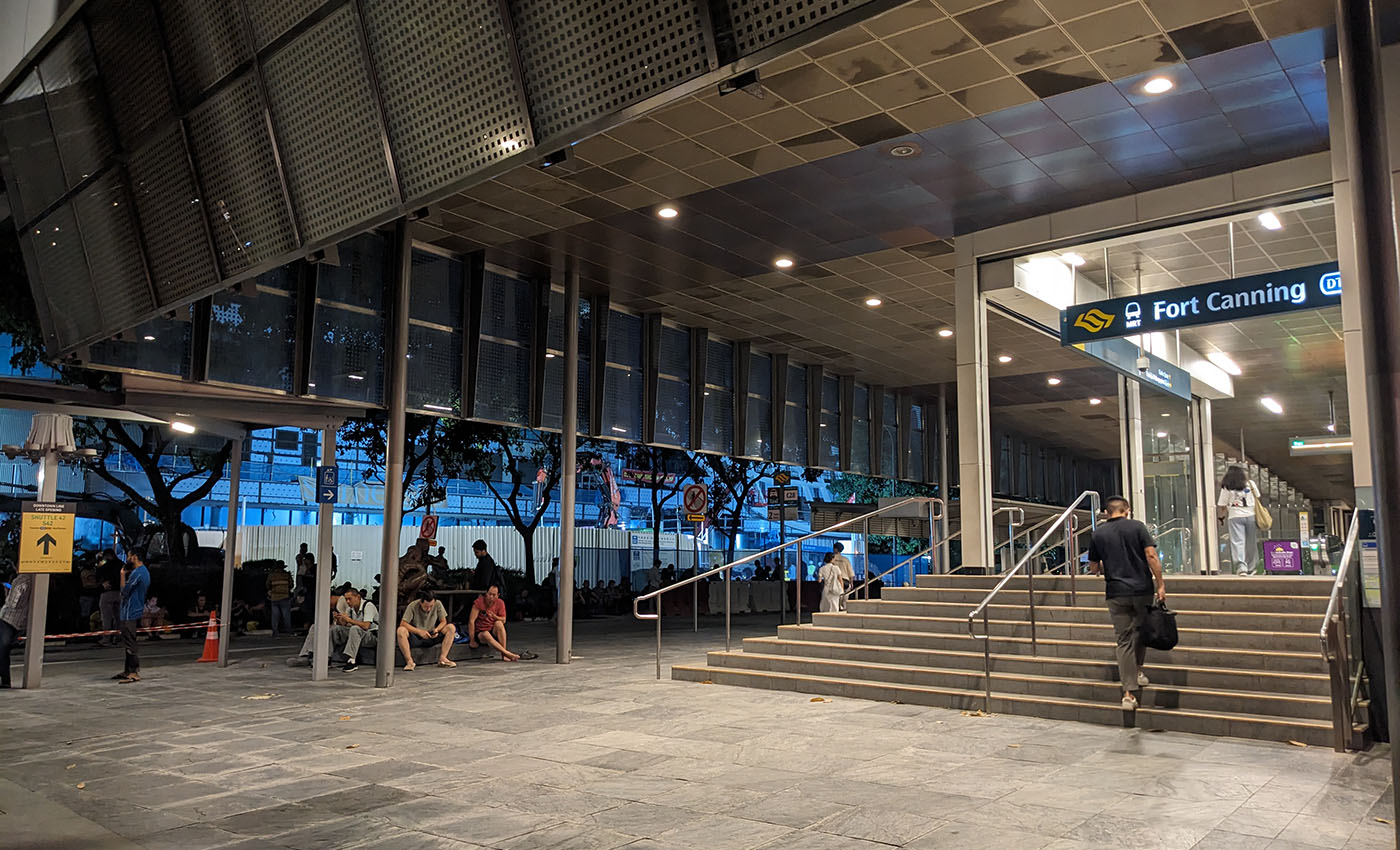
Company Ve’s employees said their worksite was near Fort Canning metro station
In July 2026, eight employees of a company we will refer to here as ‘Company Ve’ came to TWC2 for help regarding their salary claims, which they had filed on their own at the Ministry of Manpower. What was striking was that all eight were on S-Passes, a work pass that is meant for skilled technicians or mid-level supervisory positions.
Of these eight S-Pass holders, we sat down with three of them to get a better sense of what had happened during employment that led to their filing claims. Our first question, seeing that they were all on S-Passes, was: what tasks did you guys do when you were working?
“We pipe-fitters. The project is to install chiller units in a building near Fort Canning MRT.”
We looked at their In-principle Approvals (IPAs) (see Glossary) and saw that their basic monthly salaries ranged from $3,800 to $4,400. Our sense was that these salaries were very high for the actual work they were doing. Perhaps they had the appropriate technical qualifications to do high quality pipe-fitting (though we don’t know what high quality pipe-fitting even looks like) so we asked the three guys about their backgrounds.
Faruq (name changed) said he had worked for about three years in Bangladesh as a pipe-fitter before coming to Singapore. He didn’t have any formal training or certificate. His basic salary was $4,400 a month.
Imran (name changed) said he had formal training and a diploma in electrical work, but did not have any training or experience in pipe-fitting. His basic salary was $4,000 a month.
Rakib had neither formal training in any trade nor experience in pipe-fitting. His basic salary was $3,800 per month.
We get to thinking: how can Company Ve, a subcontractor installing airconditioning systems, afford to pay these salaries? Which main contractor would give a contract to a subcontractor at such high tender prices that their staff could earn what their IPAs said?
Unsurprisingly, they are here at TWC2 over salary claims. For the past six or seven months, they have each only received a few hundred dollars and very irregularly too. The way they described these cash payments, it wasn’t even clear whether these amounts were intended as a portion of their salaries or merely loose change to buy food.
Moreover, S-Pass employees are supposed to be paid through bank accounts from no later than their third month of employment (see footnote 1). None of these three guys even had bank accounts opened for them despite being well past their seventh or eighth month. The failure by the employer to do so despite the stated rule is suspicious.
More to the point, Faruq mentions that soon after they filed their salary claims at the Ministry of Manpower, their employer presented various payment vouchers as “evidence” that more had been paid to the men than was actually the case. Specifically, Faruq describes a cash voucher he had signed some months earlier for $390 but when the copy of that voucher was submitted to the mediator at the TADM (the unit at MOM that handles salary claims) an additional numeral “1” had been added to the figure. The employer claimed Faruq had signed for $1,390.
No more minimum educational requirement for S-Pass
For over a decade, the Ministry of Manpower had a rule that any worker employed on an S-Pass, a work pass category meant for mid-level supervisory or skilled technician positions, must possess a diploma. This would be commensurate with the minimum salary set out for S-Pass workers.
A few years ago, they quietly retired the rule. See our article Singapore opens S-Pass jobs to illiterate rickshaw pullers. As a result, employers have been able to hired essentially unskilled workers for these mid-salary jobs. But that doesn’t change the economic fundamentals. These workers are not able to produce the added value that would justify such salaries.
Anytime this happens, where a person does not have the qualification to do a mid-skilled job, yet is hired on an S-Pass, some kind of salary mischief is sure to follow.
In footnote 2 below, we describe the case of another worker, also on an S-Pass, and his In-Principle Approval document
Despite their forbearance over many months, trusting their employer and waiting for their salaries, scales have now fallen from their eyes. They now know that their boss never had any intention to pay their proper salaries.
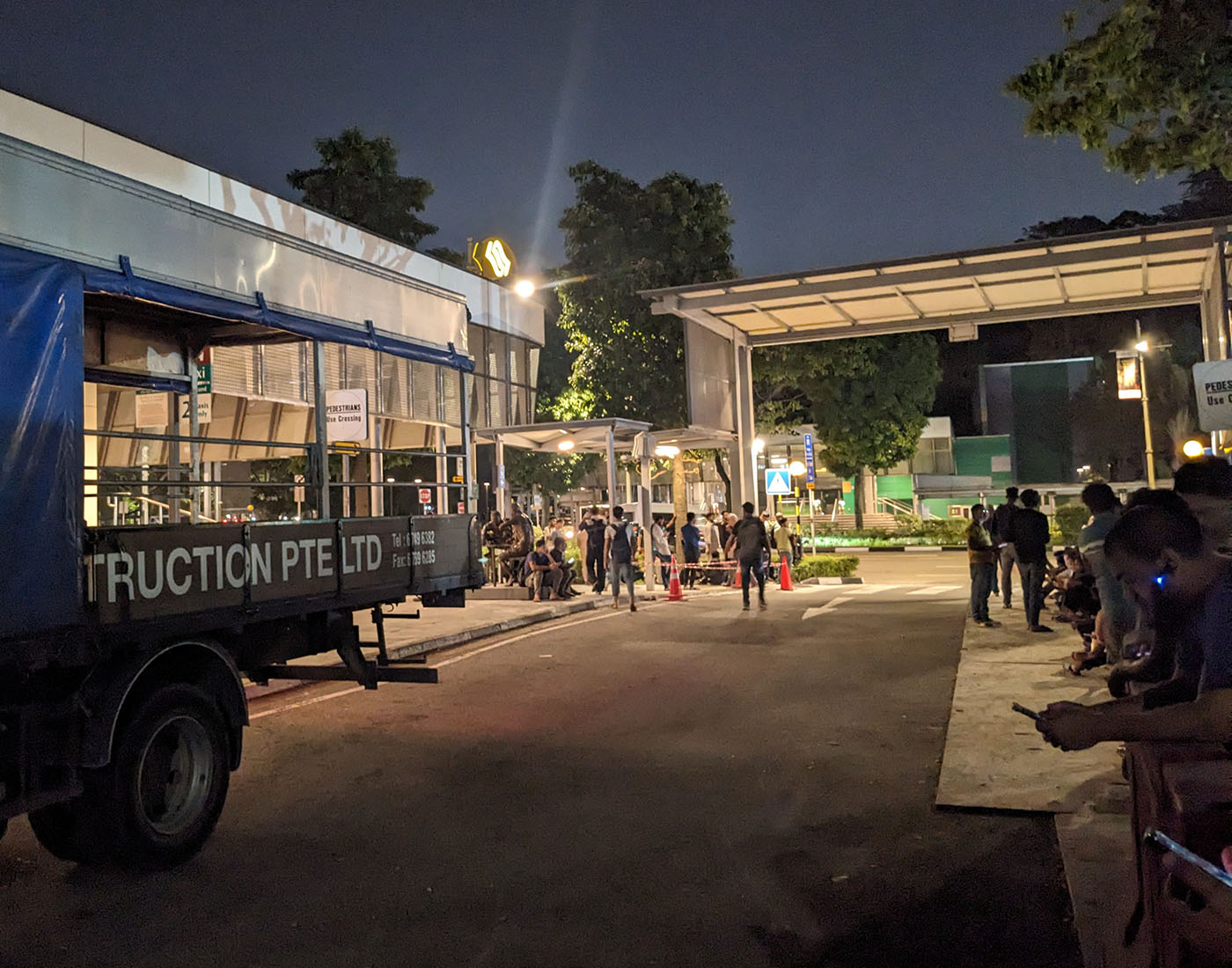
It is 8:30pm and the work shift has ended. Workers belonging to various subcontractors wait at the roadside for company transport.
Eight thousand dollars per man
That the men waited so long before launching salary claims strongly indicated that they had paid large sums for their jobs, and could not afford to write off this investment by challenging their boss over salaries – a move which would surely trigger cancellation of their S-Passes. We next ask how much they paid:
Faruq paid $8,000. His uncle worked at Company Ve last year and that was how Faruq was recruited. All $8,000 was handed to the boss; the uncle didn’t take any cut of the fee. Apparently, the $8,000 was paid by the uncle, not Faruq (though Faruq would need to pay his uncle back), so the (illegal) transaction actually took place in Singapore.
Imran paid 1.3 million Bangladeshi taka (approximately $13,000) to an agent in Bangladesh to secure this job. After he got frustrated over unpaid salaries, Imran spoke with the same agent again – something about a refund – in the course of which conversation the agent said that $8,000 had been handed over the boss. Imran mentions that he could only borrow $2,000 from a bank; to raise the entire sum, he borrowed from relatives and the family sold some land.
Rakib paid 1.4 million Bangladeshi taka (approximately $14,000) to his agent in Bangladesh (not the same agent as Imran’s). His family too sold land and he borrowed from relatives as well. Rakib has not asked his agent how much was passed on to the boss, but we can guess that it was probably $8,000 too. Usually, bosses charge the same rate for every job that they sell.
The obvious next question, as we are always interested in knowing how much money can be made: “How many workers does this company have?”
“Now less,” say Faruq and Imran. “Last time, have about one hundred.”
“Is everyone on an S-Pass?” we ask further.
Imran says, “I think so,” but Faruq says, “Not sure, because so many men.”
This last point doesn’t really matter. If an employer is of a mind to sell a job for $8,000, the rate is unlikely to change whether it’s an S-Pass job or Work Permit job. Why should he charge less for a Work Permit job?
One hundred men multiplied by $8,000 each – that’s $800,000 from recruitment fees alone. Add to that what the main contractor is likely to pay Company Ve for the contract (for which little by way of salary cost was incurred), and one can see the scale of this enterprising businessman’s achievement.
How the law caps an employer’s liabilities
Now that these eight workers have filed salary claims, one may think that the employer will not be laughing all his way to the bank anymore. Well, yes and no. It’s like this:
Each man, with an average basic salary of about $4,000, is claiming for about seven months. Just for basic salary alone, the claim is around $28,000. Nett off the small sums in cash that the worker received intermittently, and the claim may be around $24,000.
The workers also put in a lot of overtime. In monetary terms, they speak in terms of $10,000 to $20,000, to be added to their basic salary claim. But we don’t even get to calculating exactly how much because of a rule in the Employment Claims Act. This piece of legislation caps the maximum claimable amount at $20,000 for cases heard at the Employment Claims Tribunal (ECT), though the cap is higher, at $30,000, if the worker is a union member (most migrant workers are not). However much overtime these guys have put in, it’s all beyond the limit.
The unrealistic common law option
The cap of $20,000 for salary claims is only when a case is heard at the Employment Claims Tribunal (ECT). Employees have the option of not using the ECT route, and using the common law route instead.
However, whilst at the ECT, no lawyers are allowed and parties must represent themselves to minimise costs, self-representation is most unwise if taking the common law route.
Claimants should really be represented by counsel – which costs money. For workers who anyway haven’t been paid for months, this option is not realistic.
Even if the employer agrees to pay up to the limit ($20,000 per worker), all the workers will still be in a net loss position. The corollary? The employer comes out ahead.
It gets worse.
Because these are S-Pass holders, the men will have to support themselves through the duration of their cases. They have to find their own accommodation, pay rent, buy food and bear all their other daily expenses. Having only received a dribble of cash through the past few months, what means have they to do so?
The situation would have been different if they had been on Work Permits. Such workers, when they have a case pending at MOM, have rights to employer-paid housing and meals for the duration of the claim, until the matter is resolved. The law makes it clear that the employer remains responsible for provision of bed and board even if the Permit is cancelled. There is no equivalent provision in law for S-Pass holders.
If these Company Ve workers have to pay their own rent and expenses through several grueling months fighting their case, how long can they hold out? If they don’t have staying power, all the employer needs to do is to string out the process, and the workers will likely give up. Will they even manage to hang on till the ECT rules on their claim?

Depending on the employer, some workers get lorry transport, while the luckier ones get buses.
Then there’s the non-existent Security Bond.
Employers of Work Permit holders have to put up a $5,000 security bond. The bond can be forfeited when an employer breaches a condition of the Permit, and that includes failure to pay salaries. So, Work Permit holders have a chance of at getting up to $4,000 or so through the forfeiture of the bond as partial compensation for unpaid salaries.
Employers of S-Pass holders do not have to put up security bonds. There is nothing to forfeit when they don’t pay salaries.
In any case, the employer can always declare bankruptcy. Even if the workers have the financial stamina to fight on, even if the Employment Claims Tribunal – as many as six months down the road – awards every worker before it the full amount of $20,000, the company may say ‘we’re bankrupt and cannot pay’.
The employer would never have been so stupid to put the $800,000 in recruitment fee income into the company. This windfall would be untouchable. With simple money laundering, it would have been safely converted into assets long ago. In short, the system Singapore has, starting with turning an almost blind eye to debilitating recruitment fees, makes it virtually impossible for S-Pass holders like these Company Ve guys to get justice and complete remedy.
Treating this as a civil dispute is to encourage such employer behaviour
Unfortunately, MOM has a tendency to treat salary disputes as purely civil claims. As we have shown above, if we use this route, everything is stacked against the employees. They cannot conceivably win all that should be theirs by right.
At the root is an unethical scheme to hire workers on a grade of work pass which has a high salary (and reduced employer liabilities) with intention not to pay salaries as documented. Besides issues like deception and fraud (in submitting information for the IPA that the employer knew to be false), at least two serious criminal offences can be identified:
- Taking money for jobs (see footnote 3 below);
- Failure to pay salaries in full and on time (see footnote 4).
Besides overhauling the remedy routes to ensure workers can obtain full recovery of owed salares, TWC2 strongly urges the authorities to use the full range of enforcement powers on employers who use such S-Pass schemes that put workers in jeopardy. They should be in jail for the number of breadwinners’ lives they have ruined.

Footnote 1: S-Pass holders should be paid electronically. The Employment of Foreign Manpower (Work Passes) Regulations 2012 >> Fifth Schedule >> Part II >> Section (5) says:
The employer shall pay the wages of the foreign employee through General Interbank Recurring Order (GIRO) or by such other means as may be approved by the Controller in writing, except where —
(a) the S pass is issued for a period of 3 months or less;
(b) the salary represents the salary due to the foreign employee for the last month of employment of the foreign employee with the employer;
(c) the salary represents salary for overtime work done by the foreign employee; or
(d) the Controller, in his discretion, exempts the employer in writing from this condition.
Footnote 2: This worker, whom we will call Mitun, was also employed on a S-Pass for the construction sector. Company Ve was not his employer. This was his IPA, from which you can see that the employer provided no details of his qualifications, and yet the IPA was approved for a construction supervisor’s job. Mitun was 27 years old at the time the application was made.
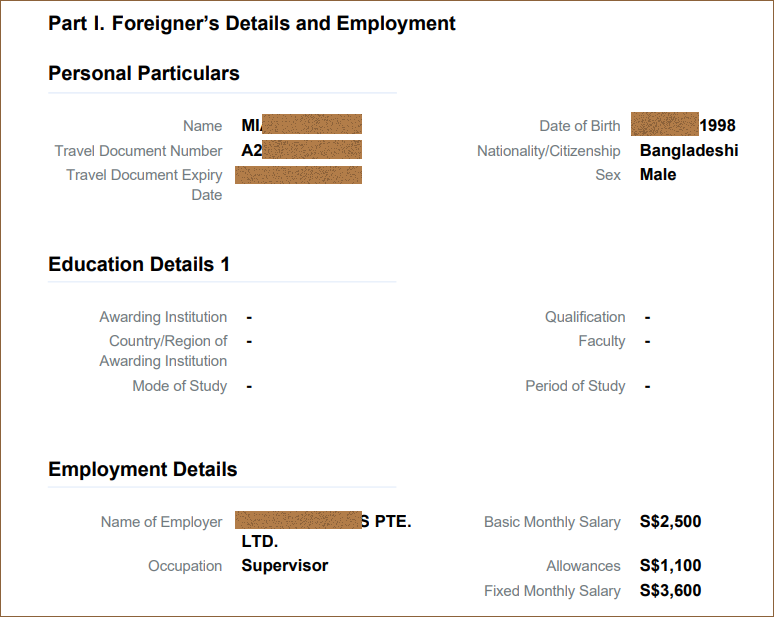
Mitun worked four months and a bit. He tried to open a bank account but the bank said he needed the endorsement of his employer to do so, and the employer would not assist. So, all this while he was paid in cash. Despite the fixed monthly salary of $3,600 – which, over four months, would had added up to $14,400 before one adds in overtime pay – Mitun only received a little over $2,000 from his employer.
TWC2 helped him compute his claim amount (over $14,000), and helped organise his evidence. Mitun settled at mediation for $12,000.
Footnote 3: Demanding payment in return for jobs is an offence under Section 22A of the Employment of Foreign Manpower Act, which says:
22A.—(1) A person must not deduct from any salary payable to a foreign employee, or demand or receive, directly or indirectly and whether in Singapore or elsewhere, from a foreign employee any sum or other benefit —
(a) as consideration or as a condition for the employment of the foreign employee, whether by that person or any other person;
(b) as consideration or as a condition for the continued employment of the foreign employee, whether by that person or any other person; or
(c) as a financial guarantee related, in any way, to the employment of the foreign employee, whether by that person or any other person.(2) Any person who contravenes subsection (1) shall be guilty of an offence and shall be liable on conviction to a fine not exceeding $30,000 or to imprisonment for a term not exceeding 2 years or to both.
Footnote 4: Failure to pay salaries on times is an offence under Section 21 of the Employment Act:
21.—(1) Salary earned by an employee under a contract of service, other than additional payments for overtime work, must be paid before the expiry of the 7th day after the last day of the salary period in respect of which the salary is payable.
(2) Additional payments for overtime work must be paid not later than 14 days after the last day of the salary period during which the overtime work was performed.
Section 20 of the same Act says that a ‘salary period’ cannot exceed one month. The penalty for flouting the salary provisions of the Act is a fine between $3,000 and $15,000, or to imprisonment up to six months, or both. For repeat offenders however, fine maximum and imprisonment maximum are doubled.
Job 19730, 19946, 19947, 19950, 19951, worker 17859 in footnote2