

Caption for photo
This is the second of a series of articles commenting on the results of the Ministry of Manpower’s (MOM’s) Migrant Worker Experience and Employer Survey 2024. The results were released in the third week of August 2025. In this Part 2, we will focus on two items in the second half of the report which dealt with questions put to employers. This is the first time that MOM’s migrant worker survey included a section involving employers.
TWC2’s immediate response to the highlights of the survey report can be found on our Instragram page: https://www.instagram.com/p/DNrZKi_J0Vv/?hl=en&img_index=1. These series of articles will analyse the findings in more detail and wherever possible, offer solutions.
MOM’s own press release can be seen here: https://www.mom.gov.sg/newsroom/press-releases/2025/0821-migrant-worker-experience-and-employer-survey-2024
Channel NewsAsia carried a story on 22 August 2025 (https://www.channelnewsasia.com/watch/over-95-migrant-workers-polled-satisfied-working-and-living-singapore-mom-5307301) in which TWC2 Executive Director Ethan Guo was interviewed.
The Straits Times also had a story, though it is behind a paywall (https://www.straitstimes.com/business/7-in-10-employers-satisfied-with-their-migrant-workers-mom-survey). This story largely regurgitated the highlights of the report and the points made by MOM, with no input from outside parties.
Recruitment
On recruitment, the numbers of the survey are quite damning if one gives it more than five seconds’ reflection.
Whilst there was no appendix setting out the precise wording used, the question asked seemed to be what channels the participating employer used to recruit workers. From the data, we can see that employers could select from a number of possible answers. The percentage total adds up to 160.9%, which indicates that the typical respondent to the survey chose 1 – 2 possible answers.
The bar chart below is extracted from MOM’s survey report, though we have added the four red dots.
Who is the ‘migrant worker’?
MOM’s survey report speaks of the ‘migrant worker’. It takes a little digging into the text to see that the survey’s scope was limited to Work Permit holders in non-domestic sectors. In other words, domestic workers are not part of this discussion.
In December 2024, there were 1,165,900 Work Permit holders here. Excluding domestic workers (301,600 of them) that meant 864,300 in non-domestic sectors. Of these, 456,800 (54%) were working in construction, marine engineering and process engineering (“CMP sectors”). The remainder (46%) would be in services (retail, hospitality, food and beverage, security, etc), manufacturing, cleaning (including town council work), landscaping and so on, with even a tiny number in agriculture.
Given this mix of sectors, we can assume that they are majority male. and they mostly come from Malaysia, India, Bangladesh, China and Myanmar (Burma). There may be small numbers from the Philippines, Thailand and Sri Lanka.
While a great majority of the 54% who work in the CMP sectors would be living in dormitories, that still leaves a few hundred thousand non-CMP workers living in rented rooms and apartments all over Singapore. A significant number of Malaysians also commute daily from Johore.
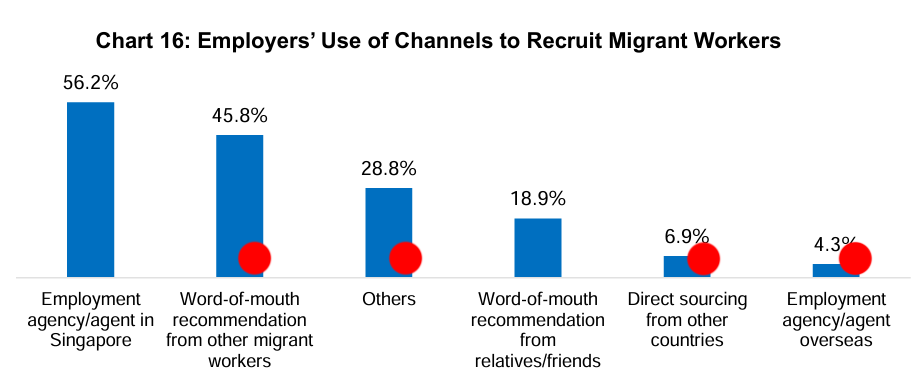
The red-dotted answers are strongly associated with excessive recruitment fees and kickbacks. The four add up to 86%, though there may be some duplication among them. Nonetheless, the answers stink; they support what TWC2 has long been saying: the great majority of Work Permit holders have to pay large sums of money to get their jobs.
Even the biggest bar in the chart is suspect. Although 56.2% said they used an employment agency in Singapore, this does not preclude excessive fees. We have seen countless In-Principle Approvals where, despite having a Singapore-licensed agency stated as the recruitment agent, the worker tells us he never met anyone from the agency, but instead got the job through an intermediary operating in his home country, or through another migrant worker who happened to have connections, or through a supervisor in the company. These workers often report having to pay much more than the allowed ceiling set by the Employment Agencies Act (two month’s salary). For first-time workers in the construction industry, figures above $10,000 in recruitment fees are common.
Internationally, excessive recruitment fees is considered an indicator of forced labour. There have been instances of trade bans imposed on this ground. And Singapore’s recruitment landscape is rife with shady players or rentseekers (e.g. supervisors within employer-companies who exploit their connections with their bosses to “recommend” a new worker).
Retention
The survey had a question asking employers what proportion of their migrant workers (Work Permit holders) they retained whenever the permits came up for renewal.
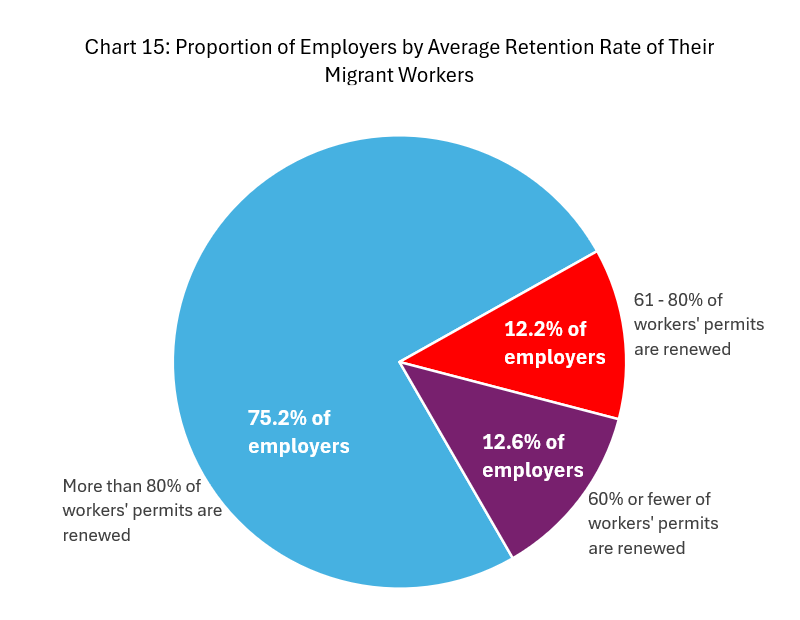
The data may make the situation a little rosier than it really is because there was no question asking employers what proportion of their migrant workers they terminated before the permits even reached renewal date. For example, if an employer of 100 workers was quick to temper and terminated 50 of them for the slightest infraction, and then renewed the permits of 45 of the remaining 50 workers, this employer would report that he “retained” 90% of his workforce at renewal.
There are also workers who choose to resign early, but these are few. From time to time, MOM revokes permits permaturely too, when employers fail to pay Monthly Foreign Worker Levies on time.
These three important caveats notwithstanding, the renewal data does not seem to contradict what we have observed in our casework.
What’s really curious is why there was this question in the survey at all, because the information must surely be there in MOM’s own database. It is MOM that approves issuance and renewal of Work Permits. MOM would also have the information about cancellations and revocations. Much better quality data (100% sampling) would emerge if only MOM data-mined its voluminous records and published them.
What needs fixing
The retention rates are not cause for concern. Even when workers leave a job, it doesn’t mean that Singapore loses them. The majority are eager to continue working in Singapore. A steady circulation of workers among employers is actually healthy for an economy, helping to allocate resources better.
It would be helpful though to have better data about durations of permits and the percentages that are cancelled prematurely (at six-month bands in a life cycle of a permit) because premature cancellations are extremely disruptive to workers’ sense of security and ability to plan financially.
On the other hand, the survey results about recruitment channels do nothing but validate how unacceptable the recruitment situation is, with much reliance on unlicensed parties and, surely, lots of illicit money changing hands. TWC2 has long called for a centralised platform wherein all Work Permit jobs must be openly advertised, and all hiring transactions must be conducted through that platform. Only pre-qualified employers and employment agents should be allowed onto the platform; only pre-qualified workers (see box) too. No one else should be allowed to participate in the jobs marketplace, to avoid ingress by unlicensed agents and rentseekers.
We hope the embarrasing data that MOM’s own survey reveals will spur action.
How would we pre-qualify a worker?
It’s not as difficult as it may at first seem. Firstly, any worker who has worked in Singapore before could be treated as pre-qualified. Secondly, if we had a nation-wide training and apprenticeship scheme, then all trainees who pass their exams can be pre-qualified.
For jobs that are outside the training scheme, applicants (who have never worked in Singapore before) can submit their education and other training certificates and (upon review) they too can be pre-qualified.