
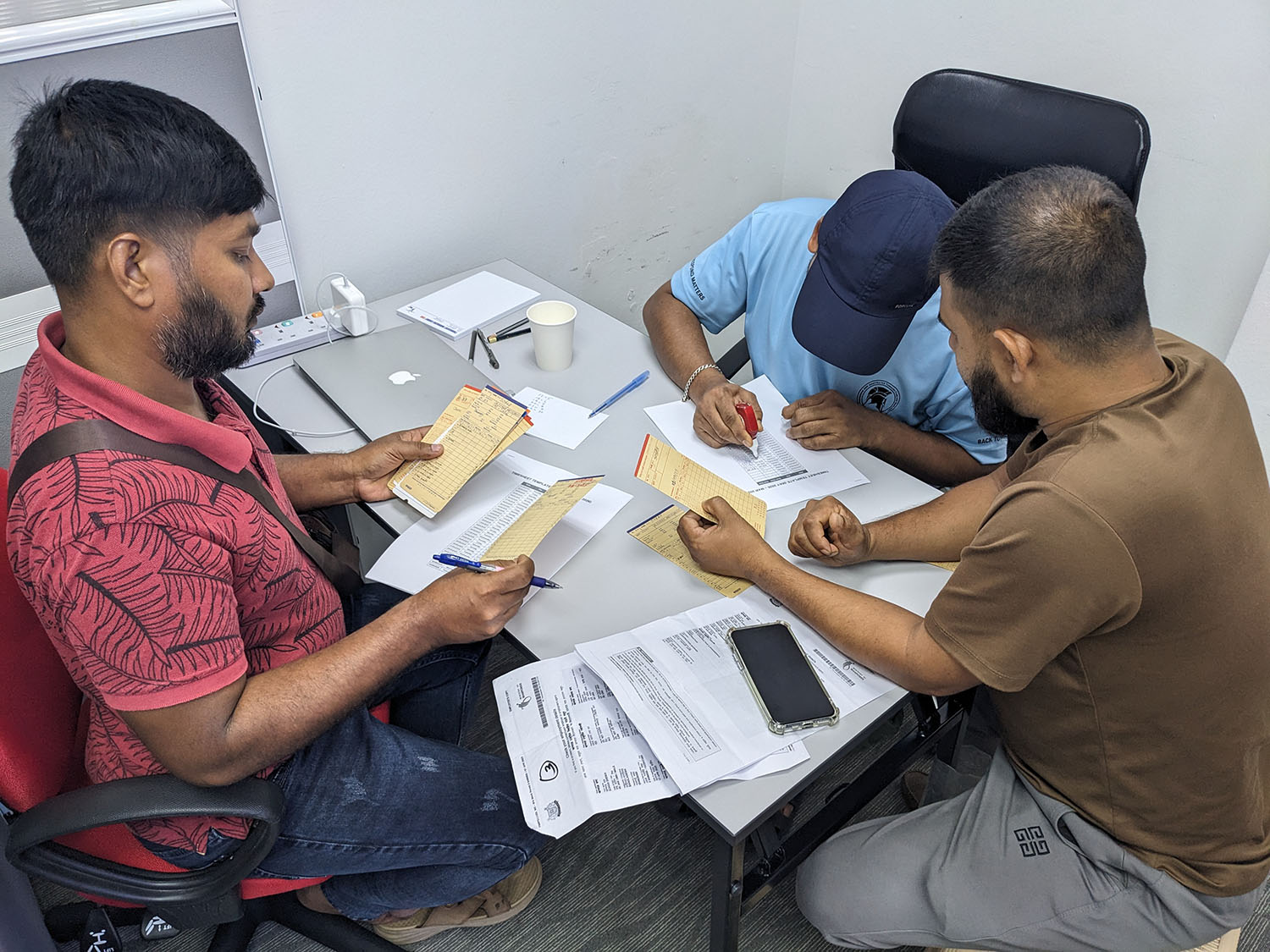
Workers from A & R Construction calculating their overtime hours from their time cards.
The above photo shows two workers from A & R Construction and Engineering figuring out from their time cards, which fortunately they had retained, how many overtime hours they had worked over as many as twelve months of employment. The third guy in the photo had earlier done a similar exercise for himself and now was helping these two do their computations.
These three men (and their co-workers) from this company had been paid, sort of, for most months. We say “sort of” because money had been deposited into the employees’ bank accounts but the company did not issue payslips. Without these, the men had no idea how the amounts were arrived at. Were the deposited amounts correct or short?
Complicating things, the bank deposits were not regular and they tended to arrive a month or two late. “It’s not clear whether a deposit made in, say, December, was for November salary or October salary or maybe even earlier,” says the case officer at TWC2 assisting these guy’s cases. “It’s a total mess”.
When payments stopped altogether, the men decided that patience was of no value anymore. They came to TWC2 to lodge salary claims. However, claimants must determine for themselves how much they are claiming and ensure that they have the evidence to support it. To this end, payslips are among the most critical pieces of evidence needed, but these are not within workers’ control. Either they’re not issued at all, as in the A & R case, or they are issued with false information (e.g. understating the overtime hours) in an attempt to cover up underpayment.
Payslips required by law
Whether to issue a payslip is not discretionary for the employer. It is mandatory and written into the Employment Act, Section 96 of which says:
Employers’ obligation in relation to pay slips
96.—(1) Subject to subsection (2), an employer must give —
(a) to every employee of the employer a pay slip, within the time prescribed for giving pay slips, for all salary paid by the employer for the salary period or salary periods to which the pay slip relates; and
(b) to every employee a pay slip for every sum paid by the employer under section 22 or 23.
(2) A pay slip given by an employer to an employee must be in the form prescribed (if prescribed) and must contain all the information prescribed.
(3) The requirement to give a pay slip to an employee under this section is satisfied if an electronic record containing the prescribed information of a pay slip is provided in a manner that enables the information contained in the electronic record to be accessible and useable by the employee for subsequent reference.
(4) An employer is taken to have failed to comply with subsection (1) if the pay slip given to an employee is incomplete or inaccurate, whether or not the employer knew that the pay slip is incomplete or inaccurate.
The Third Schedule of the subsidiary legislation, the Employment (Employment Records, Key Employment Terms and Pay Slips) Regulations 2016, prescribes the content required of payslips. It says:
1. Employer’s name —
(a) for an employer who is an individual, as specified on the identity card or passport of the employer; or
(b) for an employer which is not an individual —
(i) as specified on any register or official record kept under any written law; or
(ii) where sub-paragraph (i) is not applicable, the name in which the employer employed the employee
2. Employer’s trade name if different from that in item 1
3. Employee’s name as specified on the employee’s identity card, work pass or passport
4. Amount of basic salary paid to employee during each salary period or salary periods, calculated by reference to the basic rate of pay
5. First and last days of each salary period
6. Amount of allowances and other additional payments during each salary period, with itemisation of every allowance or payment (if applicable)
7. First and last days of each overtime payment period (called in this Schedule the overtime period) if different from each salary period
8. Overtime hours worked during each overtime period (if applicable)
9. Overtime pay paid for each overtime period (if applicable) and date of payment
10. Amount of deductions from salary during each salary period, with itemisation of every deduction (if applicable)
11. Net amount paid to employee for each salary period and date of payment.
Penalties
The penalty for failure to do so is not insignificant. Section 101 of the Employment Act says that any employer who “neglects to furnish the particulars or information required within the time allowed” is punishable by a fine up to $5,000 or to imprisonment for up to six months or both. Stonewalling is addressed as well. Continued refusal to do so attracts a fine of up to $500 for every day during which the offence continues. However, the phrasing of Section 101 isn’t altogether clear whether the penalty section applies only to employers failing to “furnish” information to MOM when requested, or whether it also applies to failing to provide information (in the form of payslips) to employees. TWC2 believes the latter reading is correct, though it really doesn’t matter very much which interpretation applies because when workers complain to MOM, the ministry can order the employer to “furnish” the detailed itemised salary information to employees within a certain time, and failure to comply with such an order will surely fall within the meaning of Section 101.
A webpage from Singapore Legal Advice (last updated December 2024 when we checked) describes a two-tier penalty regime. There is first a set of administrative penalties, followed by criminal penalties for persistent non-compliance.
If you fail to provide itemised payslips, the Ministry of Manpower (MOM) can order you to do so within 1 month. For repeat offenders, MOM will issue caution letters and can further impose an administrative penalty of up to $400 fine for each repeated infringement.
It is also an offence under the Employment Act to:
- Not provide itemised payslips within the timeframe stated above, regardless of whether this had been intentional.
- Failure to provide an accurate or complete payslip, regardless of whether this had been intentional.
Hence, apart from having to pay the administrative penalty stated above, you may also be charged in court for an offence if you fail to provide accurate payslips in a timely manner. If found guilty, you may be liable to a fine of up to $5,000 and/or a jail term of up to 6 months for each offence. For every day that you fail to produce the itemised payslip or rectify an inaccurate one, you may be liable to a further fine of up to $500.
That said, even administrative penalties can be serious. For example, for a company like A & R with about 16 foreign employees who had not received payslips for an average of 12 months (some men have been with the company for more than a year, others less than that), each month’s failure for each man counts as one instance of infringement. Even if the fine is just $100 per instance, it quickly adds up to $19,200.
Employees see the value of payslips
One of the men pictured above had previously worked with a company that diligently issued payslips. We asked him whether he saw value in them .
“Yes,” he said. “That company give every month payslip to email.”
And the payslip was detailed too. “Basic how much, OT how much … all everything have.” OT is how migrant workers refer to overtime. So, “[when] my salary coming, I can understand,” and if there was any error, for example, “if writing 70 or 80 hour, I can catch and ask HR.”
At A & R on the other hand, he put it very clearly: “They never follow the MOM rules.” Without payslips, they couldn’t figure out whether the money they received was correct. “Very difficult, hard to understand [because] no give.”
Possible reasons for not issuing payslips
Readers may wonder, if an employer has anyway done some sort of calculation as to salary payable, as in the case of A & R which deposited amounts into workers’ bank accounts, even if irregularly, why didn’t they take the last step of generating a payslip for each employee? The hard work of doing calculations would have already been done.
There are possibly many reasons for their obviously deliberate failure to do so. At TWC2, when we calculate owed salaries for workers – provided the workers have time cards in hand – we see a pattern. We often discover that the men were made to work far more overtime hours than allowed by law. Employers might feel that they could not afford to issue a document stating the actual numbers of hours worked. Instead, they would either not issue payslips at all but nevertheless pay (more or less) the correct amounts, or they would understate the hours worked (i.e. payslips with false information) and pay less than what the employees should be getting.
…the issue of absent payslips – and the issue of salary non-payment or short-payment more generally – is often linked to excessive overtime.
In other words, the issue of absent payslips – and the issue of salary non-payment or short-payment more generally – is often linked to excessive overtime.
Excessive overtime hours
We first wrote about Kamal (name changed) in Employer lowers overtime rate without worker’s consent, new rate accepted by TADM, describing what happened at the mediation session over his salary claim which was mostly over unpaid overtime. TADM is the MOM unit that handles salary claims treating them as merely civil disputes. Violations of law and regulations are handled by a different unit – which we informally refer to as the ‘enforcement branch’.
Although the earlier article dealt with the issue of the overtime rate of pay, we also mentioned that Kamal did not receive payslips through the months he was in employment. He received monies regularly into his bank account (though he had reason to believe they were short), but never received detailed itemised payslips to show how the amounts were arrived at. He was in a similar situation as the three men pictured above.
Kamal too had his time records with him and from the notations on these time cards we were able to reconstruct his working hours. We could see that the employer broke the law regarding the maximum permissible number of overtime hours.
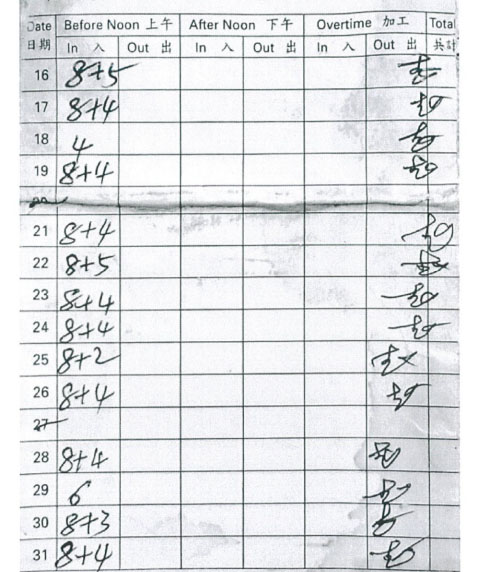
The supervisor’s notations show (on a typical day) 8 regular hours plus 3, 4 or 5 overtime hours. July 20th and 27th were Sundays
Section 38(5) of the Employment Act makes it clear that no worker should be required to work more than 72 overtime hours in any month. Kamal had to work more than this every month:
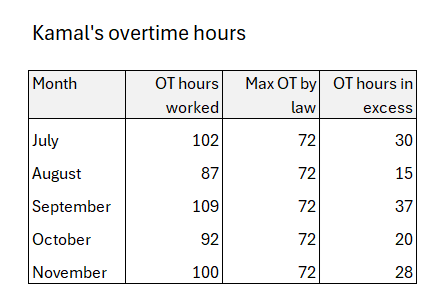
That the overtime rule was consistently breached over five months, by as much as 50 percent, shows deliberate policy on the part of the employer to ignore the law. This should never be allowed to stand.
Additionally, Section 38(8) sets a maximum of 12 hours as the working day. If one looks again at the sample of Kamal’s time card imaged above, one can see that on two of the 14 days notated by the card, he exceeded 12 hours. On the 16th and 22nd of the month, the supervisor wrote that he worked 8 regular hours plus 5 overtime hours. Kamal has many more time cards and such long days are not rare isolated events.
The penalty for failure to comply with these legal maxima regarding working hours is a fine up to $5,000. For a second or subsequent offence, the maximum fine is $10,000 and can include imprisonment of up to twelve months.
No process to flag up violations
It’s frustrating to observe that while it would be the easiest thing for TADM to notice such violations since they anyway have to study the claim calculations submitted by workers and ask them to produce the payslips they should have received, we almost never hear of TADM flagging these violations up to the enforcement branch of the Ministry of Manpower. It is as if it’s standard operating procedure to overlook these violations while focussing exclusively on getting parties to reach a settlement. Surely, when Parliament saw fit to write legislation with significant penalties, they were meant to have teeth. The unhappy result is that these violations have become extremely common. Our research report Overworked and underprotected: research into excessive overtime and loss of rest days shows the scale of the problem.
It costs nothing to change the work practices at TADM, report the violations they see and help the enforcement branch be more effective, but we don’t know why it doesn’t seem to be a priority for MOM to review their procedures, at least based on what we’ve seen from the cases we’ve helped workers with. We would have liked to hear from workers that MOM was also investigating their bosses for such non-compliance, but we next to never hear such reports. Why?
15850, 15849, 17824, 8893