
File photo of DBS ATMs
Shekdur (name changed) was just 20 years old when he arrived here for his first job. Coupled with his weak English and a debt burden of $13,000, he was exposed to his manager’s tricks. This is a story of how youth, naïveté and unfamiliarity with Singapore’s systems leave a migrant worker vulnerable to exploitation.
Interviewed in August 2026
Eight months after joining the company, Shekdur finally had a bank account opened for him. As an S-Pass holder, the law says he should have been paid his salary through his bank account (see footnote).
He thought that at last, his salary troubles would soon be over. Between his start of employment in July 2025 and February 2026, he was paid only a few hundred dollars, a far cry from the fixed monthly salary of $3,800 stated on the ministry-issued In-principle Approval (see Glossary). Despite so many months of non-payment, he could not risk losing the job by protesting. He had a huge debt hanging over him.
That debt is directly traceable to the recruitment fee that his agent in Bangladesh demanded from him: the equivalent of $13,000 in Bangladeshi currency. Naturally, the agent pointed to the high monthly salary ($3,800) to justify his high fee. Shekdur recalls his agent saying, after handing him his copy of the In-principle Approval, “you go Singapore working, now you all problem solved.”
Shekdur raised this $13,000 sum from various sources, including formal loans from a bank and informal loans from friends and relatives.
The job
“Boss have three licence,” Shekdur tells us, meaning that the employer – an Indian national doing business in Singapore – owns three companies. One is an electrical company, another a scaffolding company and the third one, so notorious that we recognised its name immediately. Reports are that all 50 employees of that third company have filed salary claims with many coming to TWC2 for help.
Shekdur, who undertook an electrical technician course in Bangladesh, was formally employed by the electrical company as a Wall Tiler – that’s the occupation listed in his In-principle Approval, incongruous though it may be for an electrical company. “But I never do tile work,” he quickly explains. Instead, he was sent here and there (“sometimes I working for the other companies belonging to boss”) and tasked with electrical work, sprinkler installation, even tasks relating to lifting heavy items. Occasionally, he adds, he was seconded out to other employers’ worksites.
Cleverly robbed
February 2026 was when things turned dramatic, albeit in a low-key way. The timing may be related to the protests breaking out at the third, notorious company over unpaid salaries.
Out of the blue, Shekdur was taken to a bank to have an account opened. He also had a bank app installed into his phone from which he could soon after see that $7,600 was deposited into his account. He was given to understand that this would be his salary for January and February 2026. The bank also issued him with an ATM card, but the company manager whom Shekdur refers to as Durai, took it away saying that he would help to activate the card.
Perhaps because he was not familiar with bank cards or perhaps still super-conscious about his bank debt, Shekdur handed the card over to his manager when asked. In this audio clip, he describes what happened:
Transcript:
Shekdur: Er February, I open the bank card [account]. Then I take bank card. After, my manager say, ‘you give me bank card, I active.’ Then he take them, my bank card….
TWC2: But hold on. The manager said he was going to activate the bank card?
Shekdur: Yes.
TWC2: Right. Did you also have a bank app installed in your phone?
Shekdur: Yes, my phone have.
TWC2: Did you check your bank app to see your money balance?
Shekdur: I, yes. seven thousand six hundred. Then after I see night-time check seven thousand six hundred have, then after, morning-time, I see balance zero.
TWC2: So the next morning you checked again and the balance was zero.
Shekdur: Yes.
TWC2: Did the manager return the bank card to you?
Shekdur: Yes [actually, this was two months later]. Then I say, er, ‘Manager, my money, my bank card money coming where it go already?’ He say this one, my bank manager mistake.
TWC2: The bank manager made a mistake or the company made a mistake?
Shekdur: Company bank. [We think he means the banking company]
By the next morning, the $7,600 had vanished. Someone had withdrawn it all from Shekdur’s new bank account.
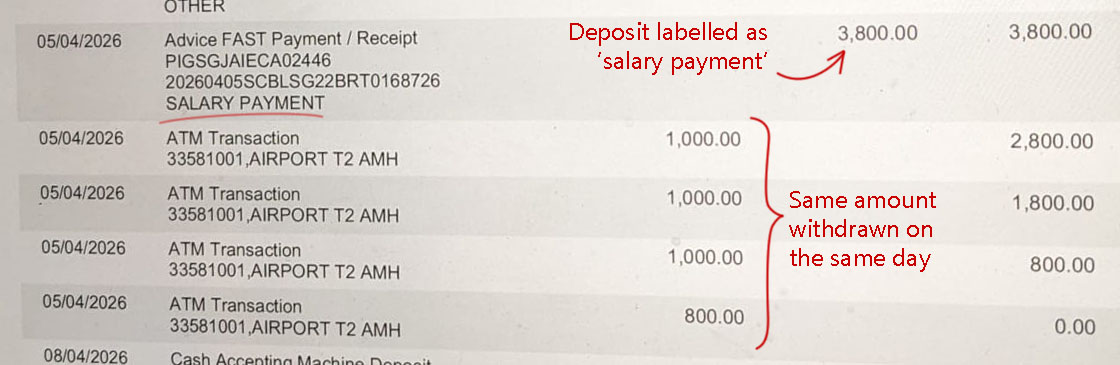
About a month later, another $3,800 was deposited into Shekdur’s account. Once again, all the money was withdrawn almost immediately. Here is the part of the bank statement that we later retrieved for him; it shows the withdrawal of this $3,800 the very same day.
Being totally new to such things, Shekdur didn’t think to make a police report. Nor did he know that ATM cards can and should be cancelled at the first sign of misuse.
The ATM card was not returned to him until April. He raised the matter of the withdrawals with manager Durai, but according to Shekdur, Durai said the deposits were mistakes, so they had to be withdrawn. This still leaves the issue of owed salaries, a point that Shekdur raised again. Durai threatened him with cancellation of his S-Pass and immediate repatriation. That was enough to silence the hapless worker.
Holiday idea
The following month, the boss told Shekdur that business was slowing down and there wasn’t enough work for the entire workforce. The boss said he was going to send Shekdur to Malaysia for a month, asking him for his passport. To sweeten the request, the boss said he would “all money arrange” during that month and when Shekdur came back into Singapore at the end of it, all his salary arrears would be settled. Once again, Shekdur complied, handing over his passport.
Not long after, the passport was returned with the boss saying that the application for a Malaysian visa was rejected.
The boss then told Shekdur that he (Shekdur) would need to go personally to the Malaysian embassy to try again for a visa. The boss gave Shekdur $500 to pay whatever fees might be needed.
By this point, Shekdur finally realised that he would be a fool to fall for this. Should he succeed in getting a visa, as soon as he crossed into Malaysia, the boss would cancel his S-Pass and he would not be able to return to Singapore. He would have to kiss all his unpaid salary goodbye. So, instead of going to the Malaysian embassy, he pocketed the $500 and went to the Ministry of Manpower (MOM) to file a complaint.
“My data all delete”
As with so many stories from workers, there are plenty of subplots. This one from Shekdur goes like this: “In January, this manager (Durai) take my phone. He delete all my contacts and all my WhatsApp (messages).”
We’ve heard of such tactics before. See the story Boss locks up his workers, seizes phones and deletes all their data.
“Did you have photos of your time cards on your phone?” we ask Shekdur. Such photos will be crucial if Shekdur wants to claim for overtime pay.
“Have,” says Shekdur, “but the photos all locked, so cannot delete.”
For once, he’s done something to protect himself.
At TADM
At the Ministry of Manpower, employment claims are handled by the unit known as TADM – it stands for Tripartite Alliance for Dispute Management, a mouthful of a name that nobody uses. There, Shekdur voiced his frustrations over not being paid his proper salary since he joined the company ten months earlier.
Just on fixed monthly salary alone ($3,800 a month) Shekdur would be claiming around $38,000, which is above the maximum claim amount of $20,000 under the Employment Claims Act. This is before even adding in claims for overtime pay.
The TADM officer then suggested to Shekdur that he limit his claim to just the months of August to December. The claim amount would then be $3,800 x five months = $19,000, which would be within the limit. Trusting that the TADM officer would know how things worked, Shekdur agreed.
Note: Employees are not prevented from claiming more than $20,000, just that they would have to file a common law claim in the District Court to do so, usually with the aid of lawyers. The $20,000 claim limit only applies to claims handled by TADM and the Employment Claims Tribunal.
At TWC2, when we heard from Shekdur what the TADM officer had persuaded him to do, we were frankly appalled.
The right way to proceed would be to claim the full amount for ten months of employment, and then let the Tribunal award up to the maximum of its jurisdictional powers. It may not look like much difference, but in practice it will be profound. This is because the employer may well argue that Shekdur had received three months of salary (the bank deposits of February and April 2026), and may ask the Tribunal to set this amount ($11,400) off from Shekdur’s claim. Since Shekdur cannot prove that Durai, on the instruction of the employer, had withdrawn the same amounts (despite the strongest of suspicions), the Tribunal may well accept such an argument from the employer – that three of five months’ worth of salary had been paid.
Amazingly, when a representative of the employer showed up at the TADM-organised mediation session, the representative offered a vastly different defence: that the company didn’t owe Shekdur any salary for the months of August to December 2025. “They say I was in Malaysia for six months, and never work for the company last year,” reports Shekdur with much disbelief.
We ask Shekdur who this company representative was. “Was it Durai?”
“No, I never see him before,” Shekdur replies. “Durai, he not in Singapore. He go back to India.” He continues by explaining that he had heard – so all this has to be treated as hearsay for now – that Durai was wanted by the police and MOM because he was alleged to have taken over $20,000 from workers as kickbacks. The company boss, however, is still in Singapore even though he has Indian citizenship. Shekdur says the company still has ongoing projects so that may be why the boss hasn’t fled.
Shekdur’s is an ongoing case, at the time of our interview (August 2026). Our sense is that it will take a while more before it concludes, and there will likely be many more twists and turns. But already, it paints a most unflattering picture of the way Singapore “welcomes” migrant workers.

The regulation that S-Pass holders should be paid through bank accounts is found in:
Employment of Foreign Manpower Regulations (2012) > Fifth Schedule > Part II > Section 5 which says:
5. The employer shall pay the wages of the foreign employee through General Interbank Recurring Order (GIRO) or by such other means as may be approved by the Controller in writing, except where —
(a) the S pass is issued for a period of 3 months or less …
The Ministry of Manpower interprets the above to mean that employers can pay their S-Pass employees in cash during the first three months. We think this is the wrong way to read it. A different reading is possible: that if an S-Pass is issued with a validity period of three months or less, then the employer does not have to transfer salaries electronically. But if the validity period is more than three months – Shekdur’s S-Pass was valid for two years – then bank payment is required even from the first payday.
Whichever way one interprets the rule, opening a bank account for Shekdur in the eighth month is way past the three-month cut-off.
17892