
Singapore ratified the International Labour Organisation’s Convention 29 on Forced Labour as far back as 1965. See also this webpage from the Office of the High Commissioner for Human Rights (OHCHR). Given this length of time, one would expect a very high degree of compliance by now.
The first Article of the Convention opens thus:
Each Member of the International Labour Organisation which ratifies this Convention undertakes to suppress the use of forced or compulsory labour in all its forms within the shortest possible period.
But what constitutes ‘forced labour’? Over the years, the ILO has put out various guidelines for detecting it. The ILO calls them ‘indicators’. The most recent edition dates from 2025, and it contains eleven indicators. They are:
3.1 Abuse of vulnerability
3.2 Deception
3.3 Restriction of movement
3.4 Isolation
3.5 Physical and sexual violence
3.6 Intimidation and threats
3.7 Retention of identity documents
3.8 Withholding of wages
3.9 Debt bondage
3.10 Abusive living and working conditions
3.11 Excessive overtime.
Four of these eleven are in grey text indicating that they are not systemically present in Singapore. Isolated examples do occur, however.
The seven that are in black are further discussed below. The ILO text is against a yellow background, and below each guideline are our comments about how they manifest themselves here. Some phrases in the ILO text have been made bold by us, simply to aid in cross-referencing with our comments.
The last section, at the bottom of this article, we ponder the question why forced labour still persists. Is it just a result of bad employers or is it structural?
3.1 Abuse of vulnerability
Anyone can become trapped in forced labour. However, some people are more likely than others to find themselves in situations of vulnerability. For instance, migrant workers are three times more at risk of being in forced labour.
Abuse of vulnerability occurs when an unscrupulous employer or recruiter intentionally takes advantage of a worker’s vulnerable position, for example irregular work or residency status, to impose abusive working conditions or tasks the worker would otherwise never accept. In certain cases, they may even deliberately create a situation of vulnerability, for instance by providing drugs or alcohol to workers to induce addiction.
Other factors that increase vulnerability to forced labour include physical or mental disabilities, illiteracy or innumeracy, and systems that tie work or residency permits to a specific employer. Vulnerability can also arise from fraudulent practices that create multiple dependencies, where workers rely on the same employer or recruiter not only for their jobs, but also for housing, food or even the employment of family members.
Virtually all migrant workers who are in their first jobs, and the majority of those in the second, third or subsequent jobs, are in vulnerable positions, chiefly because the practice of having to pay huge amounts of money to agents (mostly unlicensed) to secure their jobs leave them in debt. The amounts are so large, it may take as many as two or three years of steady income from work to pay off the debt. This has to be seen in the context of the typical Work Permit duration of two years, and even then, employers can cancel the permit at any time premature to expiry. This fear of cancellation, even if a threat to do so is never articulated by an employer, is ever-present in a worker’s mind.
Some employers deliberately create a situation of vulnerability when it is they themselves who charge for the jobs that they offer, and indirectly add that charge to the fee that the recruiter demands from the jobseeker, thus inflating the fee to astronomic levels.
Compounding the above, Singapore’s system that ties work pass holders to their employers (specifically mentioned in 3.1 above) increases workers’ vulnerability. They need a job and the income to pay off the debt, but they can’t easily walk away from an abusive employer to another job. Even when an employer has unilaterally cancelled a work permit prematurely, the default rule in Singapore is that the worker has to be repatriated; there is no right to stay and look for another job. Repatriation often means having to pay brokers all over again to secure another job.
Also mentioned in the ILO indicator is the dependence on an employer for housing and often meals as well. Singapore rules are such that this is almost standard practice.
While the vast majority of migrant workers are in unacceptably vulnerable positions, not all employers abuse it. Unfortunately, in TWC2’s view, far too many do. In the Singapore context, the most common ways in which employers exploit a worker’s vulnerability are as follows:
- Misleading recruitment
- Contract substitution
- Delayed wages
- Threat of permit cancellation
- Unauthorised application or renewal of Work Permits
3.2 Deception
Deception refers to the failure to deliver what has been promised to the worker, either verbally or in writing.
Victims of forced labour are often recruited with promises of decent, well-paid jobs. Once they begin working, however, the promised conditions do not materialize, and they find themselves trapped in abusive situations with no real possibility of leaving.
False promises may concern not only wages and working conditions, but also the nature or location of the job, housing and living conditions, acquisition of regular migration status, the identity of the employer, or even access to education. In such cases, workers have not given informed consent, had they known the truth, they would never have accepted the job.
Children may also be deceived, or their parents misled, with assurances that they will be sent to school.
The risk of deception is heightened in the absence of written contracts or when terms and conditions are poorly defined. It may be more difficult to prove in the informal sector.
Deception can also occur even when a contract has been signed. For example, migrant workers may sign a contract with the agreed conditions before migrating and, once at destination, be compelled to sign a “substitute” contract as a precondition to starting work. This replacement contract may be written in a language they cannot understand, contain far worse conditions, or even assign a completely different job than originally agreed.
Failure by employers to deliver what has been promised is common. Quite often, this is done by exploiting the In-principle Approval (IPA) system of the Ministry of Manpower (MOM).
The light blue box explains what an IPA is and its legal effect. The system creates an opportunity for recruiters and employers to deceive, through making false promises, even to the extent of signing contracts in the worker’s home country, enticing a worker to join the company, only for the employer or his licensed employment agent in Singapore to submit different details to MOM in its IPA application.
The IPA system
When an employer wishes to bring a foreign worker into Singapore, he has to first apply for an In-principle Approval (IPA) for a Work Permit or S-Pass for the foreigner. The application requires details of the occupation and salary structure. On approval, the Ministry of Manpower (MOM) issues a PDF document which is known as an IPA.
The High Court has ruled that whilst an IPA is not a contract of employment, the details on it is supposed to reflect the agreed contract, whether verbal or written, and therefore the terms of the IPA are enforceable unless it can be shown that there is another contract with different details.
“Another contract with different details” is where the rub is. If that contract was made in a foreign country, then Singapore courts will say they have no jurisdiction over that, and so they will enforce the IPA (and its stated salary) as if there is no other contract.
The worker will probably think that the contract he made (verbally or written) is what should be binding, but in fact it is the terms of the IPA that are much more likely to be enforced. To the degree that the terms of the IPA are inferior to what had originally been agreed, deception will have been achieved.
The most common form of deception relates to salary, including the appearance of deductions each month that the employer never told the worker about at recruitment.
One example was described in the story Employer lowers overtime rate without consent, new rate accepted by TADM. Although that story focussed on the rate of pay for overtime work, in fact the basic rate of pay declared in the IPA was about 40 percent less than what had been agreed at recruitment. Another example can be seen in the story Agent said basic salary would be $1,550; on IPA it was $800. Yet another story: Boss made worker accept salary reduction of 85 percent.
TWC2 has also seen cases where the occupation is different; for example, a food service job is agreed at the time of recruitment but after the worker has joined the company, she is sent off to do house cleaning.
Contract substitution is another scourge. Employers, exploiting newly-arrived workers’ debt burden and fear of losing their jobs, demand that they sign new contracts with inferior terms of employment. Even though the ILO labels this an indicator of forced labour – bear in mind, Singapore has ratified Convention 29 – MOM creates an opportunity to legitimise such substitute contracts. This is because our Regulations simply say that new contracts are valid once a worker has given prior written consent and the employer has notified the ministry of changes to the salary.
The circumstances of debt and the crushing effect on workers’ agency are completely ignored. TWC2 has long proposed that no changes to the IPA terms should be allowed that are adverse to the worker, during the term of the work pass (usually two years).
Most times, when employers engage in contract substitution, the new contract, problematic as it already is, is only in English with no translation to the worker’s native language. But this pales in comparison to
(a) refusal to let the worker even read the substitute contract, for example, by formatting it in such a way that the signature box is on the last page, but the worker is not shown the earlier pages or by demanding a signature within seconds of being presented with the paper; and
(b) a near universal practice of never giving a copy of the signed contract to the worker.
Our avenues of redress fail miserably when faced with such situations. When workers are not given copies of what they had signed, employers have been known to alter clauses in the substitute contract after signing. When a future claim is filed by the worker, employers have been known to tender such post-altered contracts in digital or photocopied form, and our courts tend to put the burden of disproving them on the worker – who really has no means to prove forgery or post-hoc alteration.
The point we are making is that contract substitution (and deception in general) is not just a bad-employer issue. It is also a matter of poor rule-making and a justice system that fails to appreciate the circumstances.
3.6 Intimidation and threats
Victims of forced labour may be subjected to intimidation and threats, either when they complain about their conditions, try to leave their jobs, or even pre-emptively to instil fear and enforce submission. Workers may even face intimidation or threats to coerce them into accepting a job in the first place.
Beyond threats of violence, common forms of intimidation include:
- Irregular work or migration status: “I will denounce you to the authorities and you will be deported.”
- Ignorance of laws and rights: “The police will arrest you if you leave the house,” fostering distrust of law enforcement.
- Economic dependency: Threats of harsher working conditions or withheld wages.
Threats may target the workers directly or extend to their relatives or co-workers: “See what happens if you disobey.”
Intimidation can be part of a broader scheme of psychological violence designed to deepen vulnerability and compliance, for instance, through constant insults, undermining and humiliation.
Importantly, threats must be assessed from the worker’s perspective and beliefs. Even if based on superstition (“You will be cursed”) or misinformation (“You will be fired if you speak to a trade union”, “You cannot trust labour inspectors here”), they may still appear credible to the worker and therefore serve as powerful means of coercion.
One of the most common phrases migrant workers hear from their employers is this: “Then I send you back.” This is the threat to cancel a worker’s work pass and repatriate him or her; it is usually deployed when the worker objects to something, for example:
- wages have been delayed and the worker questions the employer why that is so;
- employer demands that he or she work overtime or on a rest day and the worker demonstrates reluctance;
- injured worker asks the employer to send him to hospital for treatment and the employer does not want to do so.
See our story “Anything talking also send back” from 2025.
Singapore law allows employers to terminate employment at any time without cause, with few exceptions. Any worker who had paid a large amount to obtain the job in the first place would see early termination as a financial catastrophe and would take such a threat very seriously.
Coupled with threats to cancel a work pass prematurely, bosses often say that they will ensure that the worker will not ever be able to work in Singapore again. Most workers do not have a clear idea if that is a power given by law to employers; the possibility alone is enough to compel compliance.
The more unscrupulous employers actually do try to carry out this threat. At TWC2, we have heard from workers that when they insisted on quitting or filing salary claims, their bosses filed false police reports against them for theft of company property. The accusation does not have to involve anything valuable or large, in fact, it should not. The bosses can rely on the almost certain likelihood that if the matter is small enough, the police will not actively carry out any investigation. But that means that a police report hangs over the worker that is never resolved and he is never cleared. It will likely jeopardise any future application for a work visa in Singapore. What this means is that by means fair or foul, an employer can really carry out the threat that the worker will never work in Singapore again. Our Police practices become part of the employer’s strategy.
3.8 Wiithholding of wages
Irregular or delayed payments of wages do not automatically amount to forced labour. Withholding of wages occurs when payments are deliberately and systematically withheld to compel workers to remain in their jobs and prevent them from leaving. As a result, workers may feel forced to stay with an abusive employer rather than lose the wages owed to them.
The key issue to assess is whether wages are intentionally withheld to restrict workers’ freedom to terminate employment or change employer.
Unscrupulous employers may use a range of false justifications to avoid paying workers, such as:
- claiming poor job quality, or under-reporting quantity of work delivered;
- setting impossible production targets;
- paying wages “in kind” instead of money;
- imposing penalties for absence or alleged mistakes;
- making illegal or arbitrary deductions for working tools, food, accommodation or recruitment fees.
Proving wage withholding can be challenging. Payslips and records may be falsified, or workers’ bank accounts controlled by employers. In some cases, wages are deposited into workers’ bank accounts but are then forced to return the money in cash to the employer or a third party, creating the illusion of compliance.
Because this ILO guideline weaves intent into the assessment, it makes it hard to establish a clear case whether a forced labour situation is arising when a worker reports non-payment of salary. Sometimes it is not possible to know why the employer is still not paying when the company appears to be in good health. It is quite conceivable that even when a company is flush with funds, an employer may still want to delay salaries to prevent workers from quitting.
However, we have seen instances relevant to the last point, where employers first deposit workers’ salary into their bank accounts and then make them return the money. In such cases the employers appear to have adequate cashflow to deposit the full amounts in the first place, but whether the demand to return part or all of the salary is linked to tying them to the job is not as easy to make out.
Arbitrary deductions for housing is a fairly common occurance. More likely than not, it is just a means to claw back a part of workers’ salaries, rather than as a way to tie them to their jobs; nonetheless, it is good that it is mentioned here.
3.9 Debt bondage
Debt bondage arises when people are coerced into working against their will to repay a debt to an employer or recruiter, or when the debt is deliberately manipulated to ensure it cannot be repaid.
This can occur when repayment terms are not clearly defined, when workers are forced to pay inflated prices for food and accommodation, when illegal wage deductions are imposed, when accounts are falsified, or when extremely high interest rates are illegally applied.
The result is that workers become tied to an employer or creditor for an indefinite period, ranging from a single season to many years, or even across generations. In some cases, debts are inherited, with children recruited to work in exchange for repayment of their parents’ loans.
Debt can initially arise from wage advances or loans to cover recruitment fees or medical expenses in the absence of social protection. No recruitment fees or related costs should be charged to, or otherwise borne by, workers or jobseekers (ILO, General principles and operational guidelines for fair recruitment and definition of recruitment fees and related costs, 2019).
What is tricky here is that this guideline too brings in the question of intent. Was the debt structured in such a way as to compel a worker to provide labour? This is not easy to ascertain, and at first glance, the situation in the vast majority of cases do not appear to be so. After all, most non-domestic migrant workers in Singapore have to pay the full amount of recruitment fees upfront before they can enter Singapore or start on the job. The jobseeker borrows the money from third parties (banks, relatives, informal lenders), and the debt is therefore neither owed to the recruiter nor to the employer.
However, one cannot deny that employers know full well how much recruiters demand and that their employees are consequently in debt. In fact, we have many cases where a big part of the asked-for amount is actually a demand from the employer, packaged into the recruiter’s fee. Surely, it cannot have escaped employers’ notice that workers are more submissive and much less likely to quit as long as they have outstanding debt, even if salaries are delayed or arbitrary deductions made. This fact no doubt shapes employer behaviour, permitting them to demand excessive overtime, work on rest days and other abuses.
There is a mention in this guideline of falsification of accounts. One common example would be when employers deliberately under-record the number of overtime hours worked. Their intent would probably be to minimise their payroll cost, but it nonetheless has an effect on this question of debt. To the degree that a worker is short-paid, his ability to repay his loans is compromised, thus prolonging his loss of agency when it comes to other demands made by the employer, such as long hours, risky tasks, or contract substitution.
With domestic workers, the situation is a bit clearer. Typically, domestic workers do not pay their recruitment fees upfront, but instead sign a contract with the recruiter and employer that assigns a large part of their monthly salary as repayment for the “loan” extended to them by the recruiter, until that loan is discharged. As a result, domestic workers find it very hard to quit even when the employer is abusive, because the recruiter will still demand repayment of the balance of the loan.
3.10 Abusive living and working conditions
Victims of forced labour may be subjected to degrading working conditions (humiliating, unsanitary of demeaning) or hazardous ones (difficult, dangerous, or lacking adequate protective equipment), in clear violation of labour law and human dignity. They may also be forced to live in substandard conditions, which are overcrowded, unhygienic and without privacy.
While poor living and working conditions alone do not automatically constitute forced labour, they are often present in such cases.
This is why further investigation is needed whenever workers face risks, such as inadequate protective gear or training, insufficient sanitation, lack of heating, running water or adequate food, or any other circumstance endangering their health.
The key issue to assess is whether workers have been coerced into remaining in conditions that others would refuse to endure and investigate the means through which this was achieved.
We can easily think of migrant workers being subjected to hazardous, humiliating conditions and lack of privacy, but as the guideline says, these tend to be present because of their disempowered status, and are not directly instruments of forced labour. Nonetheless, when workers are required to endure such conditions to the point where they are normalised, there is psychological conditioning involved – making them “know their place” and not try to resist other, more serious violations.
The common practice of transporting workers on the back of lorries is hazardous and humiliating. Singaporeans are almost never transported on lorries.
Dormitory regulations that allow up to twelve workers per room can only mean a total loss of privacy. Domestic workers required to share a bedroom with family members are in an even worse situation; they can never escape surveillance.
3.11 Excessive overtime
Excessive working hours alone do not automatically constitute forced labour, but they should trigger closer scrutiny, particularly when they exceed limits set by national law or collective agreements.
Determining whether overtime amounts to forced labour can be complex. The ILO Committee of Experts on the Application of Conventions and Recommendations has noted cases where workers accept excessive overtime (beyond what is permitted under national laws) out of fear of dismissal, or where piece-rate and productivity systems oblige workers to work long hours just to reach the minimum wage.
Key factors to assess include whether workers face penalties for refusing overtime, such as dismissal, blacklisting or exclusion from future overtime opportunities.
Forced overtime is especially prevalent in certain sectors. Domestic workers and fishers may be on call 24 hours a day, 7 days a week, with no rest days or breaks. In manufacturing, forced overtime is often linked to unrealistic production targets. The risk increases where working hours are poorly defined or written contracts are absent.
Excessive overtime not only raises concerns of coercion, but also endangers health and safety, exposing workers to higher risks of injury, illness and even premature death.
Numerous articles on this website document the extremely long hours that many migrant workers have to put in, particularly Overworked and underprotected and Absent payslips and excessive overtime – violations routinely ignored. Workers would consider it laughable to suggest that they have any choice in the matter, even when they were working twice the legal limit.
Penalties are mostly implicit. Workers know that incurring the displeasure of the manager or the boss would risk cancellation of their work pass and immediate repatriation. However there have been report of explicit threats (of cancellation) when workers even asked mild questions about their rosters.
As mentioned in ILO’s guideline above, domestic workers are often expected to be available at any time. This is the simple result of two regulatory failings: (a) being required to live in the employer’s home, and (b) excluded on the Employment Act and its provisions for hours of work.
Why does forced labour persist?
Even as some quarters in the Singapore government would strenuously deny it, in TWC2’s opinion, much of the reason why forced labour persists here is in fact due to government policies and action, or lack thereof. Employers’ role only comes in when these private actors see opportunities presented by the regulatory framework (or enforcement lacuna) to extract profit, including profiting off disempowered workers.
The topmost indicator (3.1) is abuse of vulnerability. The biggest reason why migrant workers are vulnerable stems from the regulatory framework:
- Labour market in small country (Singapore) is open to some of the most populous countries in the region with high unemployment, thereby creating a huge imbalance of supply of and demand;
- The huge imbalance in demand creates a “price” for a job in Singapore, which plays out by way of massive recruitment fees.
- No meaningful action by the government to eliminate the cancer of recruitment fees and the consequent debt.
- The rule that migrant workers have to obtain permission from their employers to switch to another employer entraps them within their existing jobs, further disempowering them.
- Inadequate enforcement of laws on excessive overtime, or delayed salary payment or falsified salary computations permit employers to get away with such abuses.
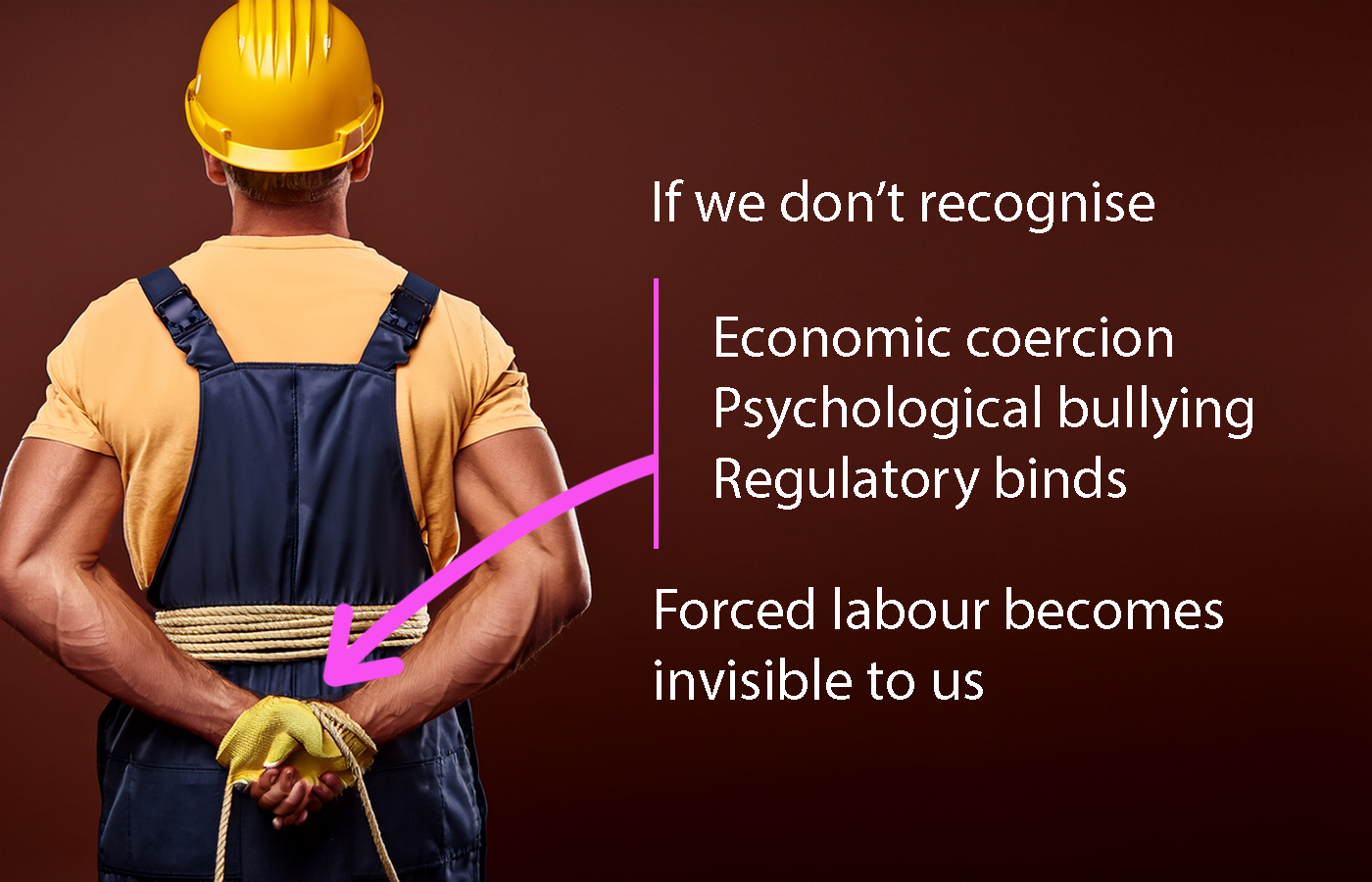
More subtly, Singapore tends to use a very narrow interpretation of forced labour. There has been effective action on confinement, restriction of movement and retention of identity documents – physical manifestations of compulsion. In contrast, there is no recognition of the coercive power of economic precarity, debt, or psychological bullying.
Nor have we seen self-reflection over how regulatidentity documents – physical manifestations of compulsion. In contrast, there is no recognition of the coercive power of economic precarity, debt, or psychological bullying.ons created by the State, such as tight controls over changing jobs, or making domestic workers live with their employers, create or add to vulnerabilities which employers can exploit. Likewise, there is no self-reflection over how insufficient enforcement of salary laws or overtime limits enable abuse of vulnerability.
At its root, one cannot help but suspect that Singapore sees access to cheap labour as an existential question for its economic future. If it thinks that it takes forced labour to keep this economic factor cheap, it is hardly surprising that Singapore is rather conflicted about doing more to combat modern slavery.