
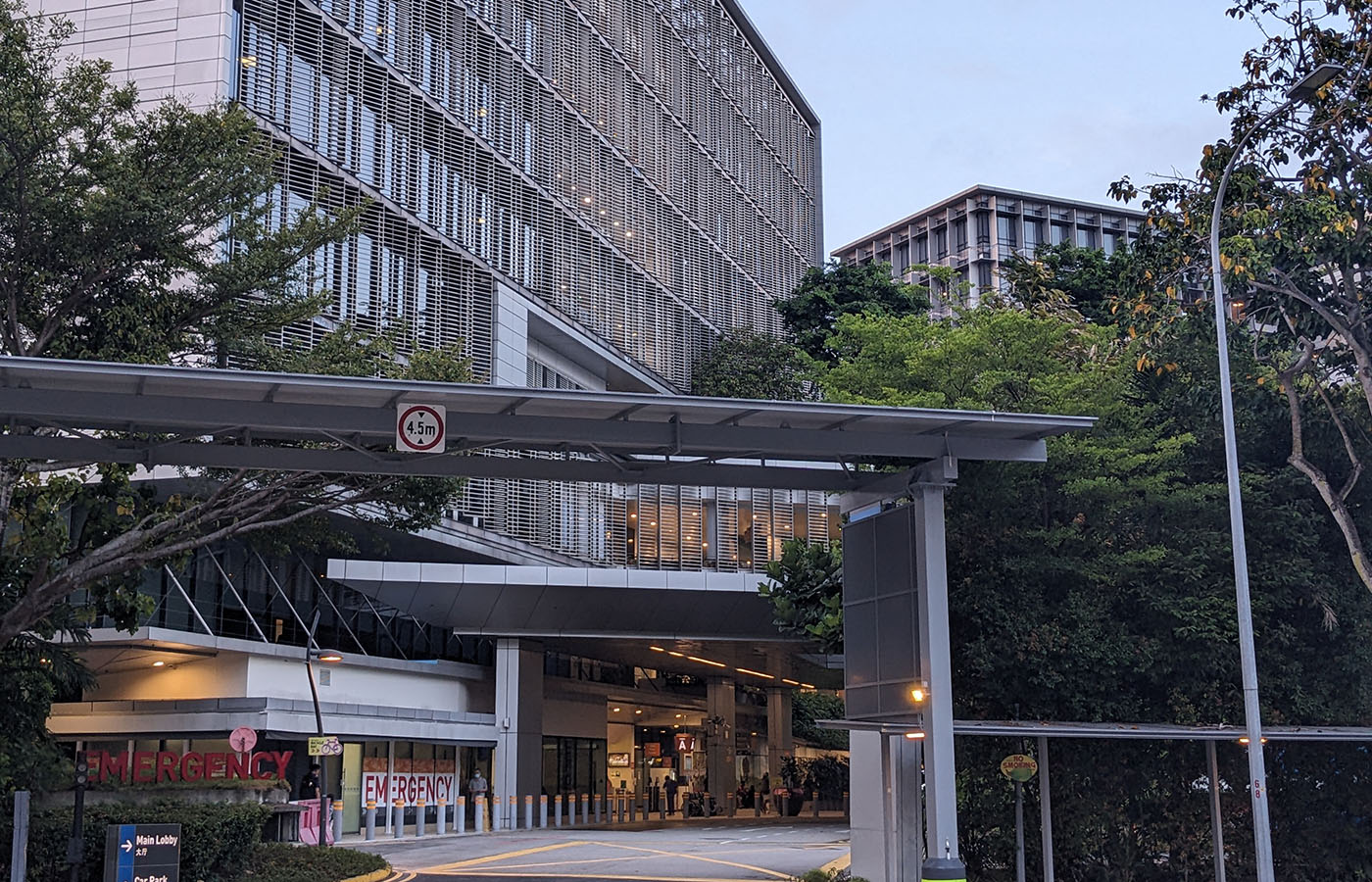
Asif (name changed) was warded at Khoo Teck Puat hopsital
Asif (name changed) is a Bangladeshi construction worker with stress etched deep onto his face. He suffered a severe workplace injury three and a half months before our interview (mid July 2026) and he had great difficulty getting medical help.
That has since been solved to a degree, but now it’s a financial problem. Asif, 32, is still waiting to know if he will receive his medical leave wages (known colloquially in Singapore as “MC wages”) and if his case will be covered by an insurance company. The Ministry of Manpower (MOM) says an investigation is in progress but neither Asif nor TWC2 has any clue what that is about. Nor do we know how long this will take. It has been three and a half months already and he is deeply distressed; three and a half months without income. How can he provide for his family back in Bangladesh? How can he afford the school fees for his 9-year-old daughter?
“If my family is broken,” he says plaintively, “I cannot tahan,” using the local term to mean it would be unbearable. “I just want to support my family.”
Below, we will explore what Asif’s case shows about
- Employer behaviour;
- The ethics surrounding medical leave certificates issued by doctors and hospitals;
- The law on work injury compensation, including medical leave wages;
- The shocking inadequacies of law, leaving injured workers in the lurch.
Delayed treatment after injury
At work on 31 March 2026, Asif was carrying a bag of plaster cement by himself – he said it weighed 40kg which is quite credible since it would be printed on the bag itself – when he slipped on a rock and fell. Streaks of pain shot through his back. In excruciating pain, he could not get up.
Other workers rushed to his aid and alerted the project manager, recounts Asif. Then there’s a gap in the story. He seemed not to have been given any medical help till the end of the work day, when his co-workers lifted him into a lorry and drove him to a general practitioner’s clinic in Little India. The doctor saw that the injury was serious — he needed to go to the hospital immediately. The workers then carried Asif back to the lorry, but the commotion drew the attention of police officers nearby. They thought it would be a bad idea to transport an injured person in a lorry, so the police called an ambulance for Asif.
The police showed more concern for Asif’s comfort and safety than his employer.
One of the construction workers and the boss’s son accompanied Asif to the hospital. The hospital advised that Asif needed to get two x-rays and remain warded four or five days for additional tests and diagnosis. But the boss’s son refused this. Why, after getting such advice from medical professionals, did he blatantly reject it? If it was a matter of cost, isn’t that what insurance is for? After all, employers of foreign workers have to purchase both medical and work injury insurance as a condition for getting Work Permits.
Maximum load for manual lifting
The safety standard in Singapore is SS 569:2011, which stipulates that the maximum load that a person can manually lift is 25 kilogrammes, and even this maximum should be lowered if the lifting is repetitive or involves other movements.
Item 1.3 in a Jurong Port document, for example, says very clearly that “The maximum load that a person can be asked to handle is 25 kg. (Note: This is a maximum and must be reduced when actual conditions are considered such as lifting or placing the load on the ground.)”
By making an employee carry a 40kg load, Asif’s employer appears to have committed an offence. See: Workplace Safety and Health Act 2006, Section 12(1).
Unfortunately, such callous refusal to abide by medical advice is something that TWC2 sees often. Once an employee is issued with a medical leave certificate or is hospitalised, employers are required to report the incident to MOM, triggering an investigation into workplace safety. To avoid this, some employers simply deny appropriate care to their workers.
The boss’s son brought Asif back to the company office and gave him $10 for dinner and some Panadol, an over-the-counter pain killer. That night Asif slept in the office. But Panadol could do little; the pain was too intense.
By 10pm, it was unbearable. Asif wanted to go to the hospital, but the boss’s son refused again. According to Asif, he cruelly lied that the hospital was closed (even though the emergency room is open 24/7). Asif ended up calling an ambulance himself.
Disc bulges
Fast forward a few months and we learn from Asif that he had changed to Khoo Teck Puat Hospital and that ultimately, he did get proper treatment including four or five days of proper rest and recovery in a ward. He also underwent an MRI scan which showed disc bulges in his lower spine. The nearby joints were swollen, causing the spinal canal to narrow.
It was a rough period. “I cannot feel my back, I eat and it comes back up,” Asif recalls.
After discharge from the hospital and still unhappy with his employer’s attitude, Asif asked among his friends to find a lawyer. Late April, he felt well enough to make his way to a lawyer’s office to get some advice. The lawyer noticed that the employer had not reported the accident to MOM, so he did it for Asif instead. Such a report should activate the insurance policy.
See also our July 2026 article: At least one in three work accidents was reported late.
Once the lawyer filed the injury claim online, the employer would have been notified about it, and his response was to promptly cancel Asif’s work permit. However, because he had a pending claim, MOM issued Asif a Special Pass which, while allowing him to remain in Singapore, forbids him from finding a new job in the meantime.
What about this thing called an ‘investigation’?
We see Asif again at the end of July, four months after he injured his back. He was walking stiffly and needed an umbrella as a cane. He was still on medical leave. By this point, money issues have become critical. He has not received medical leave wages and when we look into the record of his injury claim on MOM’s online system to try to figure out where things stand, we notice that the case is “under investigation”.
It’s impossible to parse what that term actually means – such is what passes for clarity and transparency from MOM. What is being investigated? Who is doing the investigation? Is it MOM or the insurer? If the term implies that it’s the insurer, then it is strange that no insurance company is named in the relevant field.
The blank field leaves it unclear as to whether a valid policy even exists. Perhaps the boss is stonewalling MOM’s request for details. An alternative possibility is that the boss did not purchase a policy, or did not pay the premium at renewal.
Work injury insurance
The Work Injury Compensation Act 2019 requires all employers to purchase insurance to cover their liabilities in the event that any employee suffers an injury “arising out of and in the course of their employment”.
The policy should cover three distinct liabilities of the employer:
- Cost of medical care;
- Cost of medical leave wages (also known as ‘Compensation for temporary incapacity’);
- Payout for any residual permanent disability (also known as ‘Compensation for permanent incapacity’).
It should be noted that the liability to pay compensation rests with the employer whether or not he has a valid insurance policy. Section 7(1) of the Act says (with exceptions), “Where personal injury is caused to an employee by an accident arising out of and in the course of the employee’s employment with an employer, that employer is liable to pay compensation under this Act.”
Unfortunately, many employers take the view that it is for the insurance company to pay, and thereafter wash their hands of the matter.
While all these musings may be interesting, from Asif’s perspective, they would miss the point: How was he going to provide for his family? That’s what medical leave wages are for, and right now, nothing is forthcoming.
Just to get his job in Singapore, Asif had taken up a loan in 2025 of $4,000 to cover $1,800 in recruitment agency fees and to rent farmland for his family in Bangladesh. Each month he must pay $450 to repay his loan. To do this while he is unable to work, he needed to sell one of his family’s cows for $800. Asif is worried that the next thing he may need to do is pull his daughter out of school so he can afford his next repayment.
Medical leave wages and the law
If he cannot work, then the next best thing might be to receive medical leave wages, but this is another bureaucratic nightmare. In the early days when he was treated at Raffles Hospital, the hospital either didn’t issue medical leave certificates (MCs) or if they did, they passed them to the employer. All Asif knows is that he does not have copies.
This is against the guidelines set out by The Singapore Medical Council which, in its webpage Ethical Issues around Medical Certificates (Part 1), says:
…the MC should be given directly to the patient unless he/she (and not his/ her employer) requests otherwise
Subsequently, when Asif was treated at Khoo Teck Puat Hospital, he received his MCs. The hospital is a public hospital and by TWC2’s observation, their practices are more ethical than private hospitals’.
Having MCs in hand is the essential first step to getting medical leave wages.
The applicable law is the Work Injury Compensation Act 2019, which uses the term “Compensation for temporary incapacity” instead of the more commonly used “MC wages” or “medical leave wages”. Section 17 of this Act says:
Compensation for temporary incapacity
17.— (1) Where any work injury results in the temporary incapacity of an employee, the compensation the employer is liable under this Act to pay to the employee is a periodical payment that is —
(a) an amount specified in the First Schedule; and
(b) payable not later than the same day as earnings would have been payable to the employee under the contract of service under which the employee was employed at the time of the accident, except that the interval between periodical payments must not exceed one month.
The law is crystal clear that medical leave wages should be paid at the usual point in time when salaries are paid, and should be no less frequently than monthly. The law is also crystal clear that the responsibility rests with the employer. The insurance policy is to insure the employer against such liabilities. So, even if the employer had failed to purchase a policy, he still remains liable for medical leave wages.
But the law has a huge defect that renders its protective intention moot.
The opening words of Section 17(1) are “Where any work injury results in….” At TWC2, we have seen investigations by insurance companies taking a long time, during which the question as to whether the injury was a work injury remains suspended. Insurers tend to be very generous about giving employers forever to provide details of the incident, and we have also seen employers give false information, thus complicating the insurance adjuster’s work. The question of timely support for the injured person seems nowhere on the list of priorities.
Worse, the above may not be happening at all if there is no policy. No insurer. No investigation.
And then, what? When will a determination be made that it is a work injury? And by whom? And in the meantime, the law is utterly silent on how to provide sustenance for an injured individual who cannot (and is not permitted to) work.
Very imperfect system
Superficially, Singapore has a reasonably good framework for injury compensation, through our Work Injury Compensation Act and a department in MOM dedicated to its implementation. However, once we drill into specific examples, such as Asif’s case, we see all sorts of gaps and a frustratingly opaque process.
It’s a very imperfect system, its imperfection easily measured by a simple fact: a failure, in practice, to provide any financial support to a victim and his family which, ironically, is the core justification for the legislation in the first place.
See also:
17907