
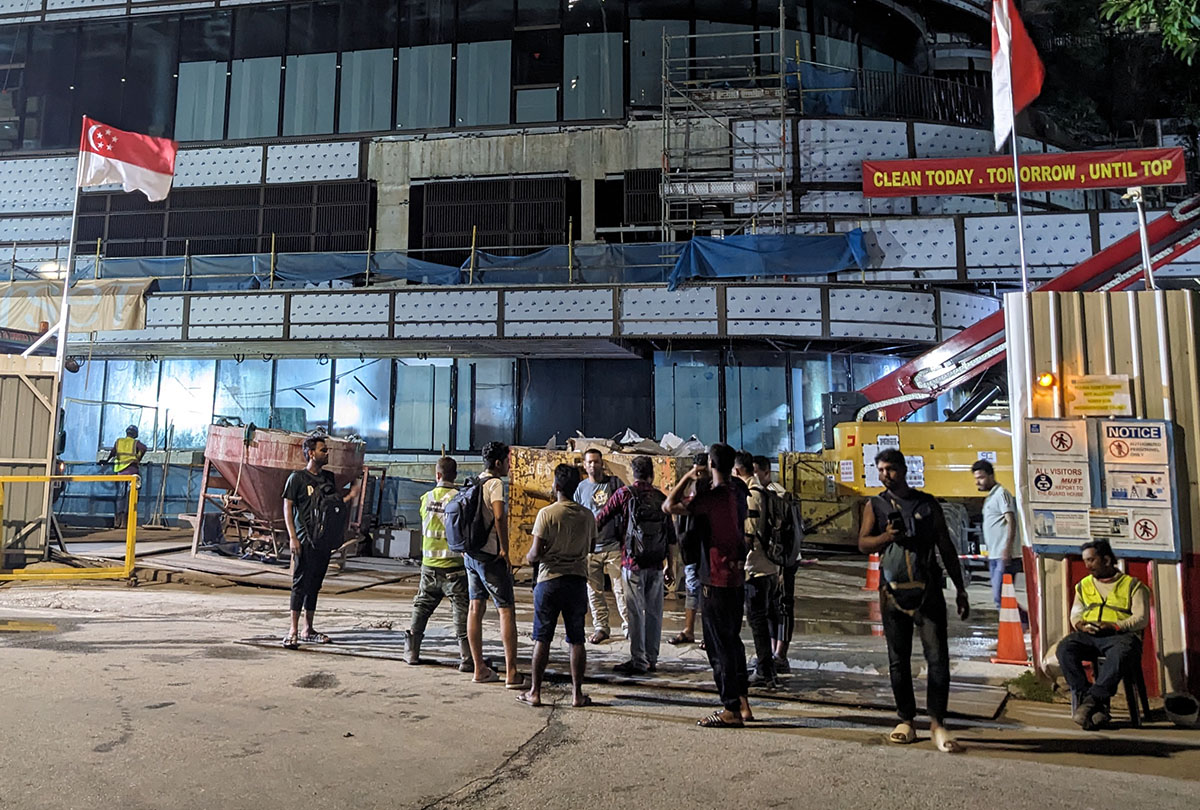
Construction workers leaving a worksite at the end of their shift (8:30pm)
This report examines the current salary landscape and recruitment cost burdens faced by Singapore’s Work Permit holders. The findings come from an online survey that was conducted between March and April 2026 and which collected 1,428 responses for recruitment cost analysis and a subset of 499 responses for detailed salary analysis.
In the main, this study’s findings are consistent with results from our previous studies. Work Permit holders experience low salaries that, in certain industry sectors, do not progress very much with experience or the number of years on the job.
Recruitment cost remains a problem, particularly for newer workers.
Nonetheless, a few somewhat unexpected insights came out of this study: Firstly, a large proportion of respondents (roughly two in three) were unable to provide a coherent breakdown of their salary entitlements, which suggests that their awareness of this key facet of employment is low – putting them at a disadvantage vis-à-vis their employers.
Secondly, the industry sectors with the lowest average salaries are also the sectors where workers appear to be paying the highest recruitment fees. This leaves many workers trapped in severe debt. The two sectors of concern are marine shipyard and process.
Salary structure varies considerably depending on the industry. The service sector tends to have large monthly allowances tacked onto basic salary, but this amount is generally intended to enable the worker to pay for his or her own housing. This is unlike the construction, marine and process sectors where employers take control of accommodation arrangements, though this too can come with complex co-payment systems. However, this variability of practice by industry makes it difficult to do cross-industry comparisons of salary.
On a more positive note, we found that construction workers had demonstrable earnings growth as they gained experience on the job, though the question of whether the growth gradient parallels better productivity or whether it keeps up with inflation remain unanswered.
Another positive note was that we could see no ethnic discrimination in the construction sector. Indian, Bangladeshi and Myanmar workers all seem to be paid similar salaries at similar stages of their work experience.
Overall, this study confirms that there are several acute issues with our migrant labour model in Singapore. Not only would more research be helpful, but serious consideration should be given to solutions without waiting for more detail.

Click the icon at right to download the full report (PDF, 30 pages).