
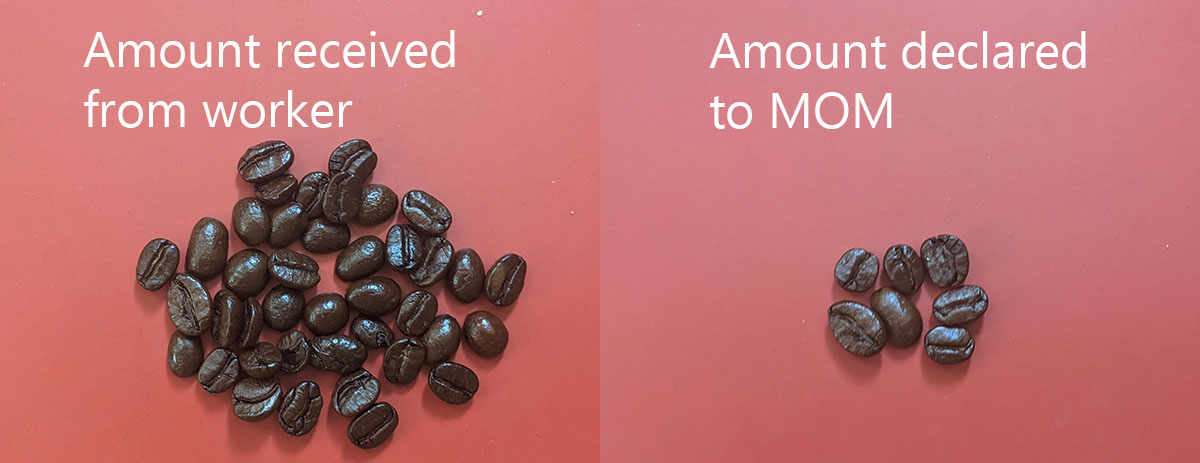
On 9 January 2026, we alerted the Ministry of Manpower (MOM) to a case in which a licensed Singapore employment agency overcharged a migrant worker. This worker, whom we will refer to as “Toung Ha” was employed as a cook in a Chinese restaurant in late December 2025. By the first week of January, he no longer wanted to work there as he felt that he had been badly misled during recruitment.
He was an experienced cook, and had worked long enough in Singapore to be able to speak Chinese. When the question of language came up at the job interview, the boss must have been glad to hear of his ability. However, Toung Ha made it a point to add that he cannot read Chinese, he can only speak it. The boss said it would not be a problem.
Yet, after he started on the job, he realised that at the restaurant, orders were communicated in writing, not verbally, and they would be in Chinese. The manager also applied pressure on him over his inability to read Chinese. It soon became apparent that the situation was untenable and he felt that he had been misled at the point of recruitment.
Having decided to cut the Gordian Knot and sever himself from the job, Toung Ha felt free to consult with TWC2 over the recruitment charges. We were pleasantly surprised to see that he had a good record of the payments on his WhatsApp; most agents are careful to only communicate verbally about money.
We then advised Toung Ha that he has a good enough case to file a complaint at the Ministry of Manpower, which he did, and we followed up with an email to make sure that it did not get lost in the works.
Below, we will share what we saw of Toung Ha’s evidence. It shows how a Singapore-licensed employment agency
(a) blithely made a false declaration to MOM;
(b) charged more than allowed by the Employment Agencies Act; and
(c) directed the worker to pay money directly into the bank account of someone who does not appear to hold an employment agency licence.
The money flow
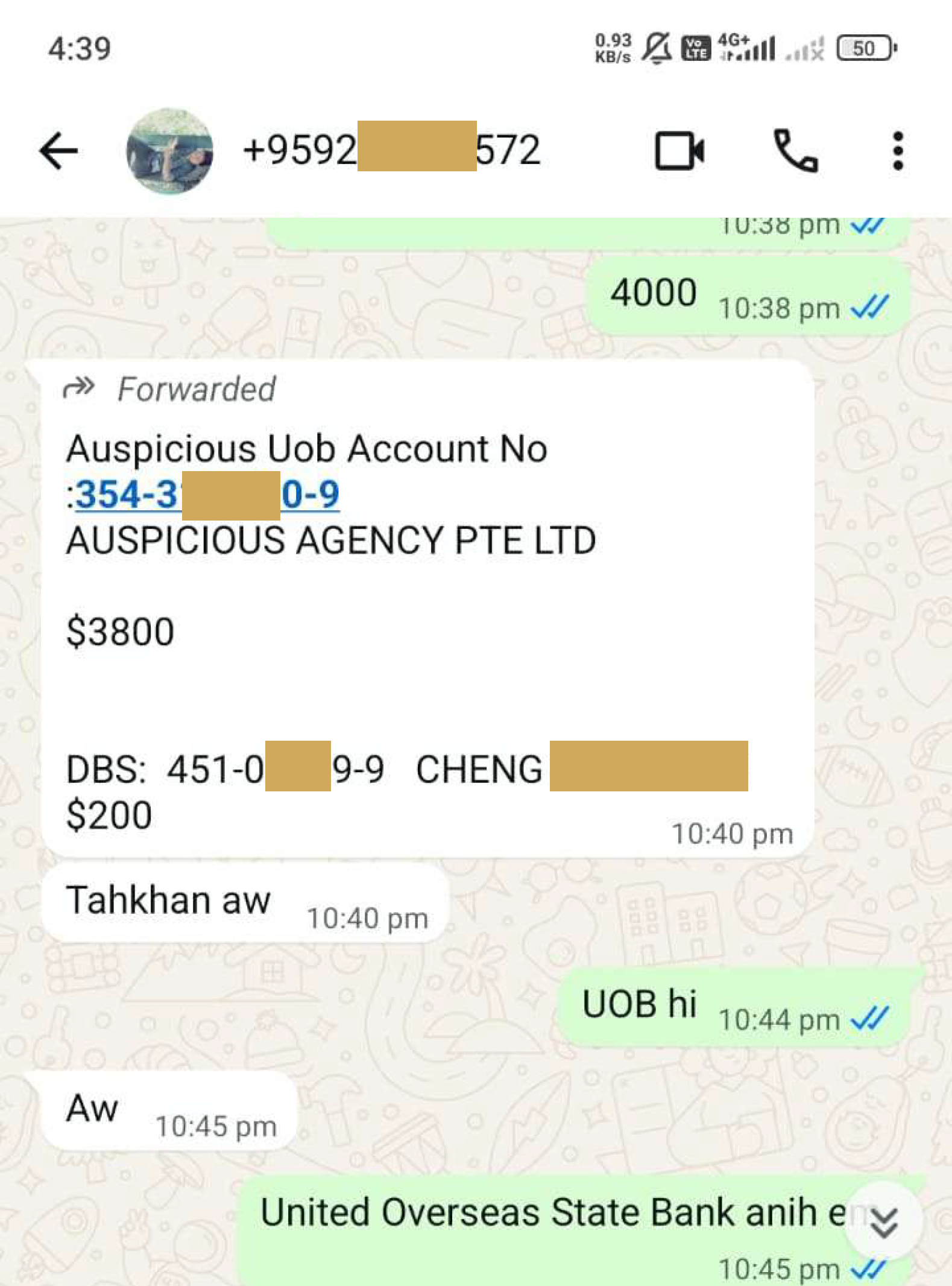
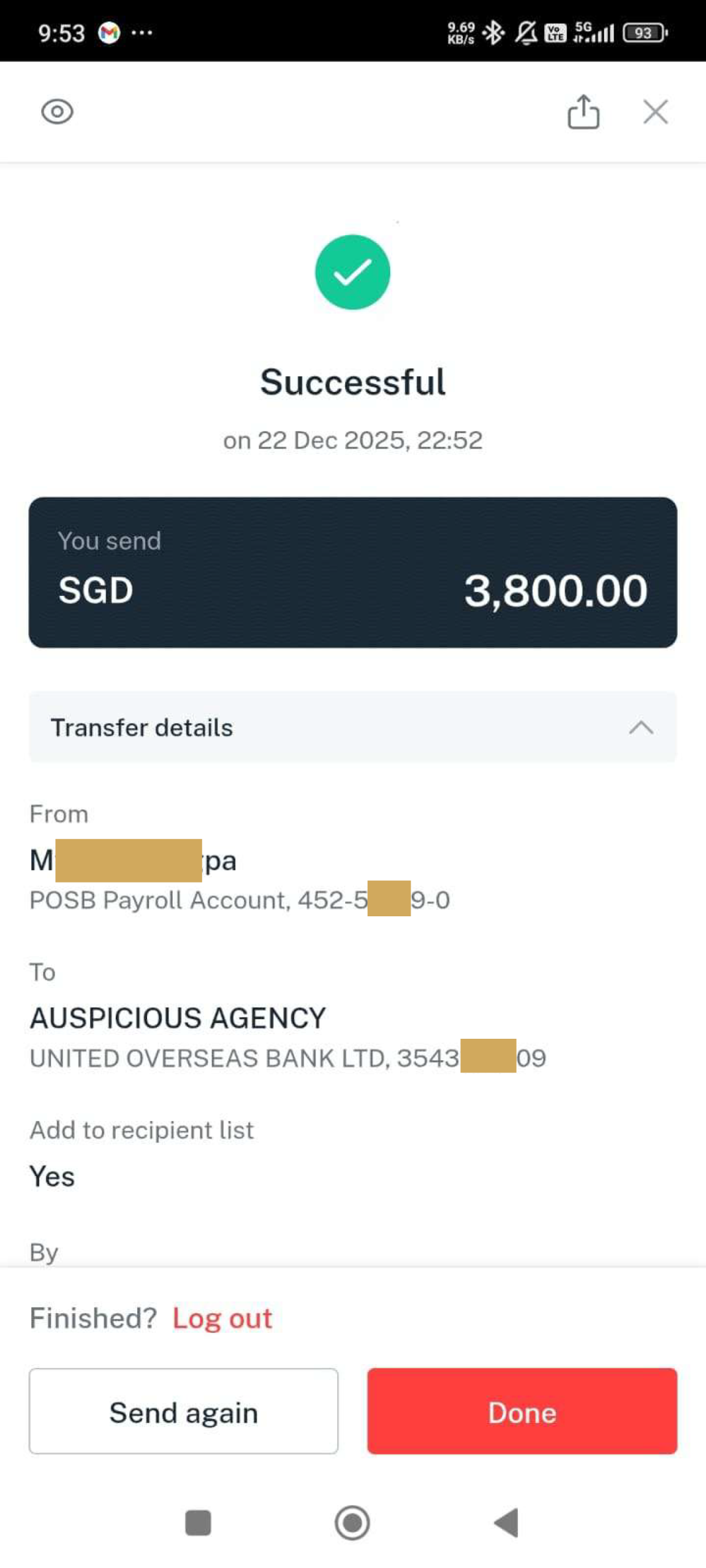
The WhatsApp screenshots below are from Toung Ha’s phone. In the first image, the Burmese agent was communicating with Toung Ha, first saying that the total amount he needed to pay to get the job would be $4,000. Of this amount, $3,800 would have to be paid to Auspicious Agency Pte Ltd, a licensed employment agency in Singapore (licence number 17C8746). The bank account number of Auspicious with United Overseas Bank (UOB) was contained in the forwarded message.
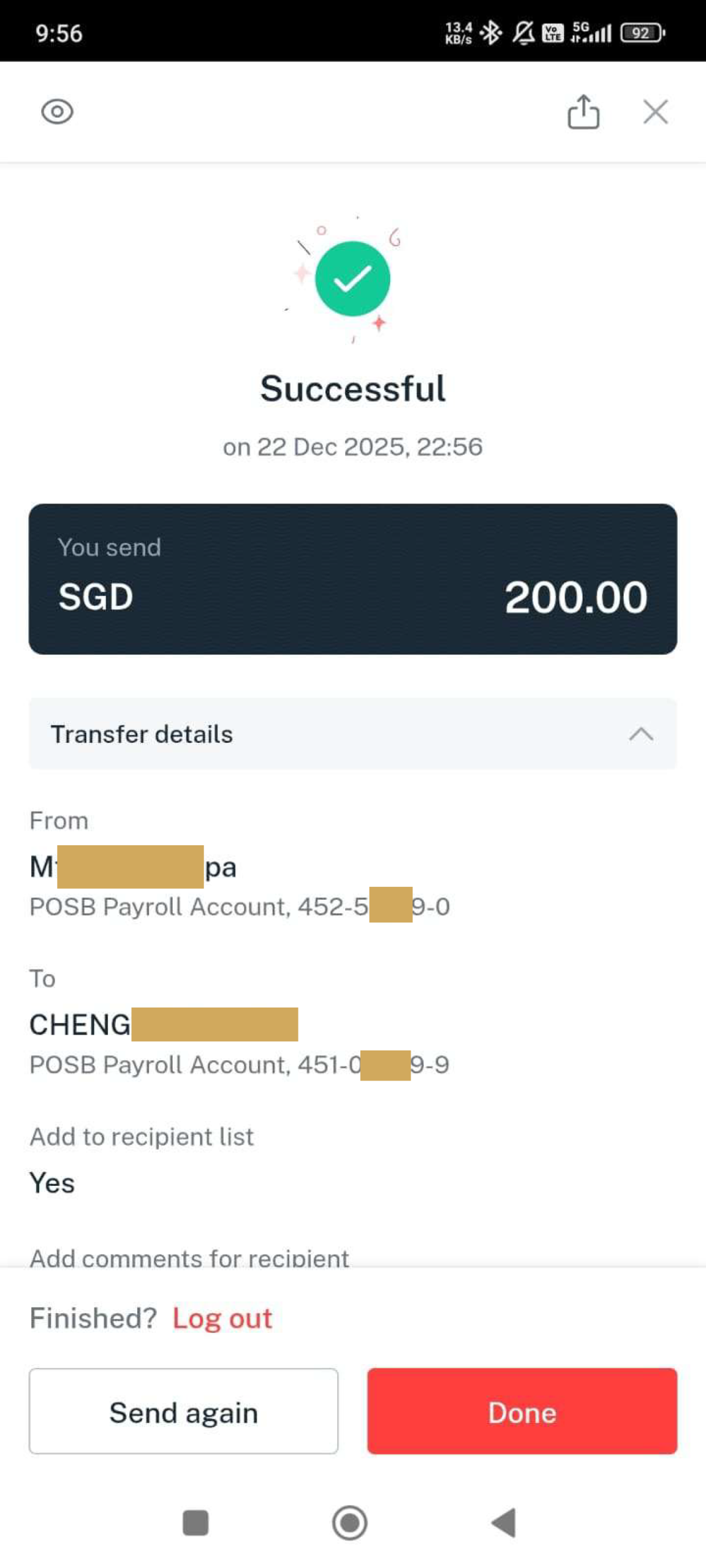
The balance of $200 had to be paid into the personal bank account of someone named Cheng. The account number of this person, at DBS Bank, was also provided. Toung Ha says that Cheng worked either as a partner or employee at Auspicious. We are unable to confirm this.
The next two screenshots show that payment was made to Auspicious and Cheng.
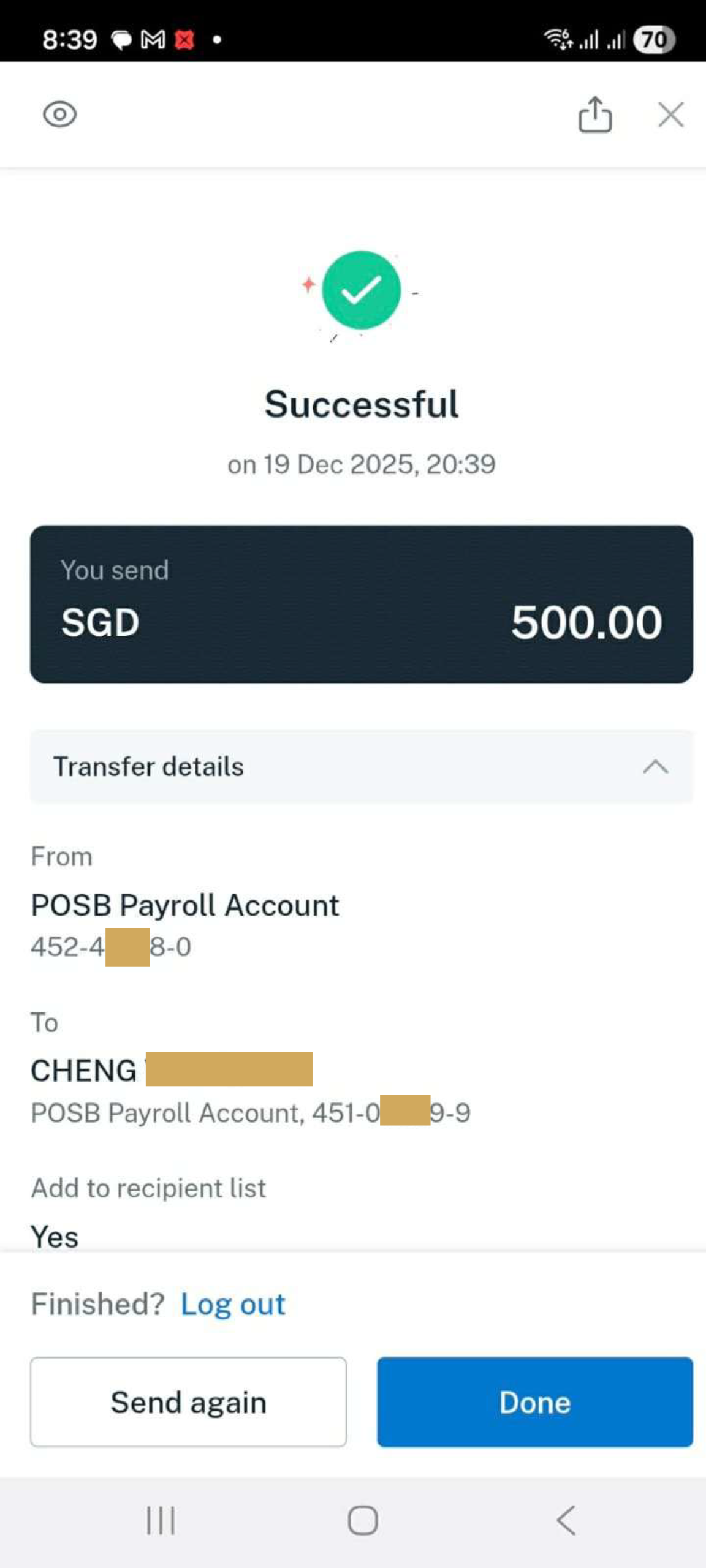
However, a further $500 was demanded from Toung Ha. He doesn’t have a screenshot of this additional request; it might have been verbal. This additional $500 was also to be paid into the personal bank account of Cheng. Toung Ha kept a screen record of that additional payment.
The details on the IPA
After Toung Ha agreed to take up the job, an application was made to the Ministry of Manpower (MOM) for a Work Permit for him (occupation: cook). We can see from the In-principle Approval issued by MOM that the agency declared to MOM that they only charged Toung Ha $1,200 in agency fee. It’s very clear that this figure would be in conflict with the truth. As we saw from the above, a total of $4,500 was demanded from Toung Ha, either in direct payments to Auspicious or as side payments to someone named Cheng who, as represented to Toung Ha, was working with Auspicious.
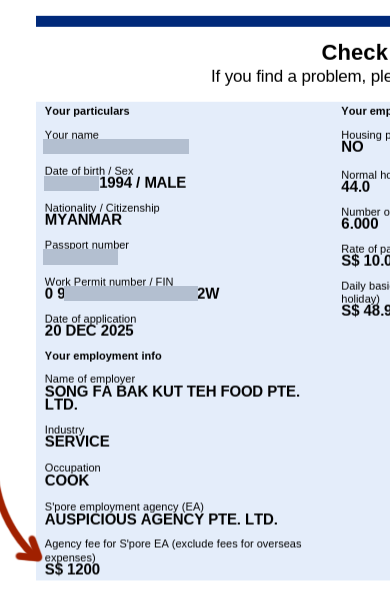
Here is an obvious case of an agency making a false declaration to MOM.
Why they did that is not entirely clear. Strictly speaking, they could have declared $4,000 as their fee, and it would have been perfectly legal. Toung Ha’s fixed monthly salary was $2,000 and the Employment Agencies Act allows licensed agents to charge up to two months’ salary as their fee. That said, even if they declared $4,000 on the IPA, it would still be in conflict with the truth since they charged Toung Ha $4,500.
We can only speculate why they chose to understate the actual amount charged. It is not unknown that some businesses wish to underdeclare their income in order to avoid taxes, but we’re not saying that that was Auspicious’ motive. Another aspect – that of channelling some of the revenue directly into Cheng’s personal bank account – also looks suspicious, but again, we do not know why they did what they did.
Reported to MOM
TWC2 alerted MOM to this case. We felt that unlike many cases (too many) of overcharging, this case had good evidence.
MOM clearly agreed and dealt with it expeditiously. While recognising that Toung Ha hoped to have all his fees refunded since there had been misrepresentation (regarding language) during the hiring process, MOM managed to get half refunded; there are complicated reasons why half, but it would be tangential to the story to get into them. What we don’t know is whether Auspicious Agency is also being taken to task for false declaration. Of course they should be, but we have no confirmation of that.
The last aspect, money channelled into Cheng’s personal account, also cries out for investigation and action. While the company has a licence, and has four licensed persons associated with it, as seen from MOM’s listing site, none of the four licensed persons has a name resembling “Cheng”. This suggests that Cheng is not licenced to carry on an employment agency activity, and therefore should not be receiving money for such activity.
17409