
This post is part of a series on the widespread problem of false declarations on In-principle Approvals (IPAs).
An IPA is a document generated by the Ministry of Manpower (MOM) signalling the ministry’s approval for a work pass for a foreigner. The details in the IPA are based on information supplied by the employer or their Singapore-registered agent, which are supposed to truthfully reflect the terms of employment (including salary) that had been agreed between prospective employee and employer (or their agent, local or foreign).
Because they are supposed to truthfully reflect the terms agreed in the verbal or written contract, the details in the IPA will be enforceable in law, unless one party or the other can show that another contract with different terms exist. See our November 2017 article about a High Court ruling in this regard.
At 5:55pm on a Wednesday, three Bangladeshi men came through our office door. Though we were five minutes from closing for the day, with them showing up, it looked like an extended day for us.
“Why are you coming so late?” we ask.
One of them replies: “Other day no have time. We working.”
“So, why were you not working today?”
“Today we go to MOM for thumb printing,” referring to the process by which they would get their new Work Permits issued.
This is interesting, we say to ourselves. These three guys have only just started on their jobs, and they are already at TWC2, obviously because of some problem at work. How quickly jobs fall apart!
Background
The three men had agreed with their recruiter in Bangladesh (acting as agent for their employer) that their basic salary would be $1,000 a month. However, when they received their In-principle Approval letters, they noticed that the stated basic salary was $520. They asked the recruiter about the difference, and the recruiter said something along the lines of “Don’t worry, this is for administrative purposes, you will be paid $1,000 a month.”
Since substantial recruitment fees were involved and the guys were quite desperate to find work, they accepted the recruiter’s assurance and came to Singapore.
By the time they walked through our door, they had already worked most of January 2026 and received their salary for that month. They were paid a pro-rated salary in line with $1,000, but the employer made a $500 deduction, ostensibly for “quarantine”. Workers use this term to refer to the mandatory two nights’ stay at a designated Onboarding Centre, where they receive post-arrival briefings and go through other arrival formalities.
The men explain that their reason for coming to TWC2 is to enquire whether employers allowed to deduct the cost of “quarantine”. The simple answer: No. MOM has unequivocally said this is disallowed.
They are happy to hear that, but TWC2 being TWC2, we go on to ask other questions, and before long, the whole sorry business of an IPA salary misaligned with the contracted salary surfaces.
Clearly stated on IPAs
It is clearly stated on the employee’s copy of the IPA that
“If you find a problem, please contact your employer or employment agent.”
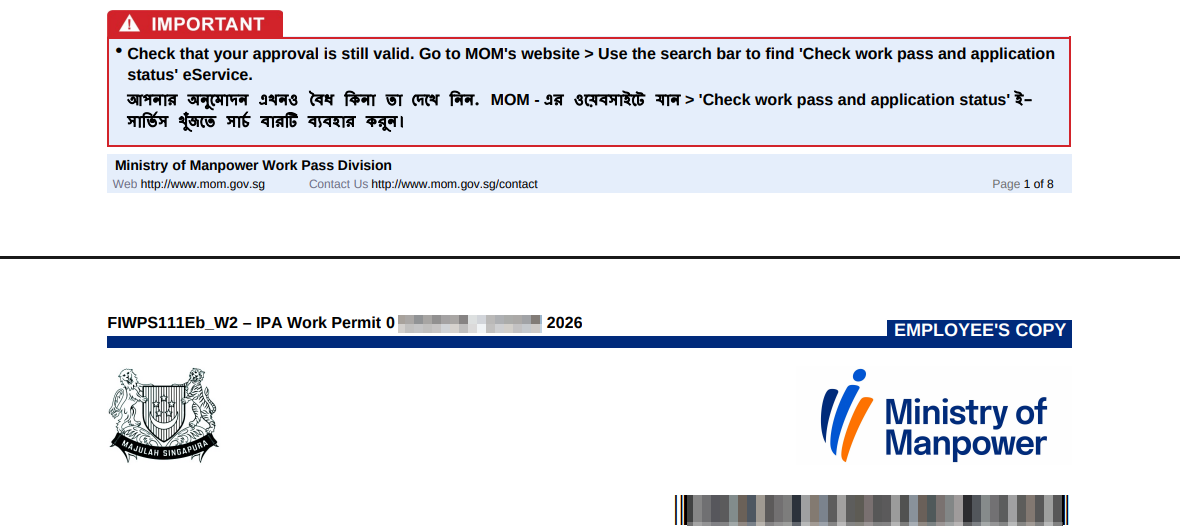
The IPA also has a statement (imaged in the header above) that advises:
“Go to MOM’s website > Use the search bar to find ‘Check work pass and application status’ eService.”
When a prospective employee goes to that eService page, he or she will see the salary details that the employer had declared (which should be the same as shown on the IPA) and an advisory there that says:
“If the salary shown is not what was promised to you, please bring it to your employer or agent’s attention to make the necessary changes.”
“Do ensure that the correct salary is stated here before you come to Singapore. If there is a dispute over payment of salary when you are in Singapore, we can only assist based on the salary shown here. We cannot help if you have any dispute with the agent in the home country.”
The three Bangladeshi workers did as advised – they asked the agent why the IPA said the salary was $520 when they had agreed on $1,000. However, they accepted the agent’s explanation instead on insisting on a correction of the IPA.
After hearing this, we say to the men that, should they bring the matter of the $500 deduction for Onboarding up to MOM, the employer may very well deny it was for Onboarding, but instead point out that the net salary was in accordance with the IPA. Almost certainly, they will find the angered boss cancelling their Work Permits, and then they’ll be out of work after only a month, despite having paid handsomely to buy these jobs.
“Even if the permits are not cancelled,” we continue saying to the men, “in the next few months, you may find the boss only paying you $520 a month which would be in accordance with the IPA. But if that happens, you will have no basis for complaint.”
The three workers decide not to proceed with making a complaint about the Onboarding deduction. Doing so will almost certainly set in motion a cascade of consequences, all of which will make things worse.
False declaration
This kind of case is one where the workers are partially responsible for their misfortune. Whilst they did raise the matter of a different salary on the IPA, they too easily accepted the agent’s explanation.
Yet the employer had committed a violation. He had declared to MOM when applying for Work Permits for the men that they had agreed to a salary of $520 when, going by what the men say, they had actually agreed on $1,000. By submitting a different figure to MOM and thereby causing the lower figure to be incorporated into the IPA, this would be a false declaration – made with intent to cheat, a serious matter. We know that it was the employer who submitted the IPA application to MOM because in the field for “Singapore employment agency”, it was declared as “N.A.” indicating that no Singapore-licened agency was involved. A foreign agent or recruiter (which was the case here) would not have had access to MOM’s IPA application portal.
Readers may have noticed that there can be a complication when drawing a link between workers and employer. The workers never once spoke with their future employer during the negotiation phase. It was the agent who assured them that the salary would be $1,000. So, when the employer declared a basic salary of $520 to MOM, had the employer been given the impression by the agent that the men had agreed to $520? If so, was the agent being untruthful with the employer? In which case, did the employer intentionally make a false declaration?
Indeed, this can happen, and it becomes difficult to prove intention on the employer’s part even though the declaration was still technically false. Between the men and the agent (who was representing the employer) the figure of $520 had never been mentioned; it was always $1,000 until the men saw “$520” in the IPA. The employer, in submitting $520 to MOM when applying for an IPA, submitted a figure that the men had never agreed to, even if that figure emanated from the agent. In that strict sense, the declaration was still false.
But in this particular case, the employer gave away his complicity. The January paycheck was really based on $1,000 – a figure that matched coincidentally or otherwise what had been negotiated. It revealed that the employer was behind the promise of the $1,000 salary. The men came to TWC2 not because the paid basic salary was lower, but because the employer added a $500 deduction for “onboarding”, which was illegal.
MOM’s standard protocol for disputes does not provide a route to remedy
Illegal or not, if the men filed a complaint with MOM, they would surely lose their jobs, and the false figure ($520) on the IPA would stymie any success in their claim.
But if the men do not file a complaint, MOM will never know about it, and then one more employer will find that it is absurdly easy to get away with such dishonesty.
17617