
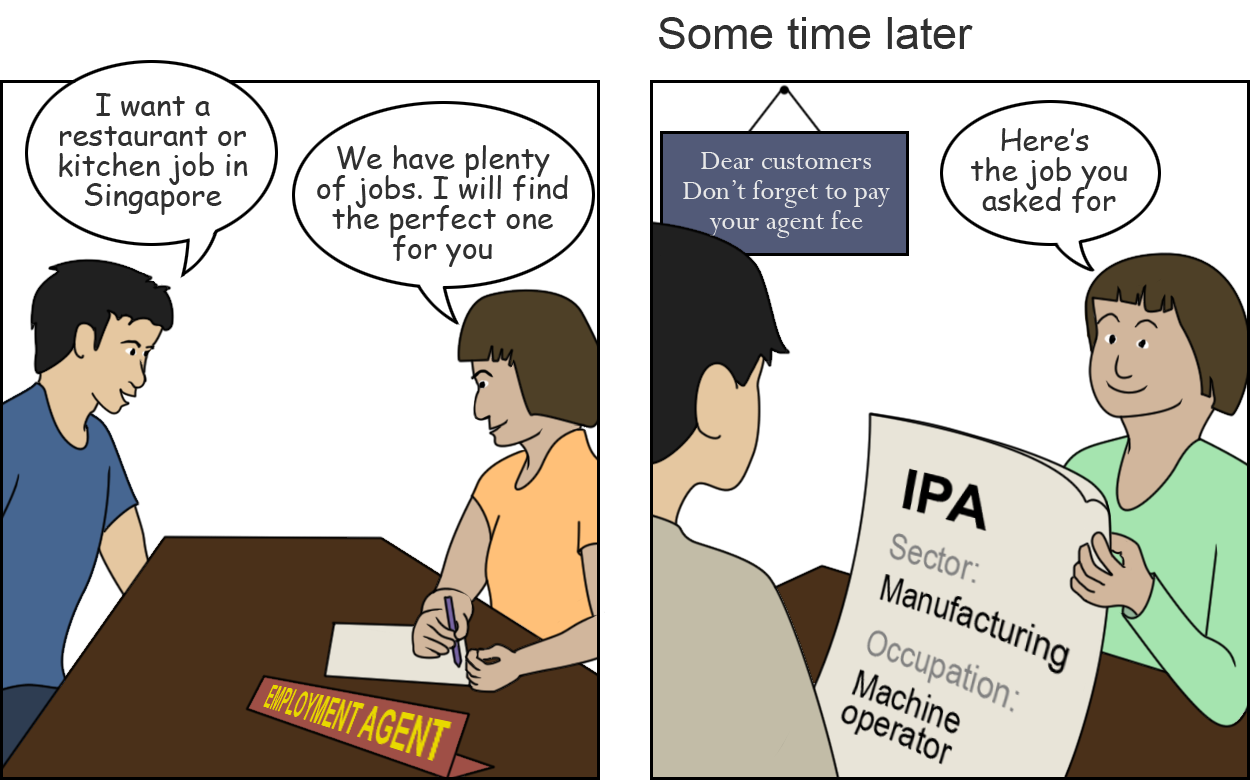
A Burmese guy messaged us through our digital hotline. Multiple messages were exchanged between him and our case officers over the following days, yet we couldn’t fully grasp what the core issue was, so we asked him to come to our office for a face-to-face consultation.
He came the following Thursday. Half an hour later, he reached a decision not to file a claim. Having heard us, he understood that his options were poor.
Mothaung (name changed) was not paid for his overtime hours at all. He regularly worked twelve hour days as a kitchen helper, and after five months, had had enough. It took us a while to understand what exactly he wanted to complain about. He had asked for help in writing a resignation letter (we helped him with that), yet he mentioned more issues even after submitting the letter to his employer.
When he finally came to TWC2 for a chat – having resigned, he now had the free time to do so – we learned about his grievances over overtime pay, salary deductions, kickbacks and a few other things.
However, along the way, we noticed significant discrepancies in his documents. On checking the details that were stored in MOM’s system regarding his Work Permit, we saw that he was supposed to work as a machine operator in the manufacturing sector. And for a different employer altogether.
“Did you begin by working in a factory?” we asked Mothaung.
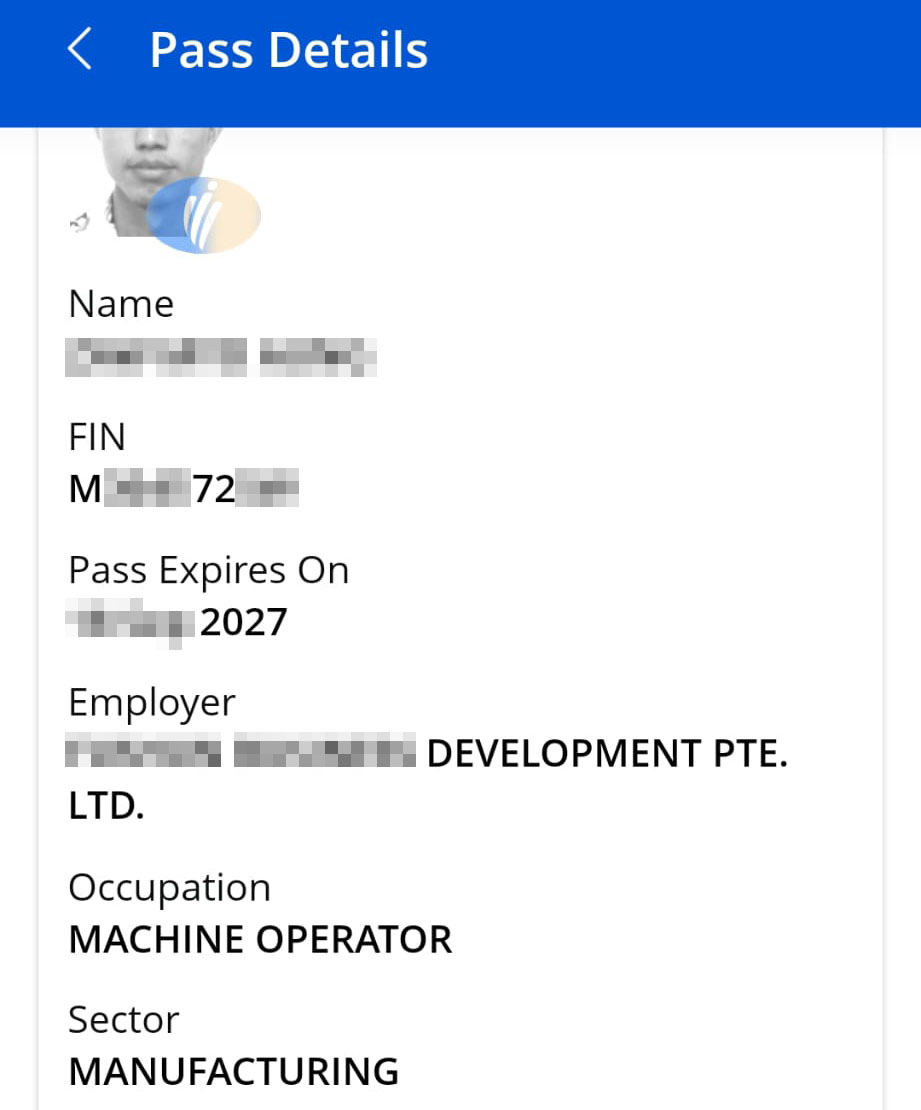
This is the information we obtained from MOM’s system. It would be the information declared by the employer (or its Singapore-licensed agent) when applying for a Work Permit.
He did not, he said. He had applied for a job in the food sector and had been offered a job as kitchen assistant. He showed us a contract he made with the recruiting agent in which it was clearly stated that he would be a “kitchen helper and handyman”. From Day One, he did this job. The salary stated in the contract was $1,100 per month.
That figure too was a problem. The information inside MOM’s system, which had been submitted by the employer (officially, the manufacturing company), or its authorised agent, said his monthly basic salary would be $1,500 with a further $1,000 monthly allowance.
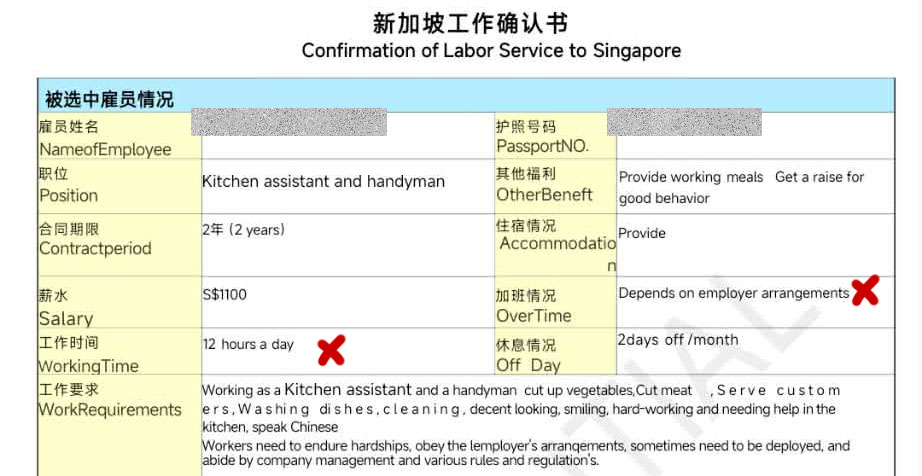
This is the contract, albeit with the agent – who was acting on behalf of the employer – that Mothaung signed BEFORE an application was submitted to MOM for a Work Permit.
As side issues, we also noticed that the contract contained two more violations of employment law (red crosses in the image above). It said that the work day would be a standard 12 hours. This would lead to excessive overtime, in contravention of law. Secondly, it said that overtime pay would be at the employer’s discretion, which is also against the law.
Illegal deployment
In our conversation with Mothaung, we had to focus his mind away from the money discrepancies to an equally serious issue – the disconnect between what his IPA said his job should be and what he was actually doing. He could be accused of working outside his permitted sector (manufacturing) and for a different employer, both of which are against the rules. It had been going on for five months. We made it a point to ask him if he had any role in choosing to work in a coffeeshop. He explained that from the start, he had expressed a wish for a food service job. After coming to Singapore, he was directed to work at the coffeeshop, which seemed entirely proper since a food service job was what he applied for. No one told him he should be in a factory,
His further response was that he relied on the contract he had signed, whereas the IPA was given to him was not a document he signed. Since the signed contract said “kitchen assistant and handyman”, it didn’t seem wrong to be doing precisely that job. It’s a valid argument, but there is a risk that MOM will not give much weight to it. With other cases, TWC2 has noticed a tendency by MOM officials to dismiss any document signed outside Singapore as irrelevant even when, we would argue, a more holistic approach would require it to be taken into consideration. Maybe it is just bureaucratically easier to ignore “complications”.
Indeed, here again was a case where the employer or the agent entered false information into MOM’s work pass application system. Here was an employer who, perhaps in collusion with another employer or Singapore-licenced agent, submitted information during the application process that was demonstrably untrue, contrary to what had been agreed between prospective worker and the employer’s recruiter. False declaration is a criminal offence, though this often means less that it appears due to weak enforcement.
However, now that the issue has surfaced, Mothaung was at risk of being accused of breaking the law by working in a kitchen for five months, even if he merely filed a salary claim. We couldn’t tell him how large or small this risk was; it depends on the MOM officer in charge and how he or she goes about it: go by the book and punish both employers and victim (the easy way out) or see the issue holistically. Mothaung now faced a choice between (a) not claiming for unpaid salary or (b) claiming, but with the risk of being caught up in lengthy investigations.
“No, don’t report to MOM”
Our conversation ended with Mothaung deciding not to file any formal complaint. He would forgo his right to overtime pay, abandon his right to recovery of all sorts of unjust deductions and kickbacks, and focus instead of getting another job.
Not only does that feel less than right, staring at us is also the stark fact that once more, another employer will be getting away with making egregiously false declarations. In Mothaung’s case, the employer in question would be the manufacturing employer that said they would be employing him but didn’t take him in. However, the restaurant employer was also infringing the law. He knowingly used Mothaung’s services – and paid salary, even if short – when Mothaung was not supposed to work there.
We should look at this case from another angle too, the public interest angle: By deciding not to file a complaint because he might be further victimised for doing so, MOM will never know about these transgressions, or many others as our numerous other stories about false declaration demonstrate. There’s an epidemic of false declarations at large, each one entrapping a worker in a no-win situation, but one has to wonder whether MOM is even aware of it.
#919554302 and #923460323